

PLCnext Technology
Use data consistently and uniformly
New connectors and an app solution for the IIoT framework from PLCnext Technology make it easier to collect data from controllers, sensors and field devices - especially in existing systems. Harmonization, edge processing and flexible data pipelines create a scalable basis for monitoring, analyses and data-driven applications.
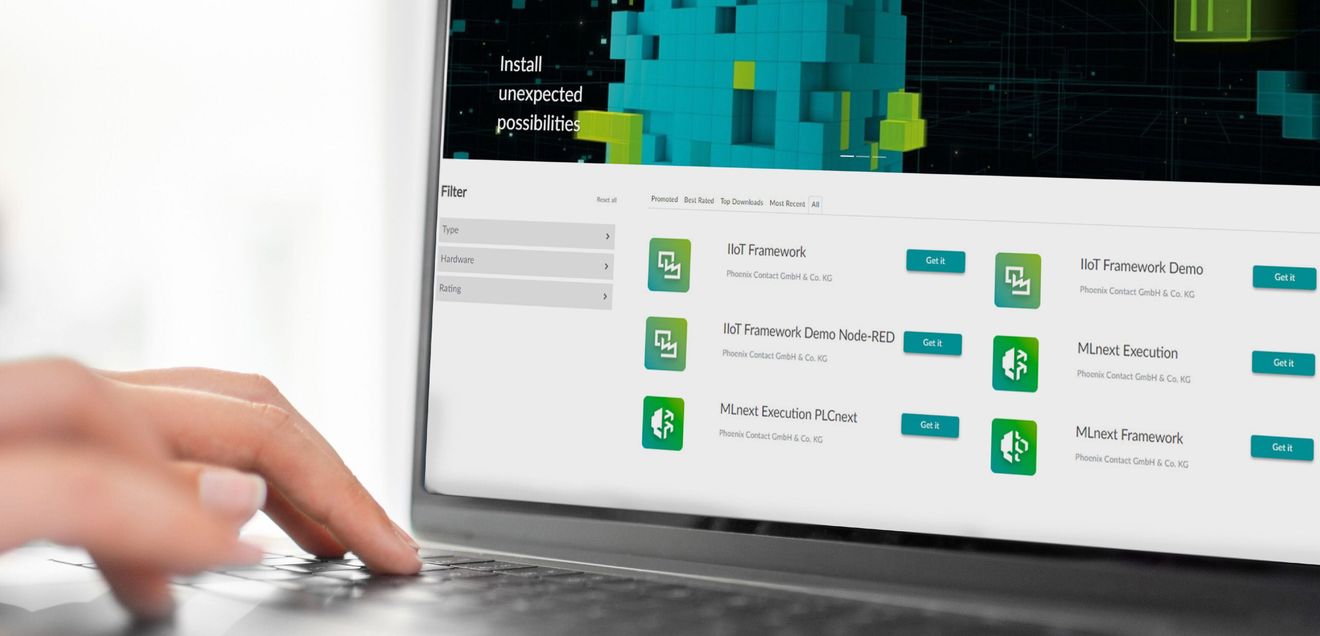
With the increasing digitalization and networking of production facilities, the need for a consistent, scalable and robust data infrastructure is growing. Especially in existing systems, it is crucial to reliably read information from different control systems, sensors and field devices and make it centrally available.
With this in mind, Phoenix Contact is adding new connectors and the Telegraf app to its IIoT framework within the PLCnext Technology ecosystem. This further simplifies data acquisition and forwarding between the field level and IT systems. As an OT/IT gateway, the IIoT framework forms the connecting layer between automation components and higher-level IT systems. The gateway is used to record various measured values such as digital signals, analog process variables or energy data. This information is then collated in the Global Data Point Table (GDPT). This is where all data points are converted into a standardized schema. The device, name, value, unit, data type and time stamp are stored for each data point, ensuring consistent and uniform data usage. Up to 1,000 data points can be processed in one system, whereby the scope can be expanded as required.
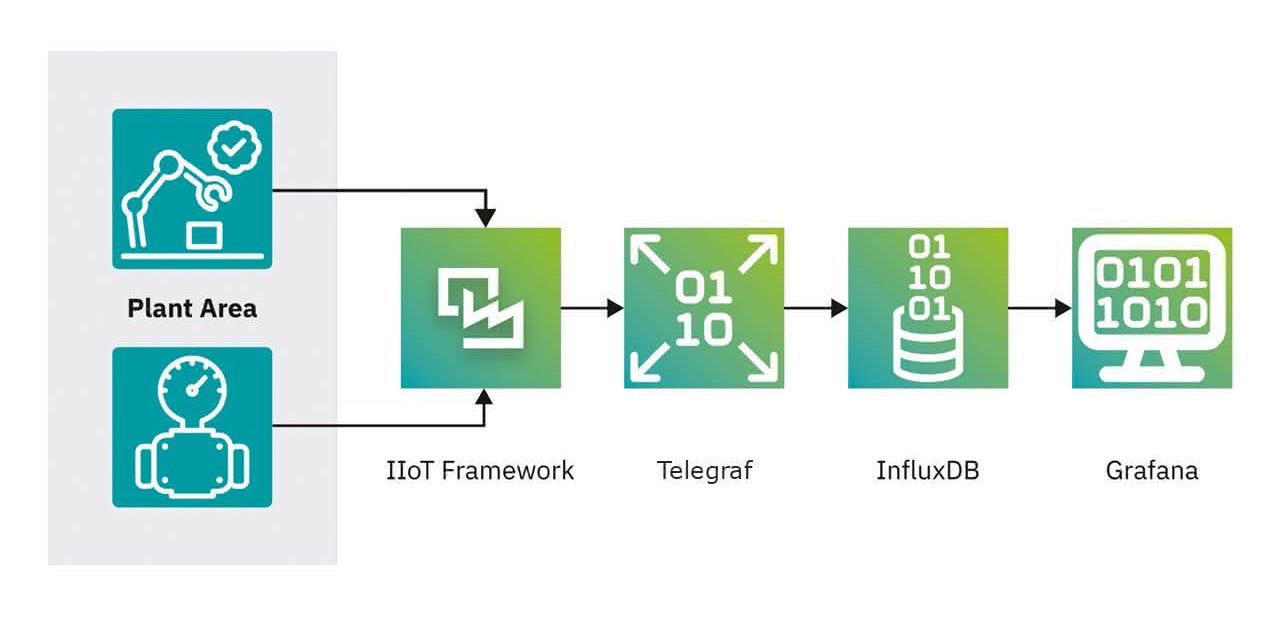
The harmonized data can be read out directly via OPC UA, REST-API or gRPC or forwarded to databases, cloud platforms or visualization tools via the Telegraf service. The engineering effort remains low, as the local bus of the Axioline I/O system is automatically read in with the connected modules. The modules are then automatically assigned to the appropriate connectors. The configuration is carried out entirely via a web visualization and is automatically saved in JSON files. This considerably simplifies updates and backups. Thanks to the open architecture of the IIoT framework and the PLCnext Technology ecosystem, users can implement their own connectors in IEC 61131-3 if required. Extensive ready-made functions and modules are available for this purpose, making implementation easy.
Connectors for control systems and transmission protocols
With the new version 2025.0, the IIoT framework receives several additional connectors. The new S7_Comm connector allows direct communication with Siemens controllers from the S7-300, S7-400, S7-1200 and S7-1500 series. Different variables can be read directly from data blocks, regardless of their structure. The S7_Comm connector is therefore particularly suitable for modernization projects in which existing S7 controllers continue to be operated but additional data needs to be provided for analyses, monitoring or connection to IT systems. The new EtherNetIP_Slave connector complements the IIoT framework, especially for users with Rockwell or EtherNet/IP-based machines. The connector can be used to connect a PLCnext Control to a scanner as a slave. The bit- and byte-accurate assignment means that even complex data structures can be precisely mapped and transferred. This results in a high degree of flexibility when integrating different machine architectures.
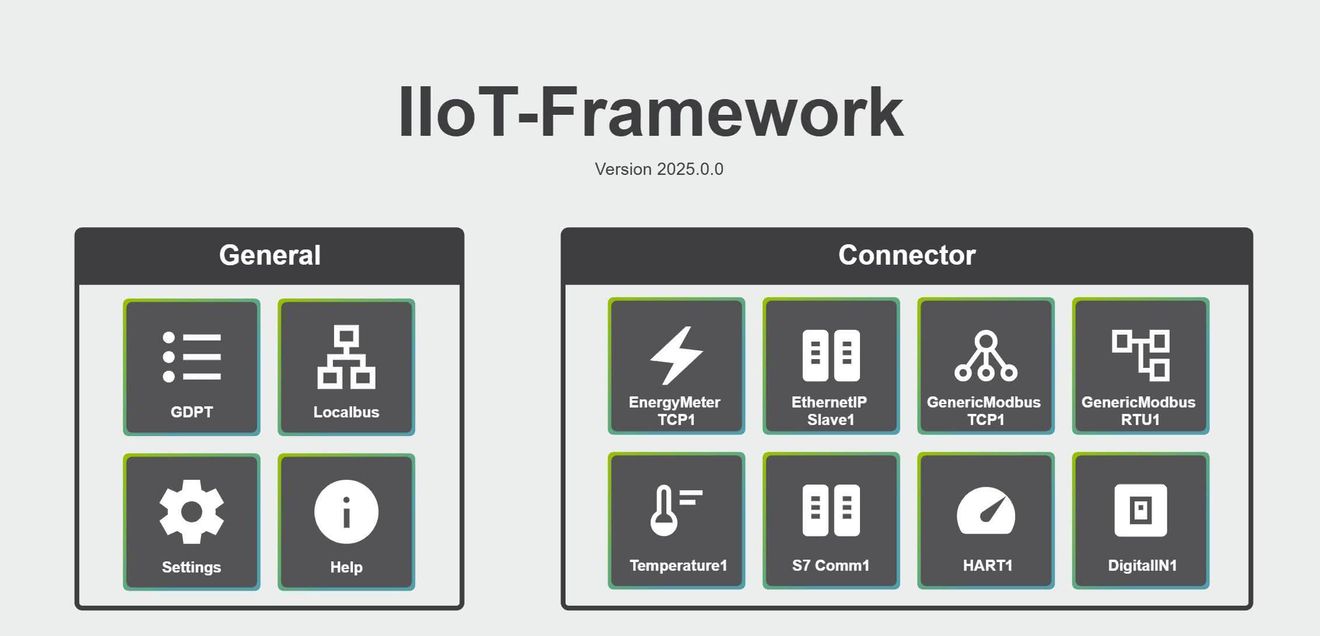
The generic Modbus connectors GenericModbus_TCP and GenericModbus_RTU extend the framework with a flexible option for requesting data from a variety of devices via Modbus/TCP or Modbus/RTU. In this way, both simple sensors and complex field devices can be easily integrated into the network. The temperature connector records temperature values from Pt100 and Pt1000 sensors directly. Two-, three- and four-wire sensors are supported, allowing different installation and wiring variants to be integrated. The new HART connector significantly expands access to smart process sensors. It can be used to read out analog measured values and the HART variables of the sensors.
Capture, convert and forward raw data
The Telegraf app provides the PLCnext Technology ecosystem with a powerful and resource-saving data agent that can be flexibly integrated into industrial IT and OT architectures. With more than 200 plug-ins available, Telegraf is ideal for both simple machine connections and sophisticated data pipelines. The tool shows its particular strengths on the PLCnext Control controllers: raw data is buffered and pre-processed locally. This reduces the load on the controller and ensures that large volumes of data are reliably forwarded to IT systems or cloud services. The close integration of the IIoT apps from the PLCnext Store digital marketplace creates a powerful edge data platform: InfluxDB serves as a robust time series database on the controller, Grafana enables visualizations without external infrastructure, and MariaDB supplements the system with relational data storage.
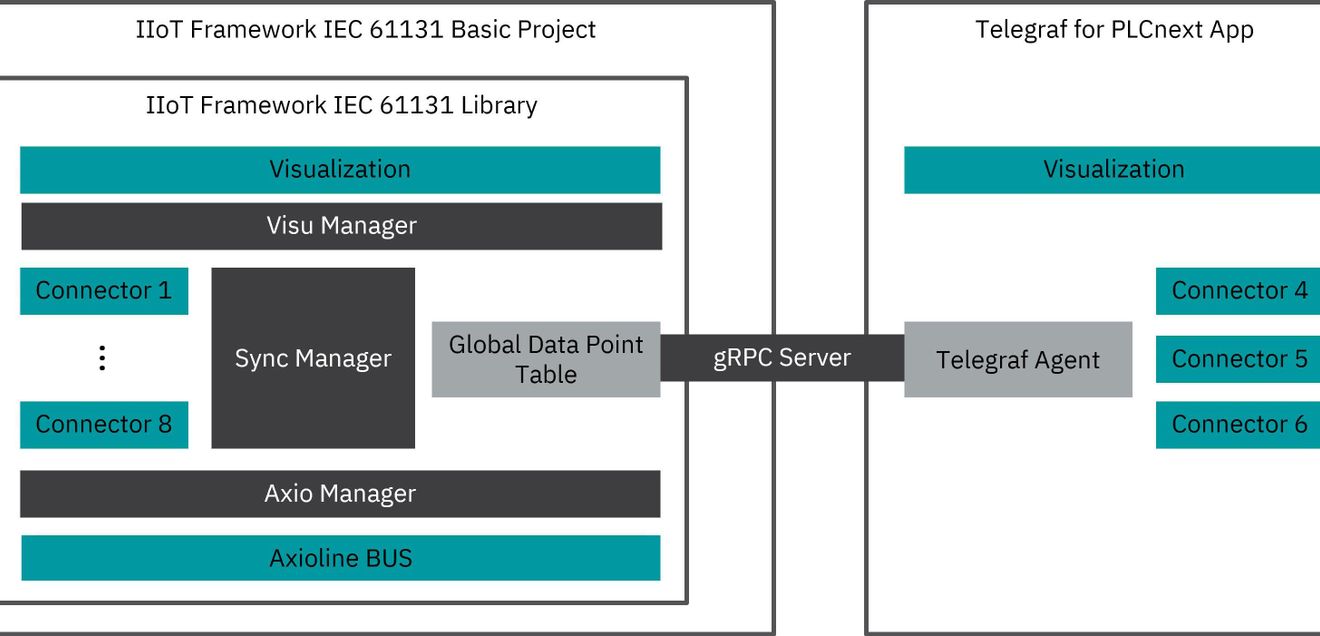
Together with the IIoT framework and the harmonized GDPT data structure, this creates an end-to-end, time-consistent data basis. Telegraf extends this architecture with scalable data pipelines that aggregate and normalize data and make it available for monitoring tasks and machine learning processes such as anomaly detection or predictive maintenance.
Robust infrastructure for classic and data-driven applications
The new connectors of the IIoT framework open up numerous applications, especially in the brownfield. Existing S7 controllers, Modbus devices and HART measuring points can be integrated into modern data landscapes without interfering with the control technology. This considerably simplifies the subsequent introduction of energy monitoring, condition monitoring and operating data acquisition. Combined data sources, such as energy meters, HART sensor values or temperature measurements, provide a standardized basis for consumption analyses as well as peak load evaluation and condition monitoring of systems. The Telegraf app expands these possibilities with flexible, robust data pipelines at the edge. It filters, buffers and aggregates data and forwards it to local databases, visualizations or cloud platforms via 200 plug-ins. This creates a scalable, consistent database that supports monitoring and condition monitoring concepts and enables data-driven optimization. With the new connectors and the integration of the Telegraf app, the IIoT framework and the IIoT apps are developing into an end-to-end data platform that covers the entire path from the field device to IT and cloud systems. Different sensors, controllers and measuring points can now be connected, harmonized and centrally evaluated even more easily. The standardized GDPT ensures a uniform data basis, while Telegraf provides flexible data pipelines for storage, analysis and visualization. This results in a robust infrastructure that supports classic monitoring tasks as well as sophisticated data-driven applications, including predictive maintenance.
Dario Bertoli and Thiemo Ludmann, both Solution Engineers at Phoenix Contact
Hanover Fair, Hall 27, Stand G26


You might also be interested in
"Implementation often takes too long"
IT and OT are growing together. Martin Ruskowski, CEO of the SmartFactory-KL technology initiative, explains in an interview why Germany is lagging behind despite good concepts and how real projects are paving the way to the smart factory.
 read more...
From Theory to the Factory Floor
IT and OT are converging, thereby laying the foundation for the smart factory. Only through seamless data integration can AI, digital twins, and flexible production processes become a reality. Why IT/OT convergence is becoming a competitive...
read more...Spectra Launches 5G RedCap Router for Industrial IoT Applications
With its new 5G RedCap routers, Spectra is expanding its portfolio to include a mobile communication technology for industrial applications designed to bridge the gap between traditional 5G and established IoT standards such as LTE-M and NB-IoT.
read more...Integration Meets Reality
OT meets IT – the two worlds are meant to converge, data is meant to flow, and production is meant to become smart. Yet the reality in industry often remains stubbornly contradictory: while systems have long been technically interconnected, they...
read more...Software at the heart of modern production
In an interview with Andreas Mühlbauer, Ulrich Huggenberger, Managing Director and CEO of Xitaso, explains why software architectures, modular control systems and networked data models are crucial for the production of the future. He explains the...
read more...How measured values are turned into decisions
Systems constantly generate measured values - but many of them disappear into systems that nobody actively uses. The problem is not the amount of data, but how it is collected. Only when information is available without detours and converges in a...
read more...AI-supported smart factory and energy...
Key drivers of the industrial transformation
Delta is showcasing at Hannover Messe how its AI-powered smart manufacturing, digital twin technologies and integrated energy infrastructure solutions are accelerating the transformation of industrial operations. At its press conference, the company...
read more...Interview with Jumo Managing Director Dimitrios Charisiadis
Ahead of Hannover Messe 2026, Dimitrios Charisiadis, Managing Director of Jumo, talks about the company's return after a seven-year break, the strategic importance of the trade fair and the technological focus of this year's appearance.
read more...Switch makes network status transparent
Gigabit Ethernet is becoming increasingly important in mechanical engineering. The scalable infrastructure enables a step-by-step approach in which the backbone is first implemented on Gigabit.
read more...