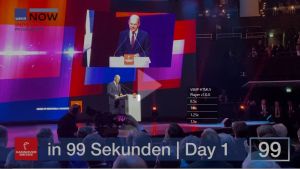
"Closing ranks with international partners"
Hannover Messe 2025 attracted around 127,000 visitors from 150 countries. The event was all about artificial intelligence (AI), automation, digitalization and sustainable energy supply.
 read more...

Articles and background information on the topic
Hannover Messe 2025 attracted around 127,000 visitors from 150 countries. The event was all about artificial intelligence (AI), automation, digitalization and sustainable energy supply.
read more...Donald Trump's unprecedented tariff package is shaking up global trade - and poses major questions for business, politics and consumers. The EU and China are responding with countermeasures, but are maintaining their dialog. Here we explain how the tariffs affect Germany, the global economy and everyday life.
read more...VDMA at the Hannover Messe 2025
At Hannover Messe 2025, the mechanical and plant engineering industry emphasized the need for comprehensive reforms in order to strengthen industrial competitiveness in Germany and Europe. The VDMA believes that the German government and the European Union in particular have a duty to improve economic conditions and reduce bureaucracy.
read more...The State Development and Reform Commission of China has announced that it will set up a publicly supported venture capital fund for robotics, artificial intelligence and cutting-edge innovations. A total of around 128 billion euros is to be raised over a period of twenty years.
read more...Despite billions invested in fibre optics and 5G, digitalization in Germany is lagging behind, as a DIHK survey shows. Slow approvals and high costs are slowing down network expansion - with consequences for companies that rely on the cloud and AI.
read more...The German automotive industry is in crisis: the Ifo Institute's business climate index fell to a new low in January, burdened by Chinese competition, US tariff threats and difficult market conditions. Experts are warning of a serious threat to competitiveness.
read more...Effects on trade and strategies
In our reader survey, we examined the impact of Trump's presidency on international trade and business strategies. Most respondents fear trade difficulties, tensions in transatlantic relations and political uncertainty. Many companies are focusing on strengthening their existing markets.
read more...IfW, DIW, IWH, RWI and Ifo Institute
The leading German economic institutes see hardly any growth impetus for 2025, but instead rising unemployment figures and persistent weaknesses in the location. According to experts, only a stable government with a clear economic policy strategy could stop a decline in investment and creeping deindustrialization.
read more...The headwind for Germany's exporters on the global markets remains strong. In October, they had to cope with sharp declines - especially in their most important sales market, the USA.
read more...Business location under pressure
The German economy has long complained about electricity prices that are high by international standards. The German government wants to take countermeasures - but no longer has a majority in the Bundestag.
read more...