
Interview
"Image processing is evolving from a monitoring tool to an active production aid."
How Image Processing and Digital Worker Assistance Optimize Manufacturing Processes: In this interview, Michael Kunze, Managing Director of MKey Solution GmbH, explains how companies can reduce scrap, improve quality, and control processes in real time.
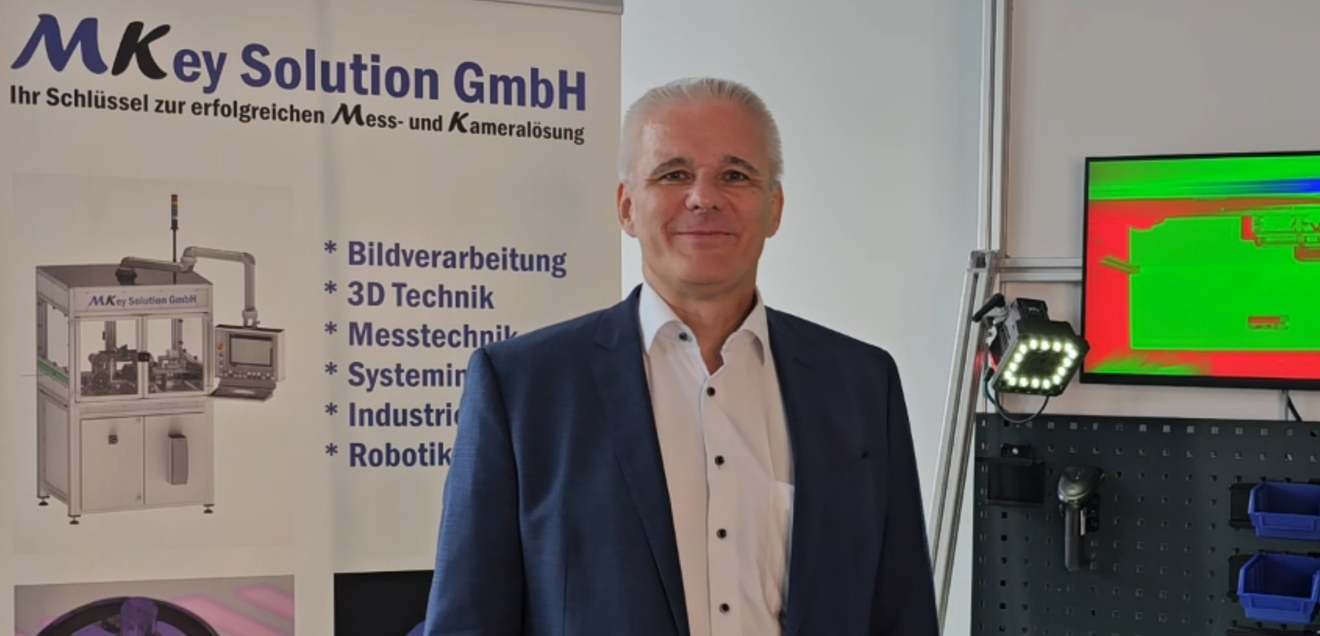
Industrial manufacturing is undergoing a transformation: Today, machine vision systems do far more than just perform traditional quality control at the end of a production line. Combined with digital worker assistance, they monitor processes in real time, support employees directly at their workstations, and provide valuable data for the continuous optimization of workflows. MKey Solution GmbH develops customized solutions for industrial image processing and metrology. The company combines cameras, sensors, and intelligent software into systems that automate production and logistics processes, visually guide employees through workflows, and detect errors in real time. A particular focus is on digital worker assistance systems that make assembly and manufacturing processes more efficient, safer, and more consistent in terms of quality. In this interview, Managing Director Michael Kunze explains how companies can use these systems to reduce scrap, improve quality, and make the transition from reactive error correction to proactive process control.
Industrial Production: Mr. Kunze, image processing has traditionally been used in industry primarily for quality control. What changes are currently taking place?
Michael Kunze: The role of image processing is undergoing a fundamental transformation. In the past, it was mainly used at the end of a production process to detect defects. Today, it is evolving into an integral part of ongoing manufacturing. Modern systems no longer just analyze end products; they monitor the entire process in real time. Combined with digital worker assistance, this creates a system that actively contributes to the optimization of workflows.
What does this mean specifically for companies?
Companies in sectors such as manufacturing and maintenance gain a completely new tool for improving quality, reducing scrap, and refining processes based on data. Cameras continuously monitor the status of components, assemblies, and work steps. This information is fed back directly to employees. As a result, errors can be identified and corrected immediately—before they affect subsequent production steps.
Can you give an example of that?
For example, a system can detect whether a component has been positioned correctly, whether assembly steps have been completed, or whether there are deviations from the defined target state. Instead of downstream error detection, feedback is provided directly during the process. This transforms image processing from a passive inspection tool into an active production aid.
What role does digital worker assistance play in this?
It serves as the central interface between technology and employees. Through visual instructions—for example, projected directly onto the workstation—work steps are presented in a structured and context-specific manner. The information appears exactly when it is needed. This reduces cognitive load and minimizes sources of error, especially in complex or highly variable processes.
What additional benefits does data collection provide?
A key advantage lies in the comprehensive documentation of all work steps. Each process step is analyzed and assigned to specific stations, employees, or shifts. This real-time transparency lays the foundation for AI-based process analyses. Companies gain detailed insights into operations at the line or workstation level and can identify variations in processing times, error rates, or process stability.
How can companies put these insights into practice?
Kunze: For example, it is possible to identify differences between various departments or systematically apply best practices from individual employees. This enables continuous optimization of production. Bottlenecks can be specifically addressed, workflows adjusted, and training measures implemented as needed.
What technical components work together in this process?
The combination of image processing, operator assistance, motion control, and process data creates a fully integrated system. Employees are guided by projected instructions, work steps are automatically verified using 3D sensors, and results are documented in real time—reliably, consistently, and regardless of lighting conditions. At the same time, an integrated user management system ensures that only qualified employees can perform specific tasks.
How does this affect efficiency and quality?
The efficiency gains are measurable. Errors are detected and corrected early on, training needs become apparent, and scrap and rework are significantly reduced. At the same time, quality and output increase. In addition, downtime is reduced because problems can be identified and resolved more quickly.
What are the implications of this approach for maintenance?
That is precisely where it offers additional benefits. Maintenance and service processes can be standardized, documented, and evaluated for efficiency. Recurring errors can be identified and prevented in the long term. The data generated enables systematic AI-based analysis and continuous improvement of individual work steps.
In your opinion, in what direction is industrial manufacturing heading?
We are witnessing a clear paradigm shift: away from reactive error correction and toward proactive process control. Quality is no longer checked exclusively at the end of the process, but is continuously ensured throughout the process. Digital worker assistance helps make human work more precise, safer, and more efficient. In my view, this is precisely where the future of modern production systems lies.


You might also be interested in
Process monitoring and fault detection
Cameras ensure quality during laser melting
Powder bed-based laser melting (PBF-LB/M) opens up new possibilities in additive manufacturing. Modern camera systems provide crucial process data to further increase quality and efficiency.
 read more...
Robots play on board the ISS
What sounds strange at first has an important background. The two robots 'Cimon' from the German Space Agency at the German Aerospace Center (DLR) and 'Int-Ball2' from the Japanese space agency JAXA on board the International Space Station ISS...
read more...Sensor solutions for industrial robotics
Security technology and image processing
At Automatica, Sick will be focusing on the wide range of solutions for functional safety and industrial image processing as well as digital approaches such as augmented reality and AI.
read more...Handling and inspection of indexable inserts
For quality control and correct handling of indexable inserts, a manufacturer uses an automated system with AI-based image analysis that detects 99% of all manufacturing errors.
read more...Products of the year 2025: the competition starts again
The INDUSTRIAL Production Products of the Year are entering a new round. This year, our readers can vote in eight categories. We are also awarding a special prize.
read more...Hermes Award: The nominees have been announced
An independent jury chaired by Prof. Dr.-Ing. Holger Hanselka, President of the Fraunhofer-Gesellschaft, has nominated three companies for the Hermes Award from the numerous submissions: Bosch Rexroth, Schunk and Siemens.
read more...New product manager for MV-Tec Merlic
Ulf Schulmeyer brings momentum to the software
MV-Tec Software, international software manufacturer for industrial image processing, announces an important change in the Merlic team: Ulf Schulmeyer has taken over product management for the easy-to-use Merlic software.
read more...Focus on intelligent networking
At SPS 2023, everything at Balluff revolved around the topic of network technology. Industrial image processing and other solutions for the factory of the future were also on the agenda at the trade fair stand.
read more...Additional interfaces integrated
MVTec Software has launched a new version of its Merlic image processing software. In version 5.4, the focus has been placed on easier process integration.
read more...