

Production technology
Producing battery cells flexibly and sustainably
The industry needs more and more battery cells. However, their production in gigafactories consumes enormous amounts of energy. In addition, the large production lines are very inflexible. A possible alternative has now been successfully tested at the wbk Institute of Production Engineering at KIT. The approach: process enclosure in mini-environments with robots from Kuka.
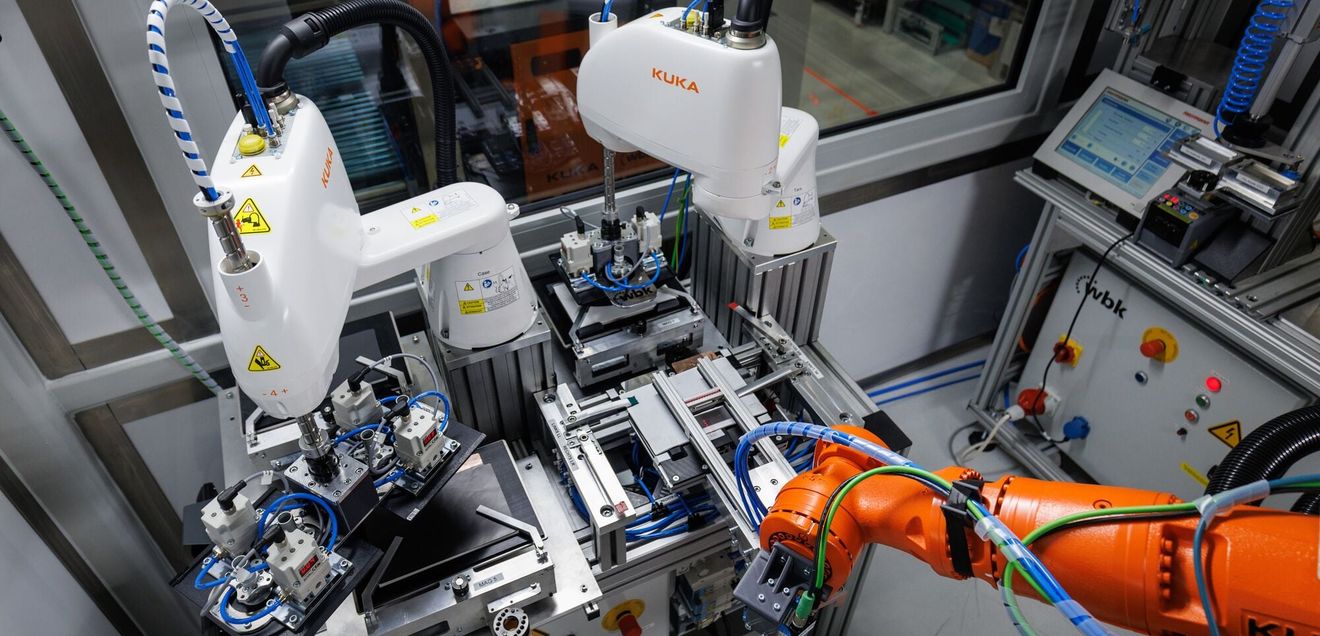
The future of battery cell production: energy-optimized and flexible
At the wbk Institute of Production Engineering at the Karlsruhe Institute of Technology (KIT), pioneering battery production can already be experienced. To make this more flexible and efficient, researchers have set up agile cell production as part of the AgiloBat project: With the help of robot-based automation in mini-enivronments, a level of flexibility was achieved that was previously only possible in the manufactory. Thanks to adaptable processes and program changes, a wide variety of cell geometries can be produced - without having to extensively retool the system!
To this end, the researchers developed special robot cells that are a world first in terms of their design and construction. They were designed and built by Exentec Germany GmbH, a company of the Exyte Group. Exyte, the international building technology and plant engineering company based in Stuttgart, designs, plans and provides sustainable and ultra-clean production facilities for high-tech industries, including semiconductor and battery factories, data centers and facilities for the biopharmaceutical industry. One of Exentec's specialties is clean and dry rooms. Or in the words of Nicole Neub, Director of Battery Technology at Exentec: "We are responsible for the necessary dry air in the battery manufacturing process."
Every process step in a mini-environment
It is well known that the ambient air in the production of battery cells must contain very little humidity. To be more precise: to prevent oxidation or moisture inclusions during the processing of the sensitive battery materials, the relative humidity is usually less than 1 percent. This is because a higher relative humidity can later lead to quality problems or even critical battery failures.
The required dryness is produced in so-called mini-environments. "Individual process steps in production and the associated machines are enclosed and the filtered air is brought directly to the process," explains Nicole Neub. "This means that only the machine is supplied with clean and dry air - and not a large unused volume in the production hall." In the industrial mass production of battery cells, entire production areas are usually operated as a dry room, which is not necessary for individual processes and requires large amounts of energy.
In the AgiloBat project, this is achieved using container-like boxes in which a dew point of up to -50 °C prevails. "This has nothing to do with the temperature of the production environment," explains the technical manager of the AgilotBat project Sebastian Henschel from the wbk Institute of Production Engineering at KIT. Rather, the dew point indicates the temperature to which air must be cooled in order for moisture to condense. In other words, the lower the dew point, the drier the air. "At a dew point of -50 °C, there are less than 100 water molecules per million air molecules by volume," explains Henschel. "That corresponds to a relative humidity of far less than one percent."
People are separated from the process - thanks to automation
A decisive factor here is the employees: "We humans are made up of 80 percent water, which is anything but helpful in a process like this," says Henschel. "And even when we are at absolute rest, we exhale at least 120 grams of pure moisture every hour," adds Nicole Neub. "These are quantities of moisture that have a significant negative impact on a stable dew point of -50°C, for example." In order to get the production environment really dry, you have to keep people out of it as much as possible. This is precisely Exentec's approach: "In our mini-environment, we consistently separate people from the process by enclosing them," explains Nicole Neub. "Of course, this is only possible if the process is fully automated." And this is where the robots from Kuka come into play.
Four KR CYBERTECH nano, one KR 4 AGILUS and, for cell stacking, two KR SCARA are being used in AgiloBat - to the complete satisfaction of the project managers. "Battery cell manufacturers have been using Kuka robots in large numbers in the dry room for years in order to reduce environmental contamination from employees and increase production quality," says Thomas Schmidberger, Business Development Manager at Kuka. Kuka has been in contact with battery manufacturers for some time regarding their technological requirements for dry room environments. "The requirements for our products in the dry room are well known to us from numerous successful customer projects and are continuously analyzed together with leading industry experts," emphasizes Schmidberger. As a leading robot manufacturer, Kuka is working on certifying its robots for use in the dry room.
Robots master the challenges in the drying room
This is because use in the drying room poses particular challenges for the robots. The extremely low humidity can lead to increased wear. This applies in particular to materials that contain plasticizers, such as seals or cable connections: Long-term use in the dry room can cause them to become porous more quickly and, in the worst case, even break. But lubricating greases, for example, can also lose their functionality because they lose water components. These are special challenges - which are taken into account at Kuka: Since 2020, the automation experts from Augsburg have already gained experience with over 10,000 robots in battery production, including more than 1,000 in dry room applications. Customer feedback has been consistently positive.
However, production in mini-environments using automation is not only interesting for battery cell production, but also for many other industries: "The topic is essential in the semiconductor sector, as well as in the pharmaceutical industry," reports Nicole Neub from Exentec. This is where the advantages of Kuka's broad product range come into their own: thanks to their versatility and flexibility, the robots can be used for completely different areas, products and environments. The project at KIT has also demonstrated this: "We wanted to build a system with maximum flexibility by mapping different process steps using different production modules and then linking them together," explains Sebastian Henschel, technical manager for AgiloBat. "Kuka's robots have absolutely proven their worth here. With their help, we have achieved industrial repeatability and accuracy - combined with a flexibility that we are otherwise only familiar with from manual production."
Attractive production option, also for small and medium-sized companies
These features are particularly attractive for SMEs - it is no coincidence that the KIT team at AgiloBat worked together with medium-sized machine and plant manufacturers. Mini-environments and automation put them in a position to offer competitive plant technology along the critical process chain within dryroom-relevant production environments. The findings from AgiloBat enable them to manufacture battery cells flexibly and to test new material systems through industry-oriented production with small quantities of material. "Finally, we must not forget that these chemical process steps in battery production involve working with critical substances," says Thomas Schmidberger. "Robot-based automation in conjunction with the use of mini-environments therefore also protects the health of employees."
Above all, however, the production process used at AgiloBat can save considerable resources - in two ways: firstly, it requires significantly less energy than conventional production. "In the gigafactories, between 25 and 40 percent of the total energy requirement is used just to create drying room conditions. And we are constantly drying against the continuous moisture input of every person in the drying room," says Nicole Neub. "Mini-environments and the consistent separation of people and processes can significantly reduce this figure and therefore also the running costs, i.e. the OPEX." And secondly, the amount of unusable scrap is significantly reduced: "With the large systems, even when they are run in, we sometimes have 15 to 20 percent scrap material that has to be thrown away or recycled," calculates Sebastian Henschel from wbk. "We can also significantly reduce this rate by making production more flexible." The robots from Kuka make it possible!


You might also be interested in
Preventing Interference from Harmonics
Harmonics are underestimated sources of interference in electrical power grids. Particularly in wastewater treatment plants and water treatment facilities, harmonic distortion leads to poorer power quality and associated costs: additional heating of...
 read more...
Digital twin in battery production
Faster to more powerful batteries
The battery factory of the future is increasingly working digitally: simulations accompany the development of new cells, and intelligent sensors monitor production in real time. Researchers at the Fraunhofer Institute for Industrial Mathematics ITWM...
read more...Operating commercial vehicles efficiently with high-voltage distributors
High-voltage distribution units (HV PDUs) from Rose Systemtechnik enable the efficient operation of electrical construction machinery, commercial and municipal vehicles. The HV PDUs ensure optimum power distribution between the vehicle's...
read more...Best quality for the steel
Conditions in the steel industry are harsh and inhospitable. The machines used must be able to withstand the demanding environmental conditions in order to deliver the best quality at all times.
read more...Energy systems for industrial trucks
Still develops new lithium-ion battery
The intralogistics expert Still is expanding its battery portfolio with a new lithium-ion battery. This covers the most common application profiles in the industry. It is manufactured and installed at the Hamburg site.
read more...Energy efficiency through high efficiency
One of the most important components in the field of automation applications is the DC supply voltage. Cost-sensitive miniature machines in particular require economical power supplies.
read more...How AI and the cloud are challenging sustainability
The rapid rise of artificial intelligence is driving up the energy consumption of data centers and jeopardizing global sustainability goals. Schneider Electric presents six practical solutions to meet the new requirements.
read more...Autonomous transport systems for electrolyzer production
The LPS and the RIF Institute for Research and Transfer are developing an automated conveyor concept for the series production of electrolysers. The modular system uses AMRs that communicate with each other and utilize the existing building...
read more...Lenze and Rittal enter into technology...
Alliance for power distribution and intelligent drive technology
Lenze and Rittal have entered into a technology partnership to jointly lead power distribution and drive technology into the future. RiLineX as the new standard platform for busbar systems and market-leading compact inverters from Lenze form the...
read more...