

Manufacturing technologies
A robot for all occasions
Industrial robots take on many tasks. Even milling with accuracies in the sub-millimeter range is now possible. Concepts with optimized kinematics and high rigidity are crucial for this. In collaboration with Siemens and the Fraunhofer IFAM, Weiss Spindeltechnologie has developed milling spindles specifically for this purpose, which make it possible to fully exploit the potential of hybrid technology.
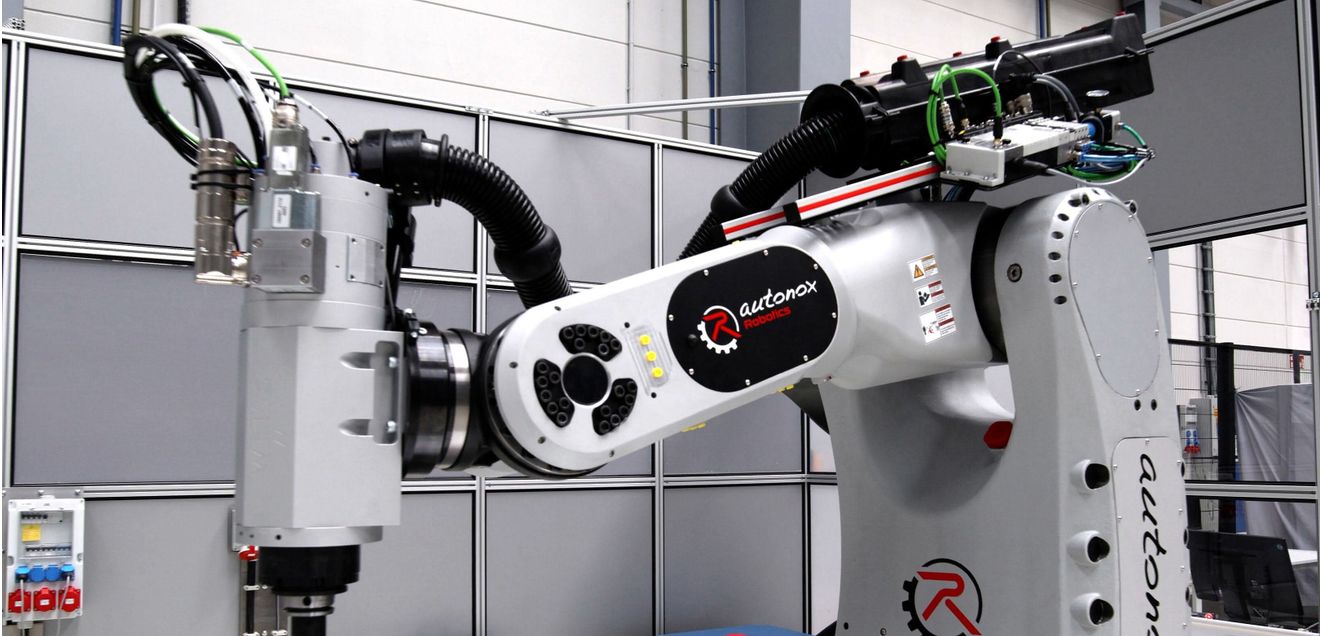
To find out which applications could benefit from improved robot technology, Siemens conducted a comprehensive market analysis together with the Fraunhofer Institutes in 2019. In addition to machining processes such as laser cutting and build-up welding, the focus was primarily on precision milling. What was missing for a broad-based, successful application was the achievable accuracy. A challenge that has now been solved.
The combination of mobility, flexibility and precision opens up fields of application (see box) that were previously uneconomical or technically impossible to implement. Whether mobile maintenance, large-scale machining or flexible production cells, the new generation of milling robots with specially developed spindle technology is ready to fundamentally change production processes.
But how and why is this now possible? The basis lies in the greatly improved kinematics, the powerful drive motors and the intelligent control technology of the patented Sinumerik Machine Tool Robot (MTR) concept. Milling robots with MTR technology now achieve ten times greater precision than conventional industrial robots. This means that they work in the sub-millimeter range, setting new standards for robot-assisted machining. However, there is another key component that is crucial to achieving this level of precision on workpieces: the milling spindle. Weiss Spindeltechnologie, a specialist division of Innomotics, has succeeded in developing and building it.
Lightness of the spindle is crucial
According to Weiss project manager Georg Sauer, the challenges were many and varied. It was particularly important to build the spindle as light as possible while still achieving maximum stability and performance. The engineer explains: "In contrast to stationary machine tools, every kilogram plays a decisive role in robot applications, as the spindle is located at the end of the arm, where the weight is multiplied." Accordingly, consistent lightweight construction was the order of the day. This was achieved by adapting the design and optimizing the choice of materials.
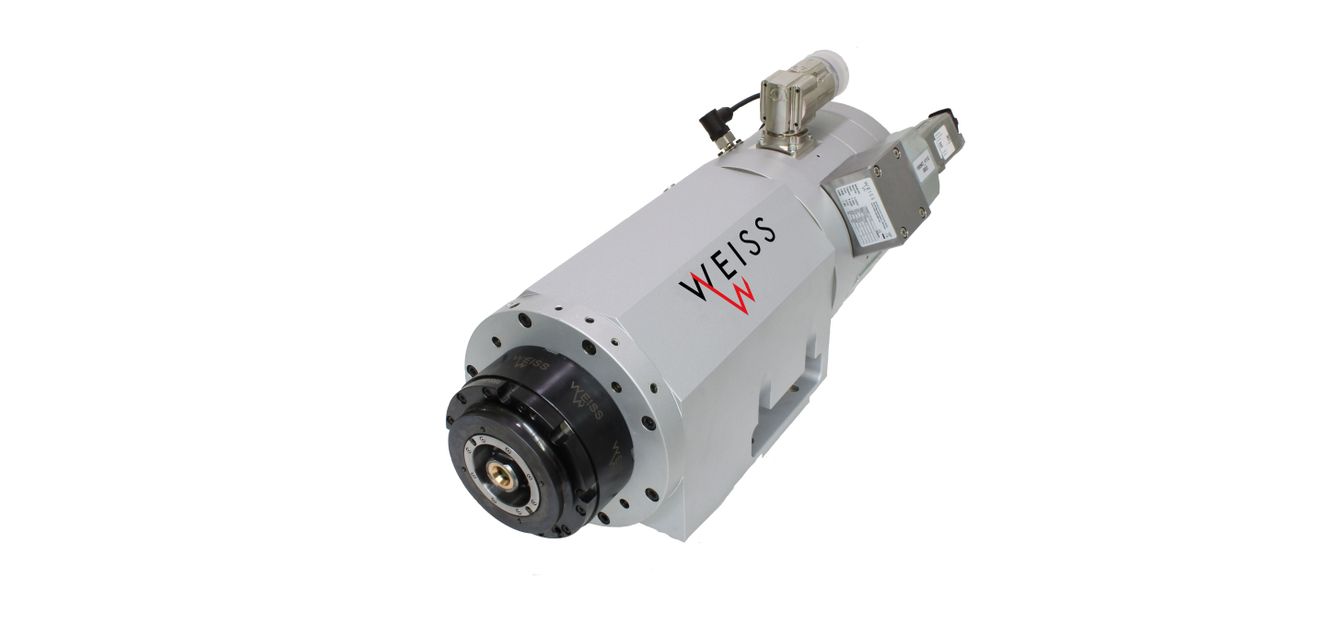
It is equally important that the engineers at Weiss have succeeded in keeping the peripheral equipment to a minimum. This is because robot systems are significantly cheaper to purchase than most machine tools, "and of course we didn't want to ruin this cost advantage with expensive additional units," explains Sauer: "We have therefore deliberately designed our spindle series as an asynchronous version. This automatically eliminates the need for a number of components that would be required for synchronous motors. We were also able to dispense with a choke thanks to the intelligent motor design."
Price-conscious spindle design
In addition, the actuation of the spindle tool changing unit is consistently pneumatic and not hydraulic, as is common in machine tools. The reason for this is that robots typically do not have hydraulic units, whereas a compressed air connection is always available. This also eliminated any additional costs. For cooling, the decision was again made in favor of water cooling, as this requires the smallest dimensions with comparable performance.
The newly developed milling spindle units for robots are currently available in five versions - from the small RS1 (6.6 kW, HSK-A32, 25.7 kg) to the large RS4 and RS5 (16.5 kW, HSK-A63, 58 kg). The only difference between the latter is the achievable speed. While the RS4 is designed for up to 16,000 min-1
the RS5 reaches up to 21,000 rpm.
Coordinated milling robot solution
As an option, all Weiss spindles can be equipped with the ISO 9409-1 standardized interface to the robot. This means that the milling spindles can generally be used on various robot systems. However, they unfold their full potential above all in a coordinated milling robot solution. This uses kinematics from Autonox Robotics, CNC drive and control technology from Siemens and Weiss milling spindle technology.


You might also be interested in
Greater Transparency in the Robotics Market
RoboFinder Launches as an Independent Comparison Platform
Launch at Gitex Europe: 'RoboFinder' aims to bring more transparency to the professional service robotics market. In this interview, founder and CEO Brian Engels discusses market potential, challenges, and the goals of the new platform.
 read more...
Artificial Intelligence for the Physical Space
Alibaba Expands Qwen Model Family with a Robotics Suite for Physical AI
Alibaba is expanding its Qwen model family with a robotics suite for Physical AI. The three models—for manipulation, navigation, and simulation—are designed to assist autonomous robots with complex tasks in real-world environments.
read more...International Federation of Robotics
U.S. Robotics Industry Sees Double-Digit Growth
In the U.S., sales of industrial robots rose by 11% compared to the previous year: 38,000 units were newly installed in 2025. This significant recovery is driven by robust growth in the food industry and other non-manufacturing sectors. However, the...
read more...Development Collaboration for Humanoid Robotic Hands Launched
Schunk is entering into a new development partnership with Robert Bosch Robotics. Their shared goal is to develop an industrial-grade robotic hand that can be integrated into various humanoid robot systems.
read more...Robot-controlled packaging of rolls
Koch Robotersysteme, a company specializing in the integration of robotic systems, has developed a complete, automated packaging line for packaging rolls based on Tentoma’s RoRo StretchPack packaging machine.
read more...Highly Automated Injection Molding
Six-axis robots automate the entire handling process
From part handoff to loading and unloading the injection molding machine to quality inspection: Yaskawa six-axis robots automate the entire handling process in a highly integrated production line for safety-critical sight domes.
read more...Record funding for accelerated development of a physical AI platform
Neura Robotics has announced a Series C funding round worth up to $1.4 billion. This will help the company accelerate its mission to build the world’s leading physical AI platform.
read more...International Federation of Robotics
The 2026 IERA Award was presented
The 2026 “Award for Innovation and Entrepreneurship in Robotics & Automation” (IERA) goes to the Swiss deep-tech company Verity for its fully autonomous indoor drone system. The flying robots support the logistics and retail sectors by...
read more...Humanoid robotics from Germany
Igus launches service robots for everyday industrial use
Humanoid robotics: With the Iggy Rob Home, igus presents a service robot for industry and everyday life. What's behind it.
read more...