

Slip rings
Freely rotating hollow body tools
The drive in the Roto-Tower 800 enables a significantly more flexible, efficient and economical rotational molding process than previously established methods.
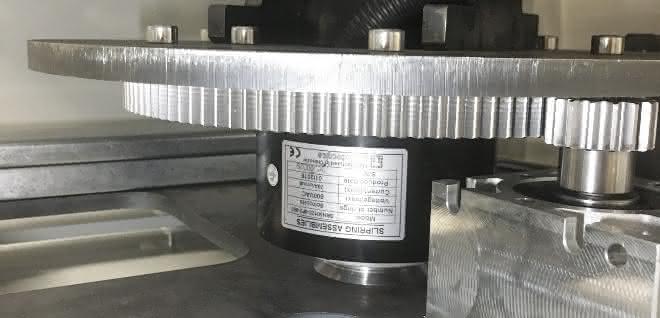
SVTS C slip rings from Servotecnica make an important contribution to the interference-free power supply and signal transmission of the system.
Founded in 2015, the Crimmitschau-based company Roto Evolution has set itself the task of further developing the rotational molding of hollow plastic bodies for Industry 4.0. In rotational molding, a powdery thermoplastic material is melted in a biaxially rotating hollow body tool. The molten plastic is then deposited layer by layer on the inner surfaces of the mold during the process and forms the outer contour of the article. This creates uniform wall thicknesses. At the end of the process, the previously heated hollow mold is cooled down again before it can be removed for demolding. Previous rotary systems are very large in relation to the article to be produced and consume an enormous amount of energy. In addition, they can only be automated at a disproportionately high cost and cannot be expanded.
Based on its many years of experience in the industry, the Roto Evolution team is pursuing an idea for a completely new drive concept for the rotation process. The tool carrier of the patented process is not permanently connected to the rotary machine, but is fixed in a spherical cage that rests loosely on a drive wheel in the machine and can roll freely. The rotation of the drive wheel also causes the ball to rotate. A constant change of the rotation axis is achieved by means of different speeds, time control and different positions of the drive wheel in relation to the ball.
Energy and signals for the Roto Tower
The connection between the machine and the rotating plate, which controls the drive wheel, is established via a slip ring. After several tests, Roto Evolution opted for the SVTS C 06-S-A-06/00-0500/0500 slip ring from Servotecnica. The encapsulated slip ring with protection class IP51 integrates six circuits for a maximum of 600 VAC and up to 20 A per circuit. The slip ring ensures the power supply for the drive wheel and transmits the necessary control signals. Two circuits of the slip ring are used for signal transmission, which is possible without any problems due to the good transmission quality of the gold-plated slip ring contacts. The remaining contacts are used for the parallel power supply. This allows a higher power to be transmitted than with one circuit.
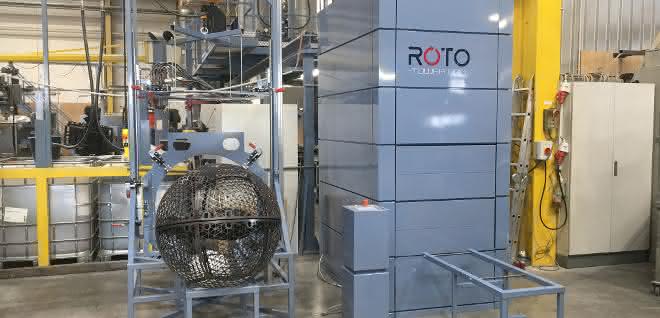
Compared to existing processes, the new rotation process in the so-called Roto-Tower 800 results in time savings with the same output as well as significant energy savings. Thanks to digital control elements, process controlling can be transparently tracked and regulated. Thanks to the modular design of the system, production can grow organically as required. Thanks to the innovative drive concept, molds can be changed without any loss of time. Cycle times and the required number of tools are minimized, as are space, time, energy and personnel costs.
The Roto-Tower can be equipped with an electric heater or a gas blower burner. The ROTO Tower measures 1,200 mm x 1,750 mm x 2,750 mm (WxDxH) and can accommodate tools with a maximum diameter of 656 mm, a height of 794 mm and a weight of around 35 kg. The ball diameter of the Roto-Tower 800 is 800 mm. The next generation is set to reach 1,100 mm.
High output on a small area
A big plus point is the small footprint required. The highly efficient heating zone is located in the upper part of the Roto-Tower, while the insertion and cooling area is located in the lower part. The drive unit with the slip ring is housed underneath in the tower's lifting frame, which moves the ball with the tool into the heating or cooling zone depending on the process phase. The entire rotation process is designed as a modular system. In addition to combined and individual heating and cooling stations, stations for manual and semi-automatic opening, for tool changes and an infeed and outfeed station for tool changes can also be integrated. If several Roto-Towers are linked in a circular arrangement to form the Roto-City and loaded and unloaded with a central six-axis robot, three times the product output per mold can be achieved and energy savings of 30 to 50 % can be achieved compared to conventional rotary processes. According to the latest findings, the total cost of manufacturing products using the ball rotation process is at least 30 percent lower than with conventional processes. The modular system and the ingenious transportation of individual tool carriers, combined with the continuous monitoring of each individual tool, enable dynamic and highly efficient production.
Versatile application possibilities
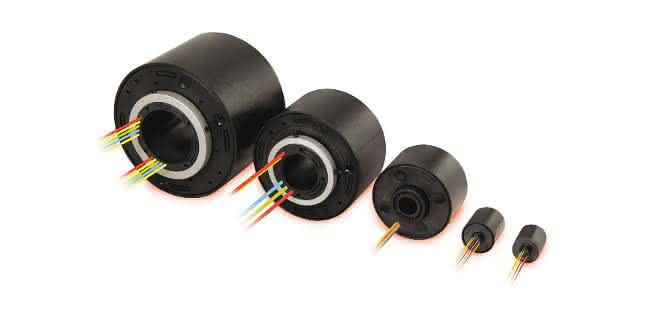
The successful hollow shaft slip rings of the SVTS C series with hollow shafts from 3 to 100 mm in diameter have already proven themselves in converting, packaging, CNC and pharmaceutical machines with their 13 model series and numerous sizes for applications. In addition to electrical signals and power, the cost-efficient slip rings from Raunheim-based Servotecnica can also be equipped with fieldbuses and fluidic lines. The robust slip rings in a hard plastic housing made of ABS and with steel ball bearings are designed for a service life of108 revolutions. They can be used at temperatures from -20 to 80 °C. In addition to the production of series components, Servotecnica also uses its manufacturing expertise to produce customer-specific complete packages.


You might also be interested in
Helu makes its first trade fair appearance under a new brand name
Helu Kabel will be presenting itself as Helu for the first time at Hannover Messe 2026, showcasing system solutions, Heluchain cables and new industrial luminaires.
 read more...
Strategic realignment with brand relaunch
In future, Helukabel will trade as Helu
The Helukabel Group is parting with part of its name: in future, the company will only operate under the Helu brand. With this step, the specialist for electrical connection technology is underlining its strategic development from a classic cable...
read more...Modular plant construction for corrugated board
Insight into the production of corrugators at BHS Corrugated: Automated, modular and equipped with Helukabel components.
read more...Best quality for the steel
Conditions in the steel industry are harsh and inhospitable. The machines used must be able to withstand the demanding environmental conditions in order to deliver the best quality at all times.
read more...If the standard cable is not sufficient
Lapp offers cables for countless applications - but not for all of them. From time to time, the developers have to modify a standard cable or develop a special cable.
read more...Slight decline in sales, strong investments
The Lapp Group has not been spared from the weakening global economy. However, the company only recorded a slight loss in the past 2024 financial year.
read more...Electrical connection technology
Cables and wires for industrial automation
Heukabel offers system solutions for cable routing from a single source. The subsidiary EKD Systems specializes in tailor-made cable drag chains made of steel, stainless steel and plastic, which are used in moving machines and systems as well as in...
read more...Lapp relies on Ultramid from BASF
Mobile charging of electric vehicles
The automotive industry is currently undergoing the biggest transformation in its history. The boom in battery electric vehicles in particular is presenting the industry with major challenges. Lapp, as a supplier of cables and connection...
read more...Cable handling application
At this year's Motek, ArtiMinds Robotics is showcasing a robot-based automation solution for the sensor-assisted assembly of flexible cables in connector housings.
read more...