

High-precision ball bearing
Family-owned company invests 28 million euros in Nuremberg site
Anyone talking about German industry at the moment is often talking about uncertainty: a weak economy, high costs, global upheavals. A different story is being told in Nuremberg. With the ground-breaking ceremony for a new production hall, GMN Paul Müller Industrie GmbH & Co. KG has given the go-ahead for the largest single investment in the past 30 years. Around 28 million euros are being invested in the construction of a new production facility for high-precision ball bearings at the company's headquarters.
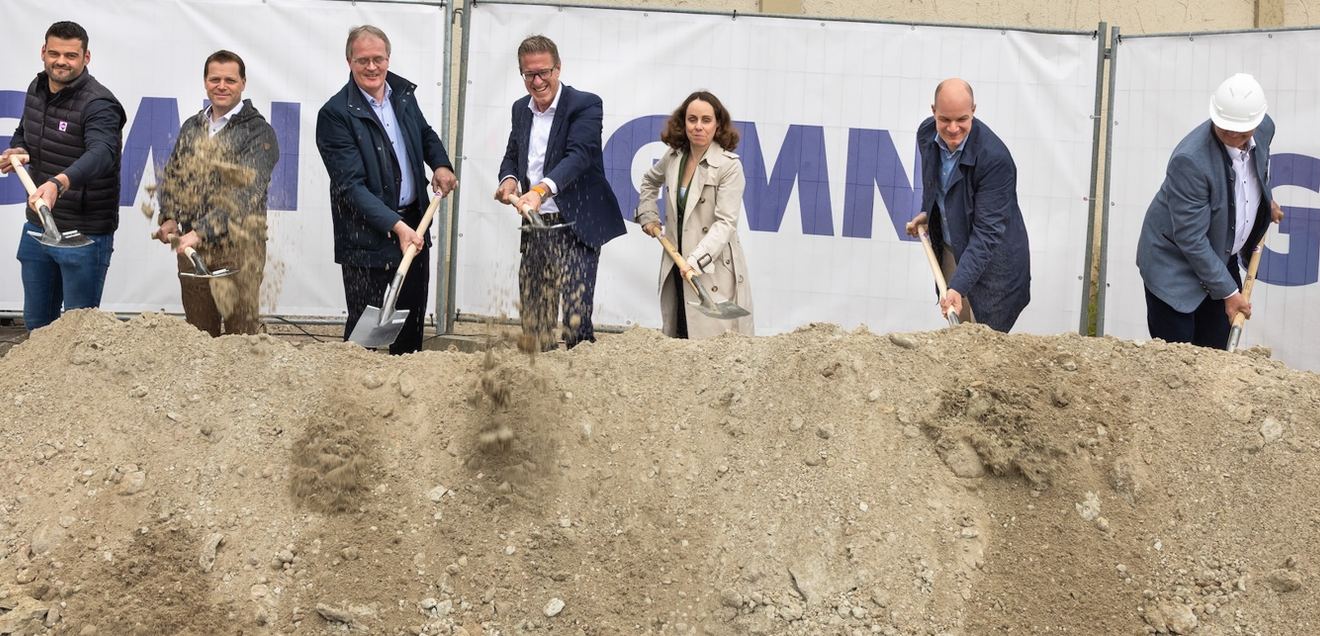
It is an investment that goes beyond the construction of a hall. Because it answers a question that many medium-sized industrial companies are currently asking themselves: Where will the future of production be created? For GMN, the answer is: in Nuremberg.
GMN Paul Müller Industrie GmbH & Co. KG began the construction of a new production hall for high-precision ball bearings in Nuremberg with a ground-breaking ceremony on May 18, 2026. According to the company, the investment volume of around 28 million euros is the largest single investment in the past 30 years. For the mechanical engineering company, the project is also a clear commitment to the Nuremberg site.
The previous production building dates back to 1932. Almost a century later, the foundation for the next generation of ball bearing production is now being laid at the headquarters on Äußere Bayreuther Straße.
Precision down to the nanometer range
On a gross floor area of around 8,650 square meters, a special building is being built that is completely tailored to the production of high-precision ball bearings. Around 85 employees will work there at full capacity.
The technical requirements are high. To keep even the smallest vibrations at bay, the floor slab of the precision measuring room is decoupled from the rest of the building. Vibrations from the nearby railroad line or neighboring production areas should therefore have no influence on production. Only under these conditions can tolerances in the sub-micrometer or even nanometer range be reliably controlled. Temperature and humidity are also controlled within very narrow limits.
The new production facility also relies consistently on automation. Autonomous transport systems will take over parts of the internal logistics in future and are intended to make production processes more efficient.
Less energy, no fossil fuels
The new building will not only be more precise, but also more energy-efficient. According to the company, the hall is expected to require 15 to 20 percent less energy than the previous building.
Process heat and process cooling are supplied by geothermal energy. The energy concept is supplemented by a photovoltaic system with an output of around 430 kWp and a battery storage system with 200 kW. GMN intends to completely dispense with fossil fuels. Instead, in addition to geothermal energy, the company relies on climate-neutral certified district heating from the Nuremberg energy supplier N-ERGIE.
This concept is intended to meet the requirements of the NH 40 sustainability standard as part of the KfW 299 program. Completion of the building is planned for the end of 2027, with the move scheduled for the first quarter of 2028.
"A historic day for the Kugelmüller"
For the company management, the start of construction marks much more than the start of a building project.
"The ground-breaking ceremony is a historic day for the 'Kugelmüller'," said Michael Lösch, Managing Partner of GMN, referring to the historical name and the company's original product. "It is the culmination of three years of planning under the leadership of Dr. Edgar Verlemann. We are courageous and believe in the future - even in times that are not super sexy. 28 million euros is a strong signal to the industrial location of Nuremberg, to our competitors and to the entire GMN team that made this step possible."
Industrial location Nuremberg under pressure and on the move
Andrea Heilmaier, Nuremberg's economic affairs officer, also sees the project as a signal that goes beyond the company.
"This ground-breaking ceremony is a date that suits the taste of an economic advisor. GMN has been part of Nuremberg's industrial history for 120 years. Our city is an industrial city and should remain so. Times are not rosy - which makes an investment of this magnitude all the more noteworthy. I believe GMN is excellently positioned with promising business areas, courage and loyalty to the location."
The investment comes at a time when many industrial companies are cutting back on spending in the face of a weak economy, high energy costs and international uncertainty. This makes the family-owned company's decision to invest tens of millions in the modernization of its Nuremberg headquarters all the more remarkable.
Family business with global operations
GMN was founded in 1908 and is now managed by the fourth generation. Around 470 employees develop and produce high-precision ball bearings and systems, machine spindles, electric drives, sprag freewheels and non-contact seals exclusively at the Nuremberg site.
Around 45 percent of products are exported abroad. Customers include companies from the mechanical engineering, model and vehicle construction and aerospace technology sectors. GMN organizes sales and service through a worldwide network of representatives and subsidiaries.


You might also be interested in
Start to the year without a recovery signal
Aluminum industry under further pressure in 2026
The German aluminum industry starts 2026 without a recovery signal: production, recycling and semi-finished products remain under pressure. Which segments are particularly affected and why the industry does not expect a quick turnaround.
 read more...
German Business Hopes for a Easing of Tensions
The German economy is showing signs of a cautious recovery. The ifo Business Climate Index rose to 85.6 points in June 2026. Companies are assessing the current situation and their expectations somewhat more positively, but remain largely cautious.
read more...HIMA Is Growing Despite Challenging Markets
The HIMA Group will increase its revenue to 190.5 million euros in 2025. International business, digitalization, and partnerships are driving this growth.
read more...Machine Tool Manufacturing Offers Hope
New orders are rising significantly again for the first time
New orders in the machine tool industry are rising significantly again for the first time. However, production, exports, and employment continue to decline.
read more...Thousands of Jobs Under Scrutiny
Evonik's Mass Layoffs: A Warning Sign for the Chemical Industry?
Evonik is restructuring the group and downsizing: The Essen-based specialty chemicals company is cutting thousands of jobs. But there is more to these job cuts than just a cost-cutting program.
read more...Accelerate the Expansion of Electric Mobility
Rittal and EcoG Expand Partnership for Charging Infrastructure
Rittal and EcoG are expanding their collaboration. The focus is on modular charging infrastructure for electric truck depots and integration into energy systems.
read more...International Federation of Robotics
U.S. Robotics Industry Sees Double-Digit Growth
In the U.S., sales of industrial robots rose by 11% compared to the previous year: 38,000 units were newly installed in 2025. This significant recovery is driven by robust growth in the food industry and other non-manufacturing sectors. However, the...
read more...Increased revenue and expanded production capacity
The Fraba Group, a manufacturer of sensors for industrial motion control, looks back on a successful 2025, a year in which both revenue and the number of employees increased.
read more...Integration Meets Reality
OT meets IT – the two worlds are meant to converge, data is meant to flow, and production is meant to become smart. Yet the reality in industry often remains stubbornly contradictory: while systems have long been technically interconnected, they...
read more...