

Rotary encoder
Precise control of standard servomotors
The Acuro AD37 absolute encoder from Hengstler records position data reliably and precisely, even at high speeds. The encoder is now also available in a version with a 1:3 cone, allowing manufacturers of standard servomotors to easily integrate it into their drives.
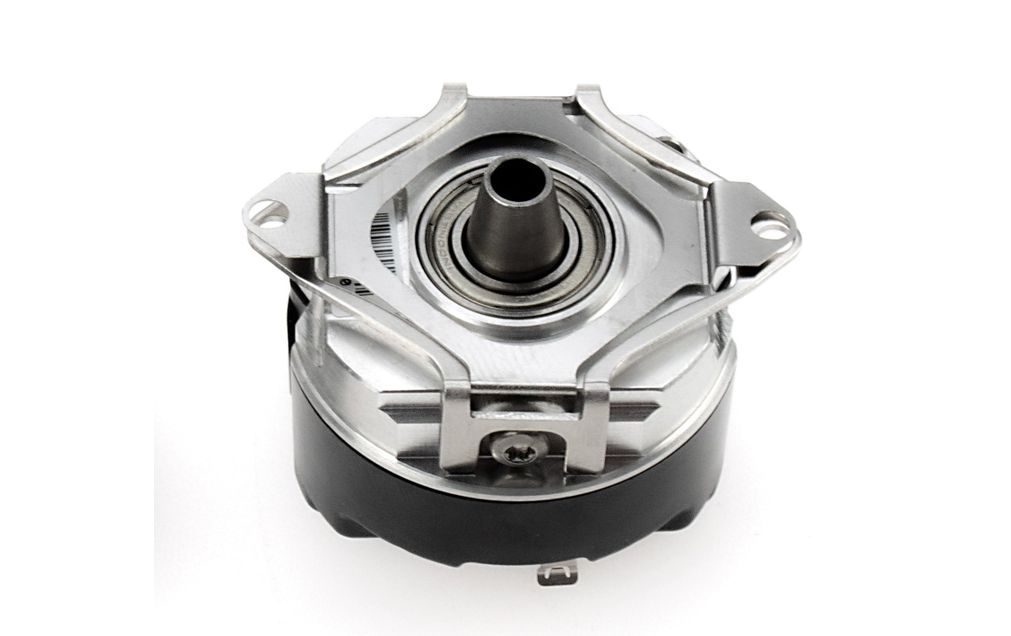
The Acuro AD37 is mainly used in highly dynamic, safety-critical applications. The encoder is optimally equipped for the strict requirements in this area: Firstly, it operates extremely precisely and dynamically, even at speeds of up to 12,000 rpm. With an absolute accuracy of ±36 angular seconds and a repeat accuracy of less than ±10 angular seconds, it also ensures maximum control performance. In addition, the AD37 is certified to SIL 3 (PLe, category 3) and offers a resolution of 20 bits in singleturn and 12 bits in multiturn operation. These features and its dual-channel redundant design predestine the encoder for applications with high safety and accuracy requirements.
The Acuro AD37 is not only extremely precise, but with an installation depth of just 29 mm, it is also the most compact multiturn motor feedback encoder in its class. This means that the encoder fits perfectly into the tight installation spaces of servo motors. In addition to its precision and very compact design, the AD37 is also characterized by its high robustness. In continuous operation, the encoder not only reliably withstands temperatures of up to 120 °C, but also vibrations of up to 300 m/s2 (10...2,000 Hz).
Another striking feature of the absolute encoder is its excellent signal quality: it enables much "smoother" control of drives than with comparable encoders and therefore also very energy-efficient operation. The high signal quality also ensures the loss-free transmission of position and temperature data at 10 MBaud over a distance of up to 100 m.
With the new version of the Acuro AD37 with 1:3 cone, Hengstler has further extended the range of applications for its proven multiturn absolute encoder. Manufacturers of standard servomotors no longer have to make complex modifications to their drives in order to use the encoder. It can now simply be plugged onto the motor shaft via the cone.


You might also be interested in
From risk to resilience
NIS2 significantly increases the requirements for industrial security concepts. In addition to cyber resilience, physical access protection is becoming increasingly important.
 read more...
Security Operations Center module
When cyber attacks reach production
Adlon is further developing its Security Operations Center and adding another module to the existing Managed SOC for Microsoft 365 environments (based on Managed XDR): Managed SOC Advanced.
read more...Lifecycle management and safe IO-Link communication
At SPS, Pilz will be presenting solutions that combine safety and security in production. The focus is on the digital Myzel Lifecycle Platform, a SaaS offering for the management of machinery and personnel over the entire lifecycle.
read more...The basics of warehouse safety
Safety in the warehouse primarily relates to the employees. However, goods must also be transported safely and transport equipment must not be damaged.
read more...Environmental containers and fire protection
Companies can choose from a wide range of environmental containers for storing chemicals and other hazardous substances.
read more...Secure focus on access
To ensure comprehensive safety, holistic safety concepts for safety and industrial security on machines are required. Authorizations and access must be clearly regulated.
read more...Added value through safety and productivity
Machine malfunctions can have serious consequences and put people's health at risk. Functional safety therefore plays a central role in industry. With control and inverter technology including integrated safety functions from ABB, plant operators...
read more...Protect Ethernet interfaces
Pilz is expanding its portfolio of operating and signaling devices with the control element PIT oe ETH. It is equipped with an Ethernet port that can be activated and protects freely accessible Ethernet interfaces in industry against unauthorized...
read more...Protective tool in everyday life
Cybershield is a company founded in 2021 with a focus on operational technologies and has set itself the goal of significantly advancing IT security in the OT sector and supporting customers.
read more...