

Remanufacturing
AI for more efficient cycle management
An increase in sustainability can be achieved through technical innovation in remanufacturing, as an insight into the EIBA research project shows.
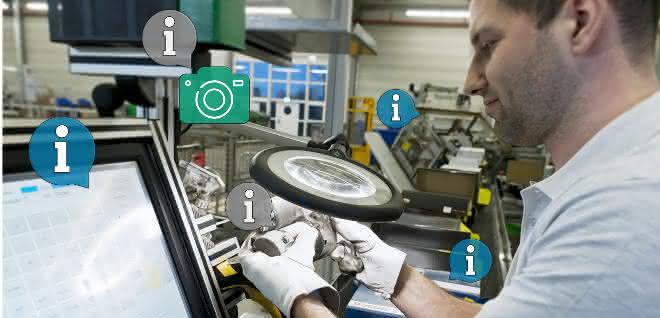
Strengthening the circularity of products and components is necessary in order to conserve resources and reduce the amount of waste. Remanufacturing, which in combination with subsequent reuse extends the service life of products, offers one way of doing this. This is why the German Circular Economy Act gives remanufacturing a high priority, as it offers ecological and economic potential. For example, a life cycle assessment of old car parts calculates that remanufacturing an exhaust gas turbocharger can reduceCO2 equivalent emissions by 37 percent compared to new production. In order to increase the aforementioned potential for sustainability, reverse logistics is required in which the old parts are collected and sorted. This process is known as sorting and involves identifying and assessing the condition of old parts. A major challenge here is the high product diversity, which requires individual and manual handling.
At the same time, no employee can distinguish between all variants. The only reliable identification feature for them is the labeling with part numbers. However, used products are often dirty, deformed and no longer clearly identifiable. Old parts are then often incorrectly sorted out.
This offers potential to make reading more sustainable through technical innovation. This is what the EIBA research project is investigating: its aim is to develop an AI-supported system for semi-automated reading.
The framework for the development is the sorting process that Circular Economy Solutions GmbH already carries out for the reverse logistics of automotive components. For partial automation, Fraunhofer IPK is developing a digitization system and AI-based object recognition for reading based on 2D and 3D image data and weights. In addition, the HAMSTER department at TU Berlin is evaluating the business and process data in order to support the employee with integrated human-machine interaction and generate process stability. At the same time, the SEE at TU Berlin collects data and information for a sustainability assessment. This is used to check whether environmental and social impacts are reduced as a result of the process change.
The German Academy of Science and Engineering (acatech) is interviewing suitable companies from the reverse logistics sector in order to understand the requirements and demand for AI-based solutions from companies in this sector. In this way, the project results can be used to determine which companies can benefit from the developed system.
Within the project, the available knowledge about a component in the form of data is combined with human experience and stored in a holistic knowledge management system. Through the continuous digitization and use of data, knowledge about each product variant is constantly expanded, analyzed and evaluated and corrected through interaction with the user. The combination of image, component and business data is a new, innovative and holistic approach from current research into decision-making. Combining human skills with AI-based analysis results in robust and objective decisions based on the "four-eyes principle". At the same time, these are documented with relevant data and are therefore traceable in retrospect.
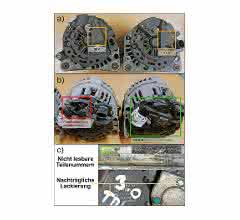
The "four-eyes principle" of employee and AI leads to greater transparency and efficiency in the process and reduces the workload for the employee.
As part of the AI-based analysis, image-based object recognition enables identification independent of part numbers. Initial results already show a recognition accuracy of around 96 percent. With a realistic quantity of one million old parts per year, 5 to 7 percent, i.e. up to 70,000 of them, are sorted out. With the help of AI-based object recognition, it is expected that 67,200 (96%) more old parts can be correctly returned to the cycle than before.
Justus Caspers, TU SEE; Hannah Lickert, TU HAMSTER; Clemens Briese and Marian Schlüter, Fraunhofer IPK, Machine Vision
EIBA, www.linkedin.com/company/eibaprojekt
Briefly explained:
Fraunhofer Institute for Production Systems and Design Technology IPK
As a production technology research and development partner with strong IT expertise, the Fraunhofer IPK in Berlin offers system solutions, individual technologies and services for digitally integrated production.
TU Berlin Institute for Machine Tools and Factory Management (IWF) - Department of Handling and Assembly Technology. (HAMSTER)
The department's expertise includes the design, experimental and simulative testing of processes, the digital control and optimization of processes and the investigation of coupled process influences for the analysis of interdependencies and the optimization of process boundaries.

The department develops scientific solutions for the sustainability assessment of products and technologies.
Briefly explained: The MHI e.V.
The Wissenschaftliche Gesellschaft für Montage, Handhabung und Industrierobotik e.V. (MHI e.V.) is a network of renowned university professors - institute directors and chair holders - from German-speaking countries. The members conduct both fundamental and application-oriented research on a wide range of current topics in the fields of assembly, handling and industrial robotics. Further information on the society, its members and activities: www.wgmhi.de


You might also be interested in
Electromobility and the supplier industry
Bosch wins major order from Mercedes-Benz for electric motors
Bosch receives a major order from Mercedes-Benz to supply electric motors for new electric drives until the 2030s. The supplier is thus further expanding its position in the growth market of electromobility.
 read more...
Production of high-voltage batteries
Electrically mobile - sustainable on the road
High-voltage batteries for electric cars are produced at the BMW plant in Leipzig. SEW-Eurodrive supplies proven and new drive solutions from the Movi-C modular system for all process steps - from cell preparation to end-of-line testing.
read more...Thyssenkrupp and Novelis cooperate
Platform for the circular economy
With a platform for the circular economy in the automotive industry, the two companies Thyssenkrupp Materials Services and Novelis want to set new standards for the recycling of used materials. The open platform will enable access to larger...
read more...85 years of precision technology from the...
Anniversary at Kammerer Gewindetechnik
Kammerer Gewindetechnik, manufacturer of screw drives in Hornberg in the Black Forest, is celebrating its 85th anniversary this year. The family business was founded in 1938 and is now managed by the third generation with 160 employees.
read more...Hydraulic brake cylinders from ACE: Easier handling even in critical environments
For active air sampling in highly sensitive cleanroom areas, special samplers are used for maximum protection of people and materials. The British company Pinpoint Scientific, which specializes in laboratory equipment, uses hydraulic brake cylinders...
read more...Expansion of the business units
Ulrich Engenhardt new CBO at Rittal
New on the Rittal Management Board: Ulrich Engenhardt has been responsible for the business units at the enclosure, IT and energy system specialist since June 1, 2023.
read more...Lifting oven grates
Bharat Forge CDP is a supplier of forged chassis and engine components as well as non-automotive systems. Since 2020, the company has been working with Kito-ER2 electric chain hoists to lift furnace grates in the production hall.
read more...Digital twins are the key to sustainability
Altair has published the results of an independent survey that shows a high level of acceptance of digital twin applications in the automotive industry. Furthermore, the use of these technologies is expected to increase as a means of achieving...
read more...Balluff remains consistently on course for growth
Balluff achieves a record result for the second time in a row. Total sales in the 2022 financial year amounted to 567 million euros. The sensor and automation specialist sees further growth opportunities for products in the field of image processing.
read more...