
Medical technology
New PTFE-free 3D printing resin
Igus has launched a new resin for 3D printers that is PTFE-free and has been successfully tested for the 96 critical PFAS: Iglidur i2000 is particularly suitable for the 3D printing of moving and friction-loaded components, such as gears in medical devices.
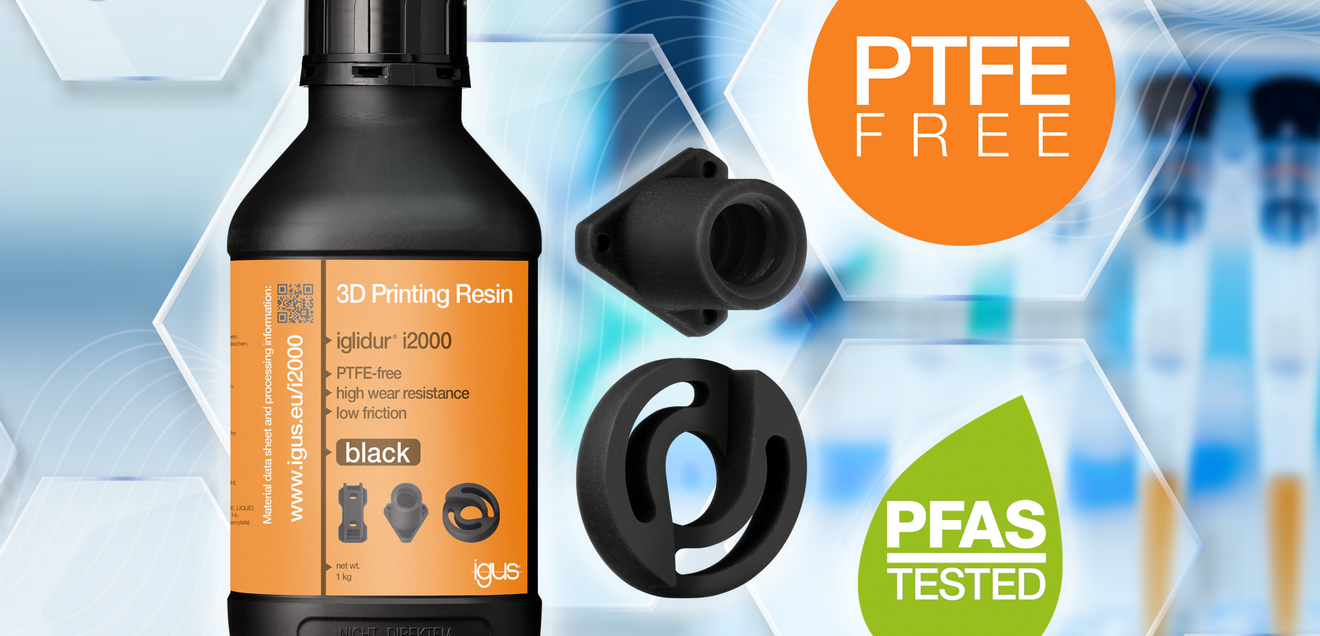
Many manufacturers of laboratory technology, diagnostic devices and surgical robots produce plastic components using 3D printers, such as miniature gears, rotating valves or pivoting levers. This saves them time and money. The problem is that many printing materials contain so-called PFAS chemicals. And the EU could restrict these in the future due to the potential risk to people and the environment. "Many manufacturers in sensitive industries such as medical technology are therefore already looking for alternative 3D printing materials," says Jonas Burk, Head of Additive Manufacturing at Igus. "One such alternative is our new iglidur i2000, a 3D printing material that does not contain any of the 96 PFAS substances considered critical in concentrations above 0.1 percent by mass."
Self-lubricating effect without PTFE
The new 3D printing material is a resin, a liquid, light-sensitive synthetic resin that SLA and DLP printers cure layer by layer with UV light to create three-dimensional plastic objects. "Iglidur i2000 makes it possible to print components with smooth surfaces with the highest precision and in a quality comparable to injection molding," says Jonas Burk. The material is particularly suitable for moving and friction-loaded components, such as smaller drive and gear wheels or bearing bushes.
A special feature of the material is that it is lubrication-free. Solid lubricants are integrated into the resin for low-friction and hygienic dry running without grease. Whereas Igus previously used PTFE, a chemical from the PFAS group, for this self-lubricating effect, a PTFE-free variant is used in Iglidur i2000. "Users can therefore print components as usual without having to worry about PFAS regulations," explains the 3D printing expert.
122 times more wear-resistant than a standard resin
Iglidur i2000 proves to be extremely mechanically resilient and durable. A flexural strength of 74 MPa ensures stability, while a Shore D hardness of 80 ensures high resistance to wear. The material is also thermally robust. It can permanently withstand temperatures from -20 °C to 100 °C and can even withstand temperatures of up to 140 °C for short periods. Iglidur i2000 was able to demonstrate its high wear resistance in the test laboratory. A stainless steel test specimen was moved over the resin surface at a speed of 0.5 m/s and a surface pressure of 1.4 MPa. "The wear rate fell from 63.97 µ/km with a standard resin to just 0.52 µ/km. This corresponds to an improvement by a factor of 122," emphasizes Jonas Burk.


You might also be interested in
UltiMaker Doubles Speed in Industrial 3D Printing
With the Factor 4 Plus, UltiMaker is introducing a new version of its industrial desktop 3D printing platform, which operates at up to twice the print speed of the standard model. The platform is designed for use in manufacturing and defense...
 read more...
Stratasys takes over MarkForged
Stratasys is acquiring MarkForged from Nano Dimension for USD 42.5 million, thereby expanding its portfolio in the field of fiber-reinforced composites. The acquisition also strengthens the company's software and materials expertise in industrial 3D...
read more...Timo Göbel, Head of BMW Additive Manufacturing
"Clearly on course for broad industrialization"
The BMW Group's Additive Manufacturing Campus (AMC) is setting the course for the next stage of industrialization. Under the leadership of Timo Göbel, additive manufacturing is being further integrated into all stages of the vehicle life cycle. In...
read more...Real-time control to make recycling materials economical
The Fraunhofer IAPT is researching AI-based closed-loop processes for industrial 3D printing with recycled plastics. The aim is to achieve less waste, greater process stability and profitable printer farms.
read more...Forum Solutions 4AMIndustry shows ways into industrial application
Additive manufacturing has developed dynamically in recent years and has long outgrown its status as a purely innovative technology in many industries. Nevertheless, companies still face the challenge of integrating AM into their production...
read more...Alliance aims to drive forward industrial 3D printing
Machine components, electrostatically shielded transport containers, large components for the automotive, rail and aviation industries or specific medical products straight from the printer - the potential applications of additive manufacturing are...
read more...Photonic microchips with 3D connector
How a 3D system makes photonic chips industrially viable
A research team from Heidelberg is developing a 3D-printed "connector" for photonic microchips. The solution promises a low-loss, standardized coupling of glass fibre and chip - and could fundamentally simplify the production of photonic integrated...
read more...Stratasys simplifies post-processing for 3D printing
Stratasys has launched a partner program for post-processing solutions to facilitate the creation of end-to-end AM workflows. The first partner is PostProcess Technologies, whose automated systems for FDM, PolyJet, SLA and P3 can now be purchased...
read more...Formnext 2026 puts UK and key industries in the spotlight
Formnext 2026 will focus on the United Kingdom as the official partner country. At the same time, the leading trade fair for additive manufacturing is further expanding its involvement in key user industries, including orthopaedics, aerospace and...
read more...