
From the CAD file to production
How online platforms are shaping the future of 3D printing
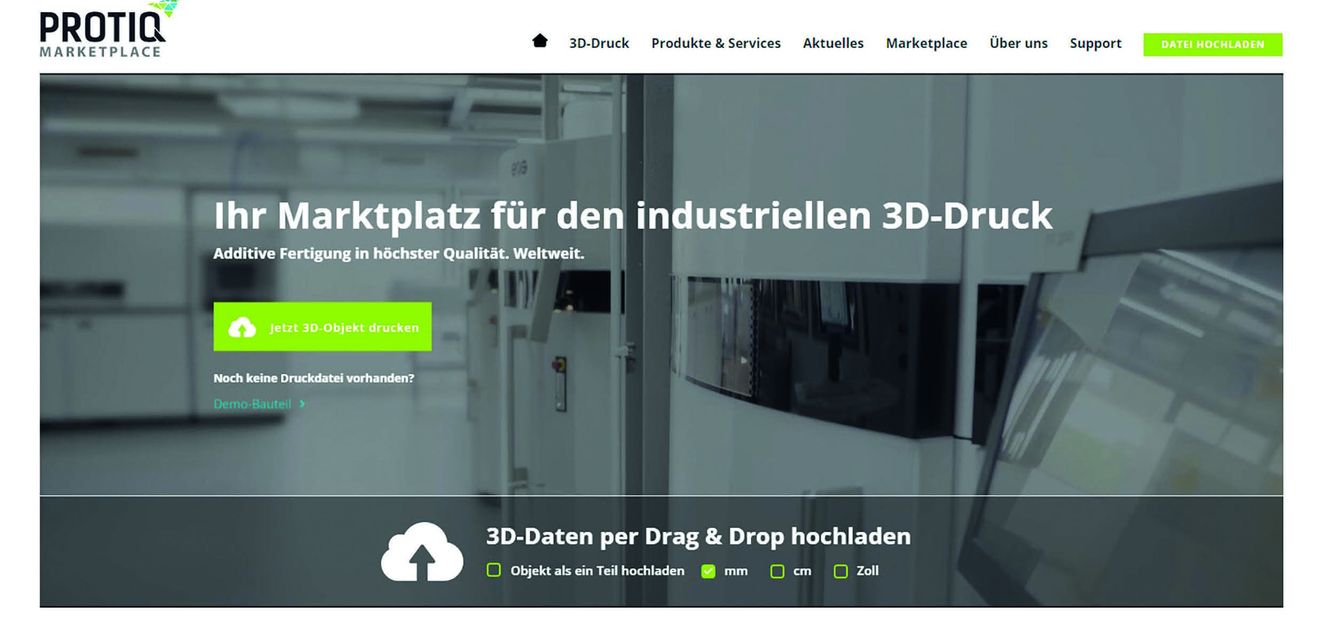
There are now numerous online platforms that offer the 3D printing of components. The Protiq Marketplace offers various functions - for example, manufacturing processes and materials as well as component visualization.
Additive manufacturing technology has already been integrated into production processes in many industries. Thanks to developments in recent years, the 3D printing process and material portfolio includes numerous possibilities, meaning that direct series production can be implemented in addition to traditional prototyping. Industrial processes can be used, for example, to additively manufacture high-strength metal components, series items made of plastic and components made of high-purity technical ceramics or quartz glass. What all 3D printing processes have in common is that the components are built up layer by layer without the need for a forming tool. This distinguishes the technology fundamentally from traditional industrial production processes such as CNC milling and turning, forming or casting. The layered structure enables the components to be produced directly from the 3D CAD data and opens up a high degree of design freedom in the production of complex geometries.
Focus on economic efficiency
For the user, additive manufacturing fits seamlessly into the existing processing portfolio alongside traditional processes and complements it with its special properties and advantages. The various 3D printing processes differ significantly. In terms of their properties and the materials that can be processed, the processes are differentiated from one another by the type of material structure and the material used. The economic efficiency of the respective production processes is also of great importance. Additive manufacturing must always be considered and evaluated in the context of traditional manufacturing processes. Only if an individual application with additive manufacturing processes proves to be economically advantageous compared to other production methods should they be used.
However, the options of 3D printing technology, the advantages of the corresponding process and the restrictions to be taken into account often differ from one another. At the same time, additive manufacturing is undergoing dynamic development, which is why new possibilities and potentials are opening up every year. Due to the high speed of innovation, however, it is becoming increasingly difficult for users to maintain an overview and to evaluate and fully exploit new options. This is where online platforms such as the Protiq Marketplace come to the rescue. It provides an interface for users and production service providers in the field of industrial 3D printing and brings the protagonists together in one place.
New processes and materials offer advantages
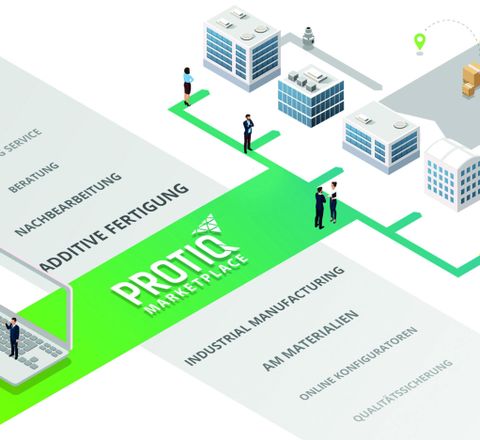
The Protiq Marketplace includes the offerings of more than 40 industrial manufacturing service providers for 3D printing and traditional manufacturing processes. The eponymous Protiq GmbH also appears as a service provider on the online platform with its own extensive production capacities and in-depth process expertise. This gives users access to the breadth of additive manufacturing technology that a single company cannot cover. On the one hand, the marketplace offers valuable information on the right choice of materials and processes. On the other hand, ongoing innovations can be presented through the extensive range of services offered by 3D printing service providers and thus made accessible to users.
The Protiq Marketplace range includes both established, widely used industrial manufacturing processes - such as selective laser sintering (SLS), selective metal laser melting (SLM) and stereolithography (SLA) - as well as innovative new developments. The latter provide users with numerous advantages thanks to the new processes and materials, but initially tend to serve niche markets and have not yet achieved widespread recognition. Innovations in the field of resin-based stereolithography, for example, which is generally known for its high precision and brittle material properties, enable the production of tough and resistant components. The methods of hot lithography and carbon digital light synthesis (CLIP) produce ESD-compliant or flame-retardant components in injection molding quality. The Micro-SLM process and Lithography Metal Manufacturing (LMM) can be used to produce highly detailed filigree stainless steel and silver components. New material developments in metal laser melting enable the processing of high-strength 440C knife steel, pure copper or the series material Zamak 5 (zinc).
Users retain control over their data
In order to find the right material and the right process for the application, users can access an interactive material database on the Protiq Marketplace. The decision-support tool is equipped with intelligent filter and sorting functions for technical specifications, such as wall thickness, transparency or tensile strength, and provides in-depth information on the respective processes and materials.
The online marketplace is specifically geared towards the quality requirements and needs of industrial users. In contrast to comparable platforms, the focus is particularly on transparency and data security. After uploading the 3D CAD data to be produced, the user is given the opportunity to compare the different processes, materials and production service providers on the basis of an automatically generated price calculation. A direct quantity-dependent comparison of the production processes provides assistance with the final order placement. The uploaded production data is stored on the company's own servers in Germany; users retain control over which service provider is awarded the contract on the marketplace. A star rating system with reviews provides additional support when selecting an available manufacturing partner.
Components are displayed realistically
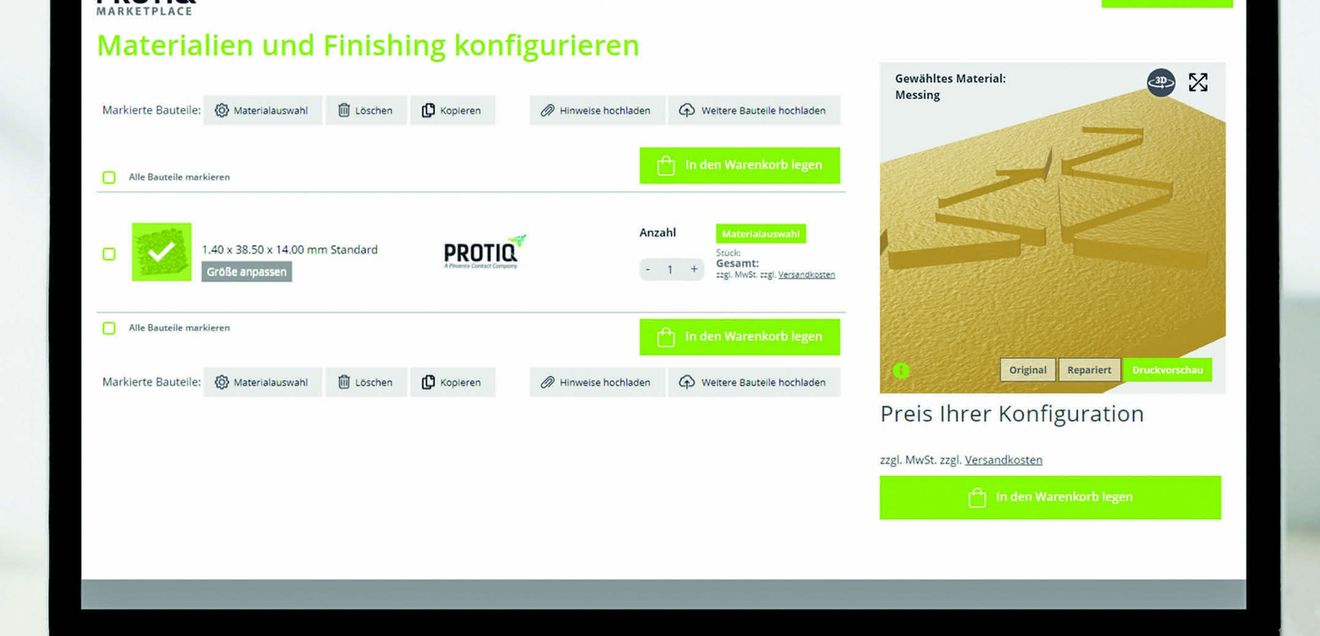
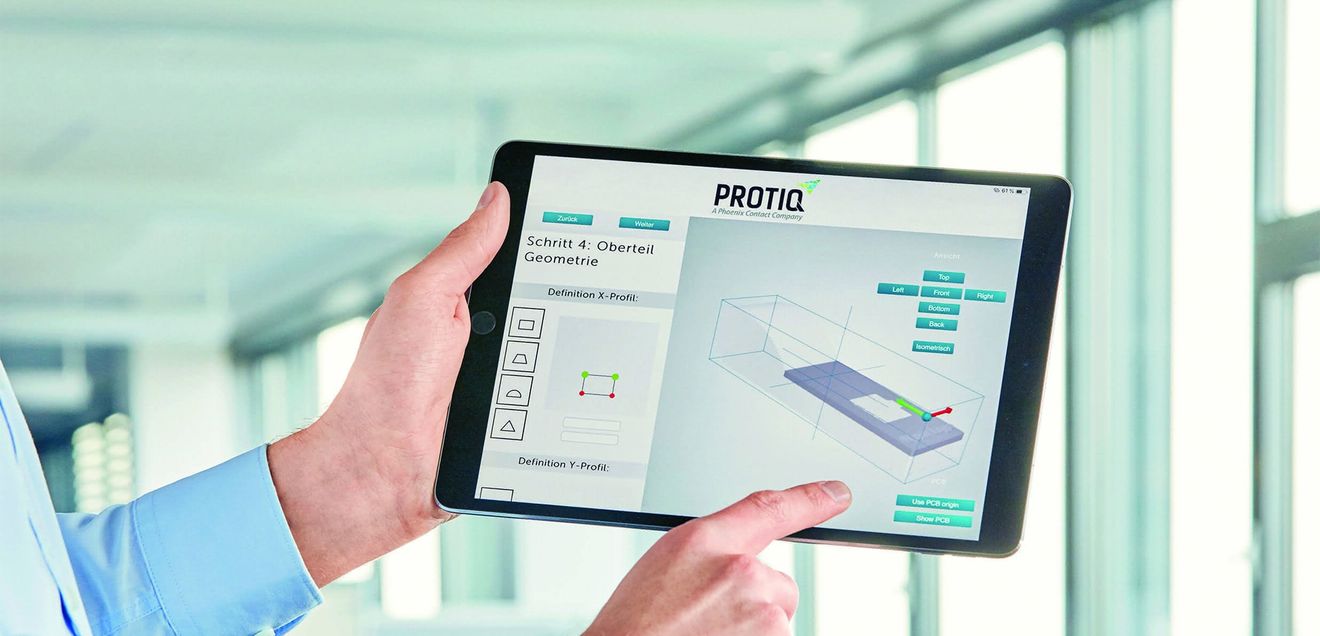
In addition to the fully digitalized process chain for creating quotations and placing orders, the online platform offers users further benefits and support. For example, frequently recurring components such as copper coils, gear wheels or ICS housing covers can be generated in interactive product configurators and adapted to individual requirements. A newly developed component visualization feature also sets Protiq Marketplace apart from other online service providers. With this function, the uploaded 3D components are displayed interactively and realistically. Users can therefore see in real time how their products will look when different materials and manufacturing processes are used. The component visualization enables adaptations in color and texture that correspond to the selected manufacturing options. In this way, users get a more accurate idea of the final product and are supported in their decision-making alongside the options in the interactive material database.
Placing the order directly via the online platform only takes a few minutes. To meet the requirements of large industrial users with established traditional purchasing processes, Protiq offers the option of an individually programmed API interface or ordering via a proven e-procurement provider such as Meplato, MyProcure or SAP Ariba. The company also aims to impress with expert personal advice.


You might also be interested in
UltiMaker Doubles Speed in Industrial 3D Printing
With the Factor 4 Plus, UltiMaker is introducing a new version of its industrial desktop 3D printing platform, which operates at up to twice the print speed of the standard model. The platform is designed for use in manufacturing and defense...
 read more...
Stratasys takes over MarkForged
Stratasys is acquiring MarkForged from Nano Dimension for USD 42.5 million, thereby expanding its portfolio in the field of fiber-reinforced composites. The acquisition also strengthens the company's software and materials expertise in industrial 3D...
read more...Timo Göbel, Head of BMW Additive Manufacturing
"Clearly on course for broad industrialization"
The BMW Group's Additive Manufacturing Campus (AMC) is setting the course for the next stage of industrialization. Under the leadership of Timo Göbel, additive manufacturing is being further integrated into all stages of the vehicle life cycle. In...
read more...Real-time control to make recycling materials economical
The Fraunhofer IAPT is researching AI-based closed-loop processes for industrial 3D printing with recycled plastics. The aim is to achieve less waste, greater process stability and profitable printer farms.
read more...Forum Solutions 4AMIndustry shows ways into industrial application
Additive manufacturing has developed dynamically in recent years and has long outgrown its status as a purely innovative technology in many industries. Nevertheless, companies still face the challenge of integrating AM into their production...
read more...Alliance aims to drive forward industrial 3D printing
Machine components, electrostatically shielded transport containers, large components for the automotive, rail and aviation industries or specific medical products straight from the printer - the potential applications of additive manufacturing are...
read more...Photonic microchips with 3D connector
How a 3D system makes photonic chips industrially viable
A research team from Heidelberg is developing a 3D-printed "connector" for photonic microchips. The solution promises a low-loss, standardized coupling of glass fibre and chip - and could fundamentally simplify the production of photonic integrated...
read more...Stratasys simplifies post-processing for 3D printing
Stratasys has launched a partner program for post-processing solutions to facilitate the creation of end-to-end AM workflows. The first partner is PostProcess Technologies, whose automated systems for FDM, PolyJet, SLA and P3 can now be purchased...
read more...Formnext 2026 puts UK and key industries in the spotlight
Formnext 2026 will focus on the United Kingdom as the official partner country. At the same time, the leading trade fair for additive manufacturing is further expanding its involvement in key user industries, including orthopaedics, aerospace and...
read more...