

3D printing
AI in production
The introduction of artificial intelligence sometimes fails due to a lack of qualified specialists or investment costs. However, AI has advantages in many areas that relieve the burden on skilled workers and make the use of AI profitable for companies.
Artificial intelligence has evolved from a futuristic concept to a driving force behind numerous innovations and efficiency improvements in production. The World Economic Forum predicts that the market for AI in manufacturing is expected to grow to around €19.3 billion by 2028. While other countries are already making considerable progress in the use of AI technology in the manufacturing sector, German companies are still mostly at the beginning of this development. This raises the question: What hurdles need to be overcome in order to master AI implementation and thereby realize innovative strength for manufacturing companies and within construction?
One of the main reasons for the lack of integration of AI in manufacturing is the continued strong focus on traditional strategies and methods, which are deeply rooted in many German companies. Another key factor is the significant shortage of skilled workers and expertise in the field of AI. Training and recruiting specialists with the necessary skills and knowledge is time-consuming and costly. Many companies are therefore competing with each other to attract the best talent on the one hand and to retain it in the long term on the other.
However, the high investment costs are also a reason for shying away from AI: the implementation of AI not only requires the purchase of hardware and software, but also extensive training and the adaptation of existing systems and processes. At the same time, there is a fear that AI projects may not make it past the pilot phase or may not have the desired effect, which is why people are reluctant to make such investments.
Potential and benefits of AI in production
AI-based systems can take over repetitive and time-consuming tasks, leading to significant time savings on the one hand and increased productivity on the other, as automation allows skilled workers to focus on more complex activities that require creativity and strategic thinking, for example. Another key advantage of AI is real-time monitoring and quality control, which is becoming increasingly important, especially in a manufacturing context. AI systems can continuously monitor production processes and immediately detect deviations from quality standards. This leads to a significant improvement in product quality, as errors can be identified and corrected at an early stage before they affect the entire production process.
In the automotive industry, for example, AI is used for the predictive maintenance of machines, which increases operational efficiency and reduces downtime. In the electronics industry, AI-based quality control systems help to ensure production quality and minimize errors. These examples show that AI not only offers theoretical advantages, but also enables significant improvements and efficiency gains in practice.
Key findings from artificial innovation
When it comes to the term AI, a distinction should be made between "everyday AI" and "artificial innovation". The term "everyday AI" refers to the use of AI to optimize everyday business processes. Examples include the automation of routine tasks, the analysis of large amounts of data for decision-making and the implementation of AI-driven quality control systems.
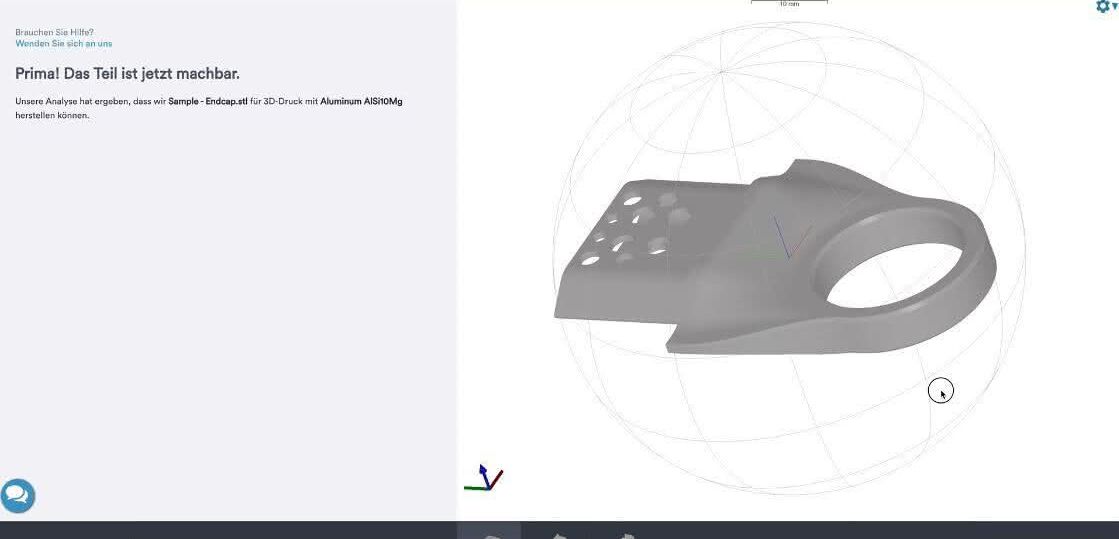
The field of artificial innovation, on the other hand, is the lever that will lead manufacturers from pure efficiency improvements to groundbreaking new ideas. Artificial innovation means that companies not only optimize existing processes, but also develop new business models and products that would not be possible without the use of AI. This includes opening up new markets, developing innovative products and services and improving competitiveness. Artificial innovation therefore uses artificial intelligence to expand innovative capacity and find solutions to problems. One example of artificial innovation is the digital manufacturing company Protolabs. One such example is Protolabs' automatic quotation system. As part of this system, the AI analyzes CAD files uploaded by customers and uses them to quickly and accurately create quotations for customer-specific parts. The process significantly speeds up quotation processing and increases the accuracy of quotations - which in turn strengthens customer loyalty.
Protolabs also uses AI in design-for-manufacturability (DFM) analysis. In this process, algorithms are used to identify potential problems in the design before production begins. This predictive feasibility analysis makes it possible to detect and correct design errors at an early stage, leading to a significant improvement in product quality. At the same time, production problems are avoided, reducing production costs and increasing efficiency. Through these innovative applications, Protolabs demonstrates how companies can not only optimize their internal processes through the targeted use of AI technologies, but also offer their customers better service and higher quality.
A look into the future
One thing is clear: AI will continue to play a transformative role in the manufacturing industry. It's fair to say that AI is well on its way to becoming an essential business tool. Future developments could include the integration of AI with technologies such as the Internet of Things (IoT) and augmented reality (AR) to create intelligent and connected manufacturing systems. However, the evidence so far shows that there are still fundamental misconceptions about how to best harness the potential of AI in an industrial setting. There is a need for sufficient expertise in this area, trained specialists and a clear strategy - is everyday AI the goal or artificial innovation?


You might also be interested in
UltiMaker Doubles Speed in Industrial 3D Printing
With the Factor 4 Plus, UltiMaker is introducing a new version of its industrial desktop 3D printing platform, which operates at up to twice the print speed of the standard model. The platform is designed for use in manufacturing and defense...
 read more...
Stratasys takes over MarkForged
Stratasys is acquiring MarkForged from Nano Dimension for USD 42.5 million, thereby expanding its portfolio in the field of fiber-reinforced composites. The acquisition also strengthens the company's software and materials expertise in industrial 3D...
read more...Timo Göbel, Head of BMW Additive Manufacturing
"Clearly on course for broad industrialization"
The BMW Group's Additive Manufacturing Campus (AMC) is setting the course for the next stage of industrialization. Under the leadership of Timo Göbel, additive manufacturing is being further integrated into all stages of the vehicle life cycle. In...
read more...Real-time control to make recycling materials economical
The Fraunhofer IAPT is researching AI-based closed-loop processes for industrial 3D printing with recycled plastics. The aim is to achieve less waste, greater process stability and profitable printer farms.
read more...Forum Solutions 4AMIndustry shows ways into industrial application
Additive manufacturing has developed dynamically in recent years and has long outgrown its status as a purely innovative technology in many industries. Nevertheless, companies still face the challenge of integrating AM into their production...
read more...Alliance aims to drive forward industrial 3D printing
Machine components, electrostatically shielded transport containers, large components for the automotive, rail and aviation industries or specific medical products straight from the printer - the potential applications of additive manufacturing are...
read more...Photonic microchips with 3D connector
How a 3D system makes photonic chips industrially viable
A research team from Heidelberg is developing a 3D-printed "connector" for photonic microchips. The solution promises a low-loss, standardized coupling of glass fibre and chip - and could fundamentally simplify the production of photonic integrated...
read more...Stratasys simplifies post-processing for 3D printing
Stratasys has launched a partner program for post-processing solutions to facilitate the creation of end-to-end AM workflows. The first partner is PostProcess Technologies, whose automated systems for FDM, PolyJet, SLA and P3 can now be purchased...
read more...Formnext 2026 puts UK and key industries in the spotlight
Formnext 2026 will focus on the United Kingdom as the official partner country. At the same time, the leading trade fair for additive manufacturing is further expanding its involvement in key user industries, including orthopaedics, aerospace and...
read more...