

AI-based image analysis
Handling and inspection of indexable inserts
For quality control and correct handling of indexable inserts, a manufacturer uses an automated system with AI-based image analysis that detects 99% of all manufacturing errors.

Indexable inserts are interchangeable cutting tools that are indispensable in various industrial applications, particularly in metalworking. They are used as cutting material carriers for cutting metals, plastics or wood. Their manufacture requires high-precision production processes to ensure exact geometry and perfect surface quality. Even minimal deviations affect not only the service life but also the performance of the cutting insert. The smallest defects, invisible to the human eye, can cause immense damage, for example when milling or cutting high-quality components - including consequential costs. Careful quality control is essential to ensure that only flawless inserts leave the production process and meet the high requirements in terms of durability and reliability.
A flagship project by automation and measurement technology specialist Xactools from Baden-Württemberg demonstrates how artificial intelligence can help visual inspection make quantum leaps. The Swabian medium-sized company has developed a fully automated handling and inspection system for Seco, a provider of machining solutions and manufacturer of indexable inserts based in Fagersta, Sweden, in which the Denknet solution for AI-based image evaluation plays a decisive role and sets new standards in terms of performance, zero-defect production and speed. Key factors for the successful implementation of such a project are the close cooperation of all those involved, their technical expertise and the team's high level of commitment. Martin Tobias Lithner, IIoT Manager and Data Scientist at Seco, played a central role in this. Together with Kyle Paulus, Sintering Engineer at Seco, he continuously drove the project forward from the conception phase onwards.
Detect defects at an early stage
Around 1.2 million indexable inserts leave Seco's production halls every week, which have to guarantee the highest possible process reliability and productivity in the metalworking, automotive and aerospace industries, for example.
They are manufactured using the sintering process, in which powdered metals, hard metals and other materials are pressed into the desired shape and then sintered, i.e. bonded together under heat and pressure. The strong and robust structure created in this way makes it possible to combine materials with different properties in order to achieve the desired cutting and wear resistance properties. After the sintering process, the edges of the indexable inserts are rounded and ground, and their surfaces are blasted, ground and coated.
The Robotvision system from the Swabian engineers is used directly after the second manufacturing step, the sintering process. "The earlier defects are detected in the process, the better and cheaper it is to rectify them," says Marvin Krebs, Managing Director at Xactools, explaining the position of the system. A total of eight high-resolution industrial cameras and two spider robots are used to handle and inspect the indexable inserts for defects, which keep an eye on and load three rotary table nests and finally one pin pallet each. At the heart of the complex image processing system between cameras, robots and a multi-GPU computing rack is the AI from Denknet.
Training for correct recognition
As versatile as the areas of application of the small tool parts are, so varied are their properties and geometries. This manufacturer alone has around 2,800 products in its portfolio, which can be divided into almost one hundred geometry families. The task was to automate handling and defect inspection for all of these. "The first challenge results from the numerous color variations within the powder per pressing process," explains Marvin Krebs. "If certain parameters such as time, pressure or positioning vary, this leads to color or gloss level deviations or to a different distribution of so-called speckles on the surface, which is not a defect." The AI-based image evaluation software used had to be trained to correctly recognize the numerous possible colour deviations of the surfaces and evaluate them as "OK". On the other hand, the smallest irregularities such as cracks, scratches, inclusions or other anomalies must be recognized as such and classified as "Not OK". The inspection of metal surfaces is considered one of the highest arts of surface inspection, as their texture can be matt, shiny or even reflective. "The AI had to be extremely sensitive to variations and lighting conditions for this application," emphasizes Marvin Krebs.
However, in addition to the visual appearance, it is also about the insert geometry. Categories such as triangle, rectangle, rhombus or square can be found in countless variants due to the smallest deviations and are therefore divided into manageable sub-categories, so-called geometry families. Xactools made the pre-selection for training the meshes; almost one hundred geometry families were defined and then taught in by the manufacturer itself. What sounds like a laborious undertaking was completed surprisingly quickly. "No more than 20 to 30 images were needed to teach in each geometry family," recalls Marvin Krebs. The Denknet palletizing AI used for this purpose uses the Denknet segmentation and classification network. The customer itself trained the individual image analysis solution with the Denk Vision AI Hub. In just a few months, the AI was integrated into the production line and achieved almost perfectly reliable AI results for the metal components to be inspected right from the start. "Indexable inserts identified as defective are sorted out and grouped according to the size and position of the defect. The AI image analysis detects 99% of manufacturing defects," emphasizes Daniel Routschka, Sales Manager Artificial Intelligence at IDS Imaging Development Systems.
How exactly does the system work?
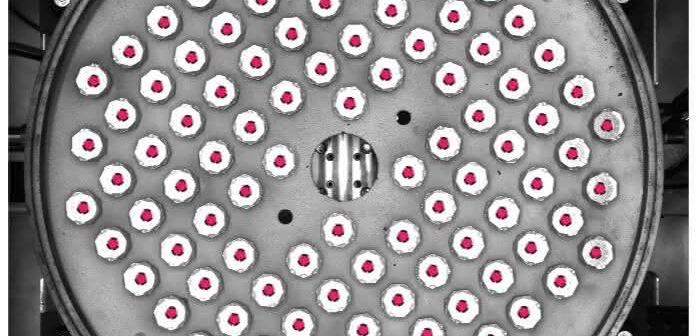
A total of eight cameras with a resolution of between 5 and 30 megapixels provide live images of the indexable inserts, which are positioned by magnetic or interchangeable grippers. For example, one camera captures the individual indexable inserts from below and one from above to check them for surface defects. Two further cameras inspect their cutting edge. A 1×1 m lighting screen ensures extremely high illumination at the palletizing points. "The system detects defects in the thousandth of a millimetre range," emphasizes Marvin Krebs. This ensures that no damage is caused to the high-end surfaces to be processed later. This is because "uneven and faulty milling processes can potentially impair profitability and competitiveness," says Martin Tobias Lither. "The main advantage of this solution is its ability to detect even the smallest errors and irregularities at an early stage of the process. Unlike humans, AI does not suffer from fatigue or inconsistency once it has been trained. This ensures that our inserts are inspected to the same high standard every time." This has a significant impact on competitiveness and will enable Seco to achieve a higher standard of quality, increase operational efficiency and realize significant cost savings in the future. "In essence, we have developed the ability to shorten innovation cycles, which enables us to bring improved products to market faster, giving us an edge over the competition," emphasizes Lithner.
The system can see exactly where and in which rotational position the indexable insert is positioned so that the magnetic gripper can finally place it on pin pallets. To ensure this, the gripper, to which the indexable insert is attached, moves over a camera that detects the exact position of the hole from below. At the same time, the contour of the insert and the outer edge of the gripper are recorded in order to correct the position of the indexable insert and hit the pin if necessary. In addition, each individual pin position is detected in order to recognize bent and broken pins so that they are not palletized in the first place. "The system has been running for six months and the self-learning, global AI now recognizes parts that it has never seen before. After just three to four months, it no longer had to be retrained to inspect new variants of indexable inserts. The underlying geometry is no longer relevant for the AI; it knows the contour and can also differentiate between IO and NOK (OK and not OK) for new parts," explains Marvin Krebs.
High-performance AI image analysis
The added value of the Denknet system compared to conventional image processing is obvious to Marvin Krebs: "Without AI, the creation of part families and defect detection would be completely unthinkable. With rule-based image processing, the robot would also recognize and sort out parts within the standard range as NOK." In addition, thanks to the Vision AI Hub, no hard coding is necessary, and the flexibility of the networks was another selection criterion for the intelligent Denknet software. "We were able to easily embed the Denknet palletizing AI and several object classes for defects into our own Xactools image processing software via an API," says Marvin Krebs.
The entire inspection process takes place in a cycle time of 4 seconds, with almost 100% picking efficiency. An enormous amount of computing power is required to evaluate live images from eight cameras via a DLL. "We work with Denknet for a reason. The performance is not comparable to that of other providers, it is truly excellent," emphasizes Marvin Krebs. "Using artificial intelligence in a wide range of variants on this scale has never been done before." Further variations are currently being tested, for example to further simplify bore detection.
Adaptable to any application
The extremely varied surfaces and geometries as well as intolerances in the thousandths of a millimeter range make the visual inspection of indexable inserts a supreme discipline that can be transferred to many other demanding applications. Denknet's self-explanatory training environment serves as a simple yet high-performance tool, as it can be operated without programming knowledge and enables automated training of the AI with just a few clicks. Various Vision AI technologies are available for this purpose. "This solution can be adapted to any use case and there are no limits - no matter how many 'classes', which camera technology, how large or small the images or even how mixed the data sets are in terms of resolution and type, for example," adds Daniel Routschka, Sales Manager Artificial Intelligence at IDS.
"Over 95% of our measuring and testing systems have at least one AI object class integrated. The potential areas of application are becoming ever larger for us and the market is growing," confirms Marvin Krebs. Promising prospects for this exemplary automated AI training for the highest demands.


You might also be interested in
"Image processing is evolving from a monitoring tool to an active production aid."
How Image Processing and Digital Worker Assistance Optimize Manufacturing Processes: In this interview, Michael Kunze, Managing Director of MKey Solution GmbH, explains how companies can reduce scrap, improve quality, and control processes in real...
 read more...
Process monitoring and fault detection
Cameras ensure quality during laser melting
Powder bed-based laser melting (PBF-LB/M) opens up new possibilities in additive manufacturing. Modern camera systems provide crucial process data to further increase quality and efficiency.
read more...Robots play on board the ISS
What sounds strange at first has an important background. The two robots 'Cimon' from the German Space Agency at the German Aerospace Center (DLR) and 'Int-Ball2' from the Japanese space agency JAXA on board the International Space Station ISS...
read more...Sensor solutions for industrial robotics
Security technology and image processing
At Automatica, Sick will be focusing on the wide range of solutions for functional safety and industrial image processing as well as digital approaches such as augmented reality and AI.
read more...Products of the year 2025: the competition starts again
The INDUSTRIAL Production Products of the Year are entering a new round. This year, our readers can vote in eight categories. We are also awarding a special prize.
read more...Hermes Award: The nominees have been announced
An independent jury chaired by Prof. Dr.-Ing. Holger Hanselka, President of the Fraunhofer-Gesellschaft, has nominated three companies for the Hermes Award from the numerous submissions: Bosch Rexroth, Schunk and Siemens.
read more...New product manager for MV-Tec Merlic
Ulf Schulmeyer brings momentum to the software
MV-Tec Software, international software manufacturer for industrial image processing, announces an important change in the Merlic team: Ulf Schulmeyer has taken over product management for the easy-to-use Merlic software.
read more...Focus on intelligent networking
At SPS 2023, everything at Balluff revolved around the topic of network technology. Industrial image processing and other solutions for the factory of the future were also on the agenda at the trade fair stand.
read more...Additional interfaces integrated
MVTec Software has launched a new version of its Merlic image processing software. In version 5.4, the focus has been placed on easier process integration.
read more...