

Founding project of the KIT
Green hydrogen directly from the sun and water
A start-up project at the Karlsruhe Institute of Technology (KIT) aims to fundamentally simplify the production of green hydrogen: Mass-produced photoreactor panels are to be used to produce hydrogen directly from sunlight and water - without electrolyzers, without electricity consumption and without a grid connection. The photreon system is designed for decentralized applications as well as for large plants in sunny regions. The project will be presented at the KIT stand (Hall 11, Stand B06) at the Hannover Messe (April 20-24, 2026).
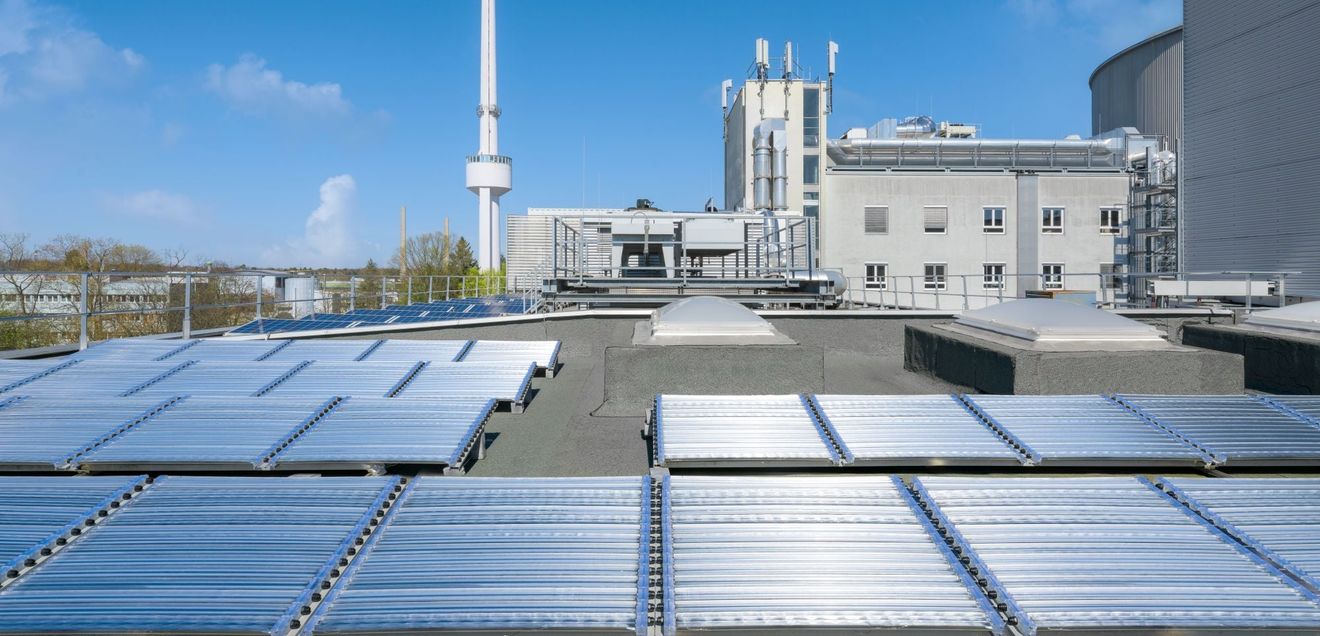
Green hydrogen is considered to be one of the key technologies for the climate-neutral transformation of industry and the energy system. However, its production has so far been expensive, technically complex and heavily tied to existing infrastructure. This is precisely where photreon comes in: The KIT spin-off is developing a photoreactor panel that produces hydrogen directly from sunlight and water - without electrolysis and without an electrical energy supply.
"We are skipping the detour via electricity-based electrolysis and producing chemical energy from the sun and water," says co-founder Paul Kant from the Institute of Micro Process Engineering (IMVT) at KIT. The aim is to use modular panels to make solar hydrogen production simpler and at the same time economically scalable.
Light as a direct driver of the reaction
Technically, the approach is based on photocatalysis. In contrast to photovoltaics, where light is first converted into electricity, solar energy is used directly to trigger chemical reactions. Special light-active materials absorb the energy of the radiation and put electrons into an excited state. These then enable the splitting of water (H₂O) into hydrogen (H₂) and oxygen (O₂).
"Photovoltaics and electrolyzers are replaced by the photoreactor panel in a single process step," says Maren Cordts from IMVT, who is also a co-founder, explaining the principle. "This significantly reduces system costs and complexity in the production of green hydrogen."
This is implemented using a photoreactor panel for which KIT has filed a patent application. Its geometry is designed in such a way that the sunlight is directed specifically into the interior, where it illuminates the active material evenly. "We designed the reactor geometry in such a way that light transport, chemical reaction and removal of the products interact optimally and were thus able to demonstrate hydrogen production in our one-square-meter prototype," says Kant.
The system is also designed for industrial production and can be manufactured using standard mass production processes and inexpensive materials. Thanks to its modular design, it can be used in small spaces as well as interconnected to form larger areas.
Use from the factory roof to the solar park
The technology is intended for applications in which hydrogen is currently too expensive or logistically difficult to obtain - for example in specialty chemicals, the food industry or metal processing. Large-scale solar projects in regions with high levels of solar radiation should also be possible.
"Our technology opens up new scope for local production, especially in places where there are neither electricity grids nor a connection to a hydrogen network," says Cordts. The spectrum ranges from the decentralized supply of individual production sites to industrial production for the international market.
Hannover Messe 2026, Hall 11, Stand B06


You might also be interested in
A quantum computer that performs calculations using oscillations
When it comes to storing information, quantum computers have so far run up against technical limitations. Instead of electromagnetic storage, researchers are now using mechanical vibrations. Their vibrating memory can store significantly more...
 read more...
Hydrogen Pipelines Put to the Test
New real-world lab tests safety and resilience
The Federal Institute for Materials Research and Testing (BAM) is opening a real-world laboratory to study pipelines and components for the safe operation of future hydrogen networks.
read more...Research Platform for the Energy Supply of the Future
For the first time, the Karlsruhe Institute of Technology (KIT) is bringing together key hydrogen technologies in a single research environment. The facility is intended to demonstrate how the production, storage, transport, and use of hydrogen can...
read more...When the quantum computer arrives
The Research Race to Ensure the Security of Critical Infrastructure
How can we protect our critical infrastructure from attacks by quantum computers in the future? As part of the QUEST project, Darmstadt University of Applied Sciences is researching new methods—post-quantum cryptography—designed to withstand even...
read more...VDE study on electrical engineering
More retirements than graduations
According to a VDE analysis, more than 30,000 electrical engineers will retire by 2029 without enough graduates to replace them. This is due to falling student numbers and high drop-out rates.
read more...Giving lightweight construction a profile
Pultrusion: A process that forms fibers under tension
Pultrusion is developing from a niche process into a key process for lightweight construction and sustainable fiber composite structures. The Fraunhofer IWU shows applications from energy to mobility.
read more...Fraunhofer shows industrial future between AI, data and new materials
At Hannover Messe 2026, the Fraunhofer-Gesellschaft will be presenting solutions for a resilient industry: from AI and data rooms to hydrogen technologies and material and recycling innovations.
read more...The bottleneck is in the system
Is the transformation of the industry failing due to "German Angst"?
A recent ISF study examines what is slowing down change in German industrial companies. According to the results of the study, the causes of innovation bottlenecks often lie in internal structures and a lack of strategic orientation.
read more...Why a data-secure Germany needs joint implementation
Is 2026 a key year for a data-secure and networked Germany? Michael Fritz from the Fraunhofer Cluster CCIT explains why the coming year will be crucial for secure data spaces, common technical standards and Germany's digital future.
read more...