

Green hydrogen
Is the way clear for mass-produced electrolyzers?
Green hydrogen is seen as a solution for industries that cannot simply be electrified: steelworks, chemical plants, heavy goods vehicles. Demand is high, supply is low. And the central technology, the electrolyzer, has so far been a product that is more likely to be produced in factories than in factories. The hydrogen flagship project "H2 Giga" aims to change this. Since 2021, universities, research institutes and companies have been working on bringing electrolysers into mass production. The Fraunhofer Institute for Manufacturing Engineering and Automation (Fraunhofer IPA) is involved in five sub-projects. Their results are now available.

Hydrogen production: the search for the missing molecule
Hydrogen is abundant, but rarely free. It is stuck in molecules such as water (H₂O) and must first be extracted - a task for electrolysers. They split water into hydrogen (H₂) and oxygen (O). The hydrogen obtained can power fuel cells or be replaced in blast furnaces. So far, however, such systems have been manufactured in Germany in small quantities and at high cost.
This is set to change. The "H2 Giga" flagship project has been researching production on a gigawatt scale since 2021. A goal that marks the transition from manufacturing to industrial production, so to speak.
Robots take over production of electrolyzers
Until now, electrolysers have mainly been assembled by hand. In Braak, Schleswig-Holstein, something has now been created that can be seen as the opposite: an automated production line.
In the "PEP.IN" sub-project, scientists have worked with industry to set up a system in which robots carry out stacking - the precise layering of electrodes and membranes.
"The robots need one second to place one component on top of the other," says Nicolas Mandry from Fraunhofer IPA.
One second - a speed that would be unattainable in manual work. The team developed the grippers themselves. Quality assurance is also carried out using cameras and image processing. They sort out what is faulty and tolerate what remains uncritical.
The result is a factory on a gigawatt scale.
"The electrolysers produced here within a year therefore have an accumulated nominal output of at least one gigawatt - a multiple of what was achieved when electrolysers were still manufactured using a lot of manual labor,"
says Mandry.
Digital twin: a digital image
Industrialization needs an overview. In the FRHY sub-project, researchers are therefore working on a networked production IT system that collects data from all production modules in real time - a digital twin that makes errors visible and enables optimization.
But despite all the ambition, not everything stayed on schedule.
"Shortly before the end of the research project, not all of the production facilities, which are spread across a total of five Fraunhofer Institutes, have been completed or put into operation,"
says Henry Himmelstoß.
Supply bottlenecks have delayed the construction. For the time being, emulators are simulating what machines will later take over. It looks like a makeshift solution - but one that nurtures hope for a follow-up project.
Iridium: The scarce element
Few details demonstrate the technology's dependence on global raw materials markets as clearly as the anode of PEM electrolysers. It is coated with iridium, one of the rarest elements of all. Around 0.67 grams are required per kilowatt.
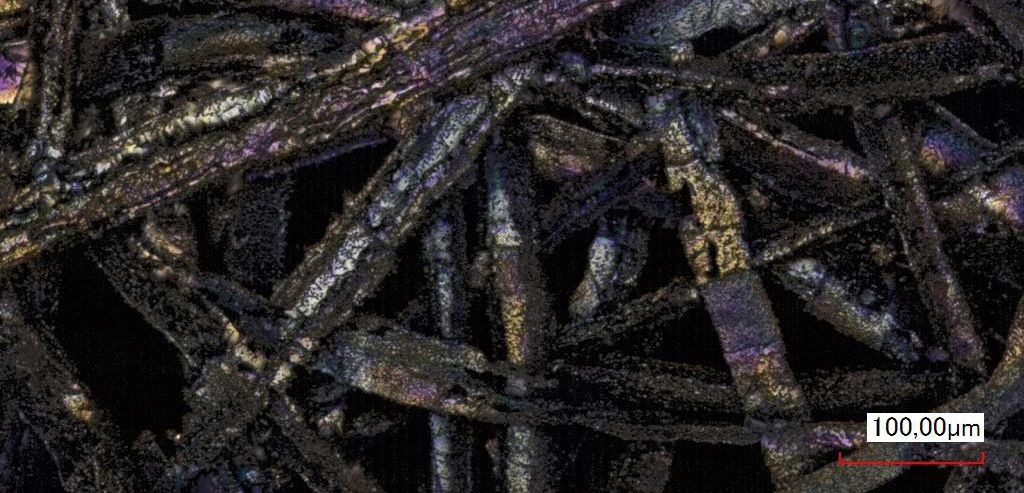
In the "IREKA" sub-project, a team led by Stefan Kölle looked for ways to reduce this demand.
The first idea was to apply iridium only where it is effective - on the surface. The team used electroplating technology to create extremely thin layers.
"Only the material directly on the surface is actively involved in the splitting of water,"
says Kölle.
It won't work without a circular economy
The function is proven. The question of long-term stability remains open.
The second option: alloys. Nickel is ruled out as a partner as it dissolves too quickly. Tin and ruthenium, on the other hand, work - but ruthenium is itself a precious metal.
"There are currently no precious metal-free PEM electrolysers in sight,"
Kölle summarizes. The consequence is obvious: it won't work without a circular economy.
Simulations at the limits of what is possible
In the "DEGRAD-EL3-Q" project, the research team is looking deeper into the matter - literally. It is about the behavior of materials during electrolysis. Traditional simulations are reaching their limits.
"Before you spend money on sometimes expensive raw materials, you should use a computer simulation to clarify how the materials behave during electrolysis,"
says Jan Schnabel.
In the long term, quantum computing could help us understand materials down to the molecular level. It is still a dream of the future, but the researchers have gained important insights into suitable algorithms. On the classical side, they developed a machine learning model that can predict the degradation behavior of electrolyzers. A step towards better service life models.
Automatically and sensibly recycle electrolyzers and fuel cells
If electrolysers and fuel cells are to be built by the millions in the future, it must also be possible to recycle them - automatically and economically. In the "ReNaRe" sub-project, a team led by Anwar Al Assadi developed a robot-assisted approach for this.
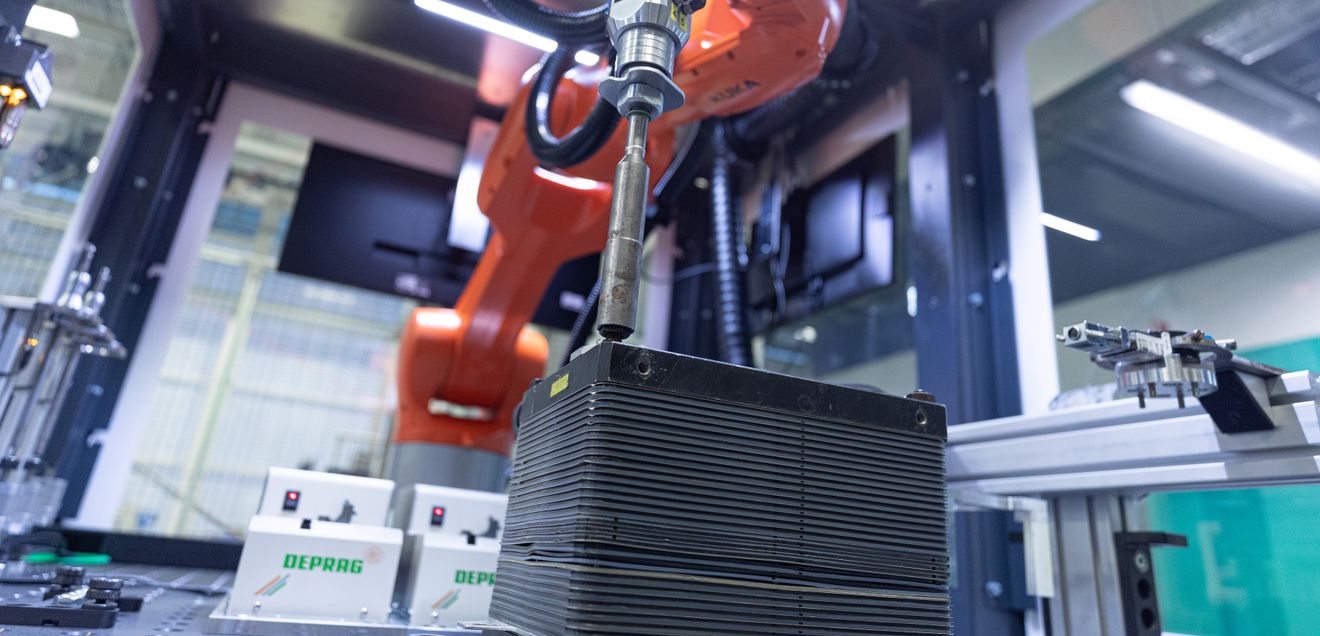
An initial analysis showed that stacks vary greatly and their status depends on how long they have been in use. This makes automation more difficult.
The team identified processes that can be adapted and developed robot skills that can be used to handle stacks and loosen screw connections. A reinforcement learning agent is used to ensure that the robot grips reliably despite inaccuracies.
At the same time, a digital twin was created that maps different stack designs and enables energy-optimized dismantling processes - a building block of a future circular economy.


You might also be interested in
A quantum computer that performs calculations using oscillations
When it comes to storing information, quantum computers have so far run up against technical limitations. Instead of electromagnetic storage, researchers are now using mechanical vibrations. Their vibrating memory can store significantly more...
 read more...
Digital twin in battery production
Faster to more powerful batteries
The battery factory of the future is increasingly working digitally: simulations accompany the development of new cells, and intelligent sensors monitor production in real time. Researchers at the Fraunhofer Institute for Industrial Mathematics ITWM...
read more...6 Criteria for the objective comparison of humanoid robots in industry
A new benchmark from Fraunhofer IPA is intended to enable the first standardized and neutral analysis of humanoid robots for industrial use based on six key criteria.
read more...Giving lightweight construction a profile
Pultrusion: A process that forms fibers under tension
Pultrusion is developing from a niche process into a key process for lightweight construction and sustainable fiber composite structures. The Fraunhofer IWU shows applications from energy to mobility.
read more...Automated restoration of windows from old buildings
The Chair of Production Systems at Ruhr University Bochum is working with the company Kilivations to develop a robot-based process for the restoration of windows potentially contaminated with asbestos in old and listed buildings. The aim is to make...
read more...New location in Leipzig for defense and security research
The Fraunhofer FKIE is opening a new site for defense and security research in Leipzig. The focus is on cyber security, resilience and industrial innovation.
read more...Development of self-adaptive industrial robots
Intelligent robotics on the way to industrial applications
The EU-funded "RoboSAPIENS" project aims to develop self-adaptive industrial robots for safe human-robot collaboration. Initial results from the Fraunhofer IFF show successful tests with digital twins in real production environments.
read more...Europe is increasingly losing touch in chip research
The research and development of semiconductor technologies is increasingly taking place outside Europe, particularly in Asia. This is shown by evaluations of semiconductor patents by EconPol Europe.
read more...Why a data-secure Germany needs joint implementation
Is 2026 a key year for a data-secure and networked Germany? Michael Fritz from the Fraunhofer Cluster CCIT explains why the coming year will be crucial for secure data spaces, common technical standards and Germany's digital future.
read more...