

Future technologies for the industry
AI transforms simulation processes
With the constant development of future technologies such as simulation and artificial intelligence (AI), there is growing pressure on companies to optimize their own products and processes in order to gain a competitive advantage.
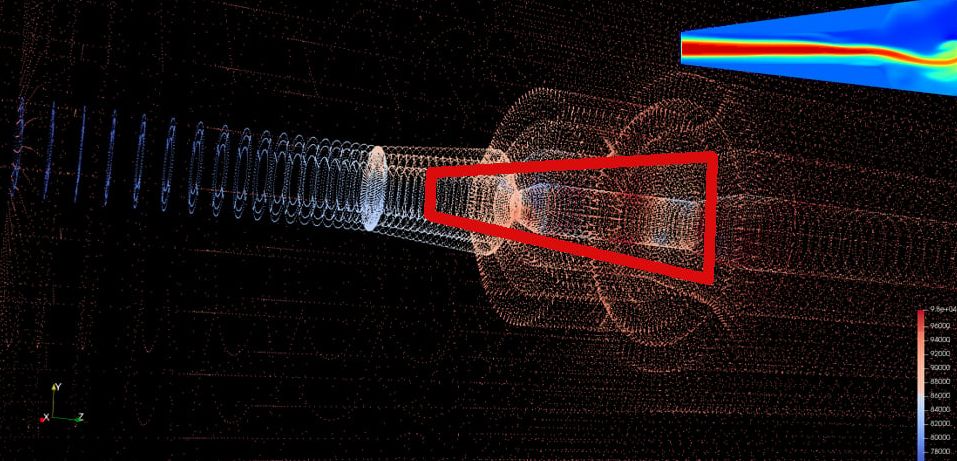
What is already common practice for large companies is often still a major challenge for small and medium-sized enterprises (SMEs) because: There is often a lack of personnel with the necessary know-how or access to sufficiently powerful computers. The company Falquez, Pantle and Pritz from Karlsruhe shows how great success can be achieved with its nuberisim2ai project. With the support of the Smart Data Innovation Lab (SDIL), the small engineering firm managed to significantly increase the efficiency of 3D simulations and the resulting noise developments with the help of AI.
But right from the start: As a specialist in computational fluid dynamics (CFD) and computational aeroacoustics (CAA), Falquez, Pantle and Pritz supports and advises companies in the product development of flow-carrying devices - such as turbines, vehicles or pipelines. CAA is a technology that is particularly time and energy intensive. High-resolution and in 3D, flow-acoustic simulation technology typically takes up to 14 days, despite parallelization on high-performance computers. The huge amounts of data and their complexity push even modern computers and special AI hardware (such as powerful graphics processors, GPUs) to their limits. Research is also predominantly "only" concerned with "smaller", two-dimensional cases.
The aim of Falquez, Pantle and Pritz was therefore to pioneer 3D simulations and shorten the simulation time there. AI jumped out at them as a promising technology, but as a small company, the engineering firm had neither the resources nor the knowledge to use it for the application and therefore applied for a tender from SDIL.
Research meets practice: the brains behind the project
The SDIL was founded in 2014 with funding from the Federal Ministry of Education and Research (BMBF) as a "data clean room" at the Karlsruhe Institute of Technology (KIT). The SDIL's practice partners from research and industry offer companies access to modern AI methodology and infrastructure, helping them to drive innovation faster. On the research side, the KIT, the German Research Center for Artificial Intelligence (DFKI), the Fraunhofer Institute for Intelligent Analysis and Information Systems IAIS and Forschungszentrum Jülich are available to companies as sparring partners for projects. On the industry side, IBM Germany, SAP and Software AG are also available as providers, while Sicos BW GmbH acts as a link between research and industry. For selected projects, the SDIL regularly advertised so-called micro-projects, meaning that companies could apply for these and benefit from collaboration free of charge. In the case of Falquez, Pantle and Pritz, the KIT provided support with experts as well as physical and AI-based models to update the time series of a 3D flow simulation in high quality.
Reduce computing time with AI forecasts
Time series of the 3D simulation of a generic vacuum nozzle of varying quality served as the use case. In the course of the project, it ultimately became clear that an AI has different requirements for simulation data than engineers. Together with the KIT, Falquez, Pantle and Pritz therefore developed a strategy to prepare the data from simulations in such a way that it can be better used by the AI.
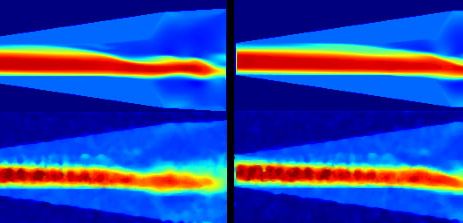
In addition, the team was able to identify the best possible AI method out of several in order to expand a time series of 100 3D data sets to at least 120 - while maintaining the same high quality. This makes a significant contribution to shortening the computing time of the CAA simulation. From the outset, the experts also attached great importance to the fact that the AI-supported software can be applied to a wide variety of flow-through or flow-around objects, because: Every project brings new geometries with it. Vehicle manufacturers can therefore benefit from the new method just as much as turbine or pipe manufacturers.
Projects to promote future technologies
The nuberisim2ai project is just one of numerous successful projects that SDIL has supported and driven forward. The aim has always been for companies to recognize the potential of modern future technologies for themselves, to integrate them meaningfully into their own day-to-day business and thus secure their competitiveness in the long term. This applies to both large companies and SMEs; the latter in particular are often unaware of their potential or shy away from the subject matter from the outset.
Sicos BW therefore supports SMEs in particular. The organization provides neutral and - for companies from Baden-Württemberg - free referrals to suitable partners such as the SDIL or, most recently, the RescHKI. With "RescHKI - Resource Efficiency with HPC and AI", funded by the Baden-Württemberg Ministry of the Environment, Climate Protection and the Energy Sector, Sicos BW is now also focusing on resource intelligence. The aim of the project is to pave a sustainable way for SMEs in particular, but also large companies and institutions (such as public administration), to increase resource efficiency; this is achieved through the use of simulations and high-performance computing (HPC) as well as data analytics and AI. In order to show companies that resource intelligence works in practice and quickly leads to savings in resource consumption, RescHKI has also announced three pilot projects with funding. Interested parties can find further information at: reschki.de
Falquez, Pantle and Pritz are showing what other companies should emulate: using the latest technology to leverage previously unimagined potential in order to stop giving away competitive advantages - at best in favor of sustainability. After all, this is also becoming an increasingly relevant success factor for companies. They should therefore set the key course for the future now - whether with external support or under their own steam.
Dr. Andreas Wierse, Managing Director Sicos BW


You might also be interested in
Intuitive CNC HMIs with simulation functionality
With CNC HMI Base (TF5310) and CNC HMI Simulation Server (TF5320), the TwinCAT 3 automation software from Beckhoff offers two new function libraries for CNC-specific user interfaces, which can be used to create a modern, intuitive HMI application...
 read more...
Flexible and efficient processing
New high-performance CNC series
Fanuc's presentation at EMO will focus on the new FS500i-A CNC series. The new CNC generation offers high user-friendliness, process optimization as well as digital and network technologies.
read more...Florence Verzelen becomes Executive Vice President for EMEA
Dassault Systèmes has appointed Florence Verzelen as Executive Vice President for Europe, Middle East and Africa (EMEA). She will report directly to Pascal Daloz, CEO of Dassault Systèmes.
read more...StarterSET compact and digital twin
Realize compact machines quickly
By simulating and testing applications before they are physically implemented, errors can be detected at an early stage. The packaging machine that SEW-Eurodrive is presenting at Automatica also underwent virtual commissioning using a digital twin.
read more...Leo AI and Core Technology integrate AI analysis into CAD engineering
The AI platform Leo AI and the software provider Core Technologie are cooperating to automatically evaluate CAD data using artificial intelligence. The integration of the SDK 3D_Kernel_IO enables AI-supported analyses of technical data from over 40...
read more...Digital solutions for higher development speed
The demand for fast development and manufacturing processes makes it necessary to obtain design feedback even before the first physical prototypes are created.
read more...Floating hybrid actuator increases precision in guideways
For large machine tools with a large working area, the challenge is to maintain the shape tolerance of the guideway over the entire length of the guideway in order to achieve precision throughout the entire working area.
read more...Simulation and industrial software
Billion-euro deal: Siemens takes over Altair
Siemens wants to strengthen its software business with a billion-dollar takeover. The Munich-based company intends to take over the US company Altair Engineering for around 10 billion US dollars (around 9.2 billion euros), as Siemens announced.
read more...Combi for effortless commissioning
The idea of hybrid commissioning can be seen as a logical step after virtual commissioning. The Institute for Control Engineering of Machine Tools and Production Facilities at the University of Stuttgart is working on such a concept.
read more...