

Sustainability approach
Sustainability along the robot life cycle
Automation through the use of robots offers numerous advantages. One is often overlooked: Robots can make a valuable contribution to sustainability, for example by helping to reduce emissions. However, this requires the entire robot life cycle to be designed for sustainability. But what does a holistic approach to sustainability in robotics look like?
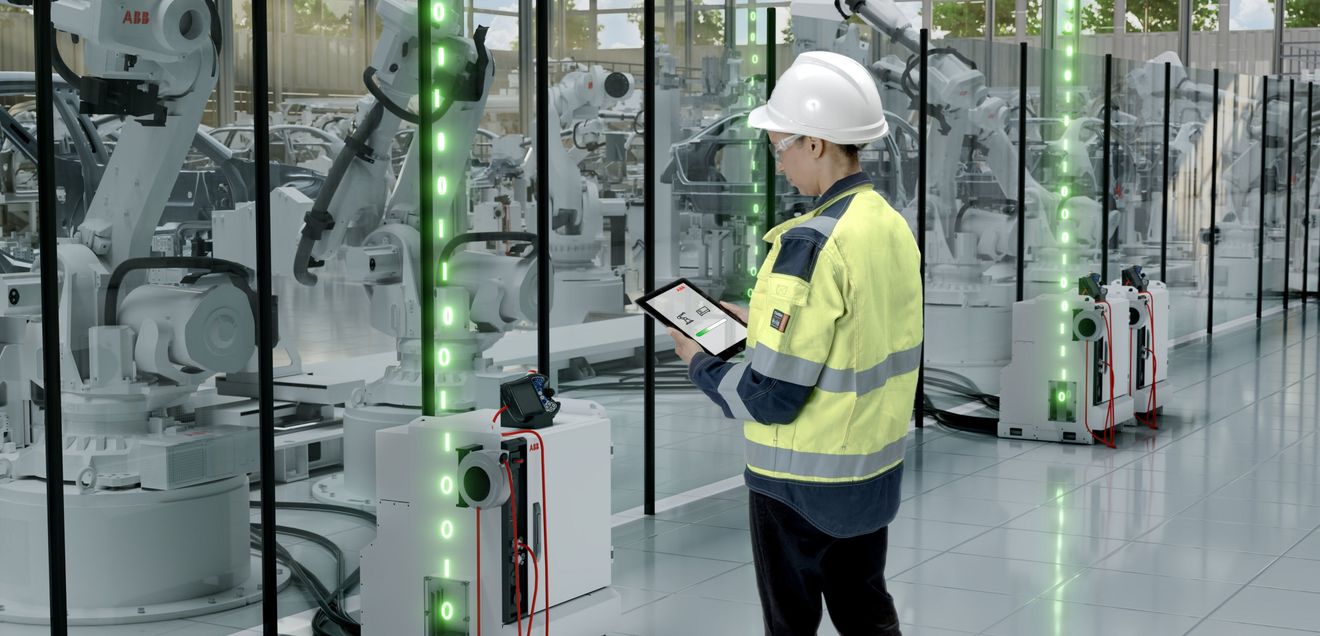
Automation solutions must also be as sustainable as possible in order to reduce the ecological footprint and contribute to achieving sustainability goals. Robots are a prime example of this. But they do not only make an important contribution during use. The entire life cycle, from development to reuse or disposal, plays a role in sustainability.
ABB's holistic approach ensures that every robot is sustainable in all phases of its life cycle. Attention is already paid to the selection of environmentally friendly materials and energy-efficient manufacturing processes during robot production. ABB robots are designed to be highly efficient in operation, helping to conserve resources, avoid breakdowns and reduce waste. They also support the manufacture of sustainable products through precise automation and intelligent control. Sustainable robots help to drive forward an environmentally friendly and future-proof production landscape. To ensure that a product contributes to greater sustainability throughout its entire life cycle, manufacturers must make smart decisions as early as the design and development phase. There are a number of starting points for this in robotics. One of these is reducing weight. A lighter robot contains less material, which saves resources. The reduced weight also has a positive effect on transportation and subsequent energy costs.
Efficient and automated
Increased efficiency and the higher quality that comes with the use of robots also mean fewer rejects and therefore lower resource consumption. By identifying robots that are subject to heavy wear, maintenance work can also be planned preventively and carried out on a condition basis, which significantly extends the service life of the robots. 93% of respondents to the 2024 ABB Energy Efficiency Movement report said they would invest in improving energy efficiency over the next three years to reduce costs and make progress towards more sustainable operations. Determining energy efficiency is a complex task that involves measuring multiple electrical components. It is also difficult to assess the impact of factors such as inefficient equipment, component size, overloading and application changes that can lead to changes in a robot's initial performance. ABB Robotics offers an energy efficiency service consisting of consulting, analysis procedures and tools to increase the energy efficiency of installed robots. The service enables energy savings of up to 30 %.
Intelligent energy management also increases energy efficiency. The new OmniCore robot controller from ABB, which will be launched in 2024, uses the energy released during braking and feeds it back into the system. Compared to the previous controller, OmniCore enables up to 25% faster robot operation and 20% lower energy consumption. The new Automatic Path Planning function in RobotStudio, the offline programming and simulation software for ABB robots, additionally reduces energy consumption by up to 10 to 15 % - while at the same time reducing the cycle time by up to 50 %. The tool minimizes the offline programming of robot movements to just a few clicks and delivers movements that are superior in several areas, even to programs created by robotics experts. The robot is simply told what to do, whereupon it translates the instructions into the optimal movements for its capabilities and the environmental conditions.
Robots in action for a more sustainable future
Robots are predestined when it comes to manufacturing sustainable products. For example, customers of Kiefel Technologies, a specialist in thermoforming and joining technologies, enjoy flexibility in the production of sustainable packaging from common fibers used in paper production and other natural fibers thanks to the integration of ABB robots. An ABB robot is working directly for the environment in the Amazon. Here, the US non-profit organization Junglekeepers uses an ABB YuMi cobot powered by solar energy for the automated planting of seeds. The cobot takes over this repetitive task to relieve employees - thanks to cloud technology and remote control.
Even sectors that are currently still less automated benefit from the sustainable use of robotics. This is the case in the construction industry, for example, where new solutions are needed that enable sustainable and cost-effective construction. Robot-assisted automation can also help to improve quality and consistency in order to reduce construction waste. By using automation - for example in the prefabrication of entire building modules on the factory floor using robot-assisted 3D printing processes - and digital solutions, construction companies can make their design and manufacturing processes more effective and avoid construction waste right from the start of the project. Prefabrication reduces material consumption by 25 %. Robotics in the design process is also suitable for using raw materials such as glass, cement and steel more efficiently, thereby reducing thecarbon footprint of buildings.
Robotics also helps with sustainability in automotive production. ABB's PixelPaint technology, for example, eliminates the need for masking the car body during two-color painting and prevents paint mist. With the innovative inkjet head, no paint is wasted and productivity is accelerated by halving the painting time.
Repair, refurbish, recycle
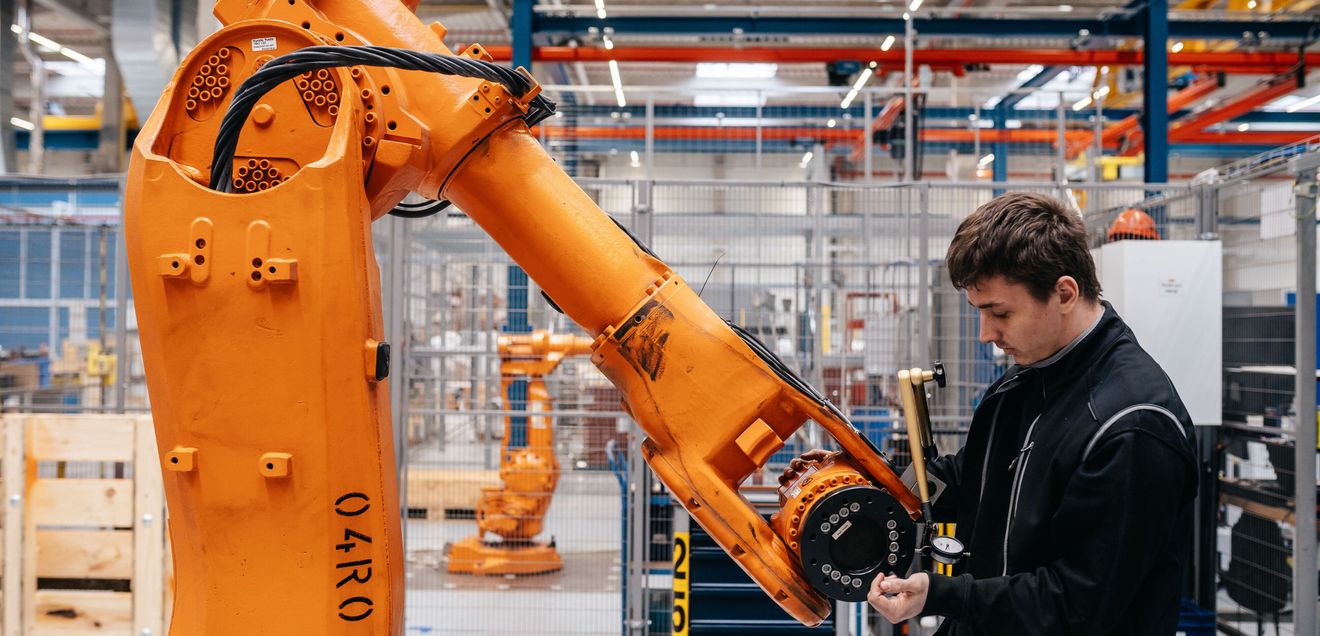
Until now, sustainability in robotics has often been limited to efficiency gains during operation and the resulting reduction in the use of raw materials and harmful emissions. Sustainability during operation is important, but the end of the life cycle is also crucial. If a robot fails in operation, there are a number of ways to respond sustainably. Many defects that occur in older robot models can be quickly rectified by repair. If the robot can no longer be repaired, manufacturers such as ABB offer to take the products back, for example in exchange for a refurbished device or a product of a newer generation. This is because many robots can be reconditioned for reuse - with a positive effect on the environmental balance: reconditioning a robot produces 75% lessCO2 than manufacturing a new robot. Many customers also opt for remanufactured models because their bus and safety technology is not compatible with newer robot models.
Reconditioning follows strict guidelines. At ABB, every robot is inspected according to a precise plan, thoroughly checked and subjected to strict functional tests. If the robot passes, it is put back into circulation with a twelve-month warranty. "We completely remanufacture our robots using the original design plans, specifications and dimensions. This ensures that they offer the same level of quality, performance, durability and safety as a new ABB robot," says Jan Borsky, sales manager of ABB's global repair and remanufacturing centers. "We always have more than 400 used and refurbished robots of various types in stock for sale. The demand for second-life robots is currently so high that more than one robot leaves our factory in Ostrava, Czech Republic, every working day." In automotive manufacturing, almost all robots can be installed in a new production line after reconditioning, and between 10 and 20 % can even be installed a third time. In the last 30 years, ABB has reconditioned over 12,000 robots and put them back on the market.
Sustainability also in demand from customers
Another example is the expansion of an existing production line. If a company wants to expand production, it is easier to add a remanufactured robot of the same generation to the production line. In this way, companies ensure that the robots are compatible with each other. No additional training is required for employees and there is no need to expand the spare parts warehouse. In both cases, opting for remanufactured robots is more cost-effective than converting an entire production line. For customers, the service life of a robot is often less important. It is more about how long spare parts will be available for the respective model.
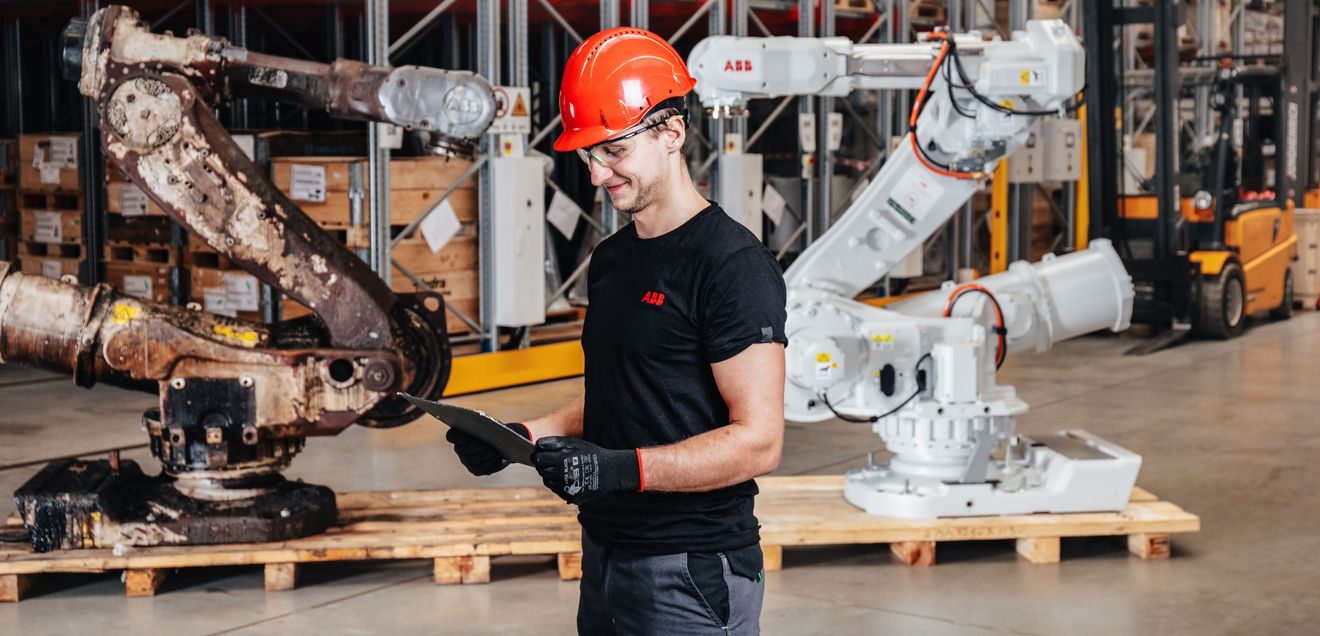
However, remanufacturing is not always an option. In these cases, the individual parts of the robots are recycled. Around 95% of a robot is made of material that can be easily recycled. ABB works with certified recycling partners to ensure that the reuse of raw materials is as sustainable as possible.
If robotics manufacturers want to promote sustainability, they should also ensure that they implement the resolution in their own corporate practices. Compared to 2019, ABB has already reduced itsCO2 emissions by 76% in 2023. The company has also stopped using fossil fuels to heat its buildings and has switched its vehicle fleet to electric vehicles.
The robotics expert has also equipped its production facility in Shanghai and the reprocessing center in the Czech Republic with solar panels. Geothermal energy is also used at the new Robotic Campus in Sweden. By producing sustainable robots that increase efficiency and reduce environmental impact, ABB is helping customers to break new ground.


You might also be interested in
Greater Transparency in the Robotics Market
RoboFinder Launches as an Independent Comparison Platform
Launch at Gitex Europe: 'RoboFinder' aims to bring more transparency to the professional service robotics market. In this interview, founder and CEO Brian Engels discusses market potential, challenges, and the goals of the new platform.
 read more...
Artificial Intelligence for the Physical Space
Alibaba Expands Qwen Model Family with a Robotics Suite for Physical AI
Alibaba is expanding its Qwen model family with a robotics suite for Physical AI. The three models—for manipulation, navigation, and simulation—are designed to assist autonomous robots with complex tasks in real-world environments.
read more...International Federation of Robotics
U.S. Robotics Industry Sees Double-Digit Growth
In the U.S., sales of industrial robots rose by 11% compared to the previous year: 38,000 units were newly installed in 2025. This significant recovery is driven by robust growth in the food industry and other non-manufacturing sectors. However, the...
read more...Development Collaboration for Humanoid Robotic Hands Launched
Schunk is entering into a new development partnership with Robert Bosch Robotics. Their shared goal is to develop an industrial-grade robotic hand that can be integrated into various humanoid robot systems.
read more...Robot-controlled packaging of rolls
Koch Robotersysteme, a company specializing in the integration of robotic systems, has developed a complete, automated packaging line for packaging rolls based on Tentoma’s RoRo StretchPack packaging machine.
read more...Highly Automated Injection Molding
Six-axis robots automate the entire handling process
From part handoff to loading and unloading the injection molding machine to quality inspection: Yaskawa six-axis robots automate the entire handling process in a highly integrated production line for safety-critical sight domes.
read more...Record funding for accelerated development of a physical AI platform
Neura Robotics has announced a Series C funding round worth up to $1.4 billion. This will help the company accelerate its mission to build the world’s leading physical AI platform.
read more...International Federation of Robotics
The 2026 IERA Award was presented
The 2026 “Award for Innovation and Entrepreneurship in Robotics & Automation” (IERA) goes to the Swiss deep-tech company Verity for its fully autonomous indoor drone system. The flying robots support the logistics and retail sectors by...
read more...Humanoid robotics from Germany
Igus launches service robots for everyday industrial use
Humanoid robotics: With the Iggy Rob Home, igus presents a service robot for industry and everyday life. What's behind it.
read more...