

Humanoid robotics from Germany
Igus launches service robots for everyday industrial use
With the new Iggy Rob Home, Igus wants to take humanoid robotics out of the experimental stage and into practical applications. The robot is based on a mobile platform, costs from 55,000 euros and is intended for use in service areas as well as in industry.
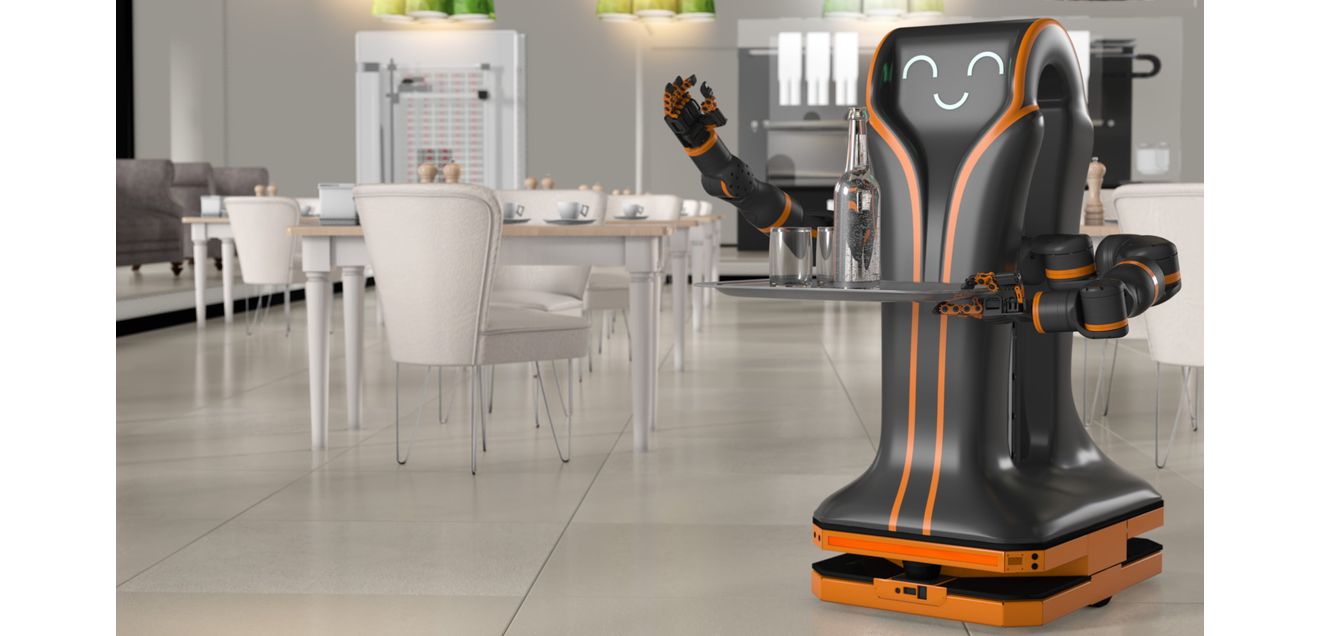
Humanoid robots are currently one of the most talked-about technologies in the automation industry. They run marathons, dance the moonwalk and impressively demonstrate what is already technically possible. However, there is often a large gap between spectacular demonstrations and everyday use in companies. One of the main reasons for this is the high cost of many systems.
This is precisely where Cologne-based motion plastics specialist Igus comes in. Having already presented the Iggy Rob Industrial for production environments in 2025, the company is now expanding its humanoid robot platform with a second variant. The new Iggy Rob Home is designed to enable the use of humanoid robotics in service, educational and everyday environments and is available from 55,000 euros.
Development and production take place entirely in Germany - from mechanics to electronics to software.
Why the robot has no legs
Anyone who automatically thinks of humanoid robotics as human-like walking movements will be surprised by Iggy Rob. Both the Iggy Rob Industrial and the new Iggy Rob Home do not move on two legs, but on an autonomous mobile robot base. The ReBeLMove Pro with a load capacity of up to 250 kilograms is used.
For Igus, this is a pragmatic decision. Mobile vehicles have long proven themselves in industrial halls and buildings, can be integrated safely and are comparatively easy to integrate into existing environments in a CE-compliant manner. For many real applications, running systems are currently neither necessary nor economical.
"Our world is built by people for people. It is therefore logical that automation technology will eventually take on human-like forms," says Alexander Mühlens, authorized signatory and head of the Low-Cost Automation division at Igus.
"At the same time, we are convinced that humanoid systems will only develop further in practical use. That's why we rely on an open, robust platform that users can adapt to their requirements."
Open platform for industry and service
Depending on the design, the robots reach a height of between 1.30 and 1.70 meters. With 16 degrees of freedom (DOF), they should be able to perform natural movements. Navigation is carried out using LIDAR and 3D camera systems, and the autonomous running time is up to eight hours.
The standard equipment includes two ReBeL robot arms from Igus, each with a load capacity of 2.5 kilograms. Alternatively, cobots from other manufacturers or humanoid hands can also be integrated. The platform has an open design: Sensors and end effectors can be adapted, control is via ROS 2. The systems are also CE-certified and prepared for fleet operation in accordance with VDE 5050.
From machine operator to receptionist
While the Iggy Rob Industrial was primarily developed for production and logistics environments, where it is intended to perform tasks such as material handling, machine loading or simple assembly work, the new Iggy Rob Home is aimed at a much wider range of applications.
The intended applications include reception and information areas, educational institutions, research laboratories, catering businesses and a wide range of service tasks in buildings. At the same time, the robot also remains interesting for industrial tasks, such as pick-and-place applications, in-house material transport or transportation between different workstations.
Igus also sees the robot as a platform for AI training, data acquisition and research and educational projects at universities and institutes.
More interaction, greater reach
Technically, the Iggy Rob Home is based on the same industrial-grade platform as the Industrial model. However, additional functions have been added to the system for use in service-oriented environments.
This includes smoother movement profiles, a display for simple facial expressions and preconfigured service functions. An integrated linear axis increases the working range of the arms. A back basket with a load capacity of up to 50 kilograms is available for transporting objects.
An integrated 3D camera supports object recognition as well as gripping and navigation tracking. Thanks to wireless charging, uninterrupted operation should be possible. The robot can be integrated into existing robotic systems via the ROS-2 interface.
Depending on the application, different end effectors can be used - including suction grippers, two- and three-finger grippers or a bionic hand with integrated gripper recognition.
When the robot communicates with AI systems
According to Igus, the Iggy Rob Home can be operated via an intuitive programming interface even without in-depth robotics knowledge. The underlying system architecture is designed to ensure stable and reliable operation.
With the Dynamic Mission Data Interface software add-on, missions can be started via a network and data can be exchanged bidirectionally in real time. This enables dynamic interaction with external AI systems during ongoing tasks.
The mechanics, electronics and software are developed entirely by Igus in Cologne and Commonplace Robotics by Igus in Osnabrück. Individual adaptations and further developments can therefore be coordinated directly with the development teams.
Test first, then invest
As with other automation solutions, Igus also follows the "test before you invest" principle for humanoid robots. Companies can first test the systems in their own environment and evaluate technical feasibility and cost-effectiveness together with the manufacturer.
Igus also operates the robotics marketplace RBTX. According to the company, around 100 humanoid robot models from 35 providers were listed there at Hannover Messe 2026. In addition to hardware, integration services, consulting and various usage and financing models are also offered.
With the Iggy Rob Home, Igus is attempting to move humanoid robotics from the realm of spectacular demonstrations to concrete applications - and at a price level that the company believes will pave the way for practical everyday use.


You might also be interested in
Greater Transparency in the Robotics Market
RoboFinder Launches as an Independent Comparison Platform
Launch at Gitex Europe: 'RoboFinder' aims to bring more transparency to the professional service robotics market. In this interview, founder and CEO Brian Engels discusses market potential, challenges, and the goals of the new platform.
 read more...
Artificial Intelligence for the Physical Space
Alibaba Expands Qwen Model Family with a Robotics Suite for Physical AI
Alibaba is expanding its Qwen model family with a robotics suite for Physical AI. The three models—for manipulation, navigation, and simulation—are designed to assist autonomous robots with complex tasks in real-world environments.
read more...International Federation of Robotics
U.S. Robotics Industry Sees Double-Digit Growth
In the U.S., sales of industrial robots rose by 11% compared to the previous year: 38,000 units were newly installed in 2025. This significant recovery is driven by robust growth in the food industry and other non-manufacturing sectors. However, the...
read more...Development Collaboration for Humanoid Robotic Hands Launched
Schunk is entering into a new development partnership with Robert Bosch Robotics. Their shared goal is to develop an industrial-grade robotic hand that can be integrated into various humanoid robot systems.
read more...Robot-controlled packaging of rolls
Koch Robotersysteme, a company specializing in the integration of robotic systems, has developed a complete, automated packaging line for packaging rolls based on Tentoma’s RoRo StretchPack packaging machine.
read more...Highly Automated Injection Molding
Six-axis robots automate the entire handling process
From part handoff to loading and unloading the injection molding machine to quality inspection: Yaskawa six-axis robots automate the entire handling process in a highly integrated production line for safety-critical sight domes.
read more...Record funding for accelerated development of a physical AI platform
Neura Robotics has announced a Series C funding round worth up to $1.4 billion. This will help the company accelerate its mission to build the world’s leading physical AI platform.
read more...International Federation of Robotics
The 2026 IERA Award was presented
The 2026 “Award for Innovation and Entrepreneurship in Robotics & Automation” (IERA) goes to the Swiss deep-tech company Verity for its fully autonomous indoor drone system. The flying robots support the logistics and retail sectors by...
read more...New sales and service unit in Gurugram
Yamaha Motor expands robotics business in India
Yamaha Motor is opening a new Robotics Business Support Division in India to strengthen sales and service in the growing robotics market. The unit will support SMT systems and industrial robots, among other things, and will be complemented by a...
read more...