
Reduce set-up effort
Efficient retooling of robot systems
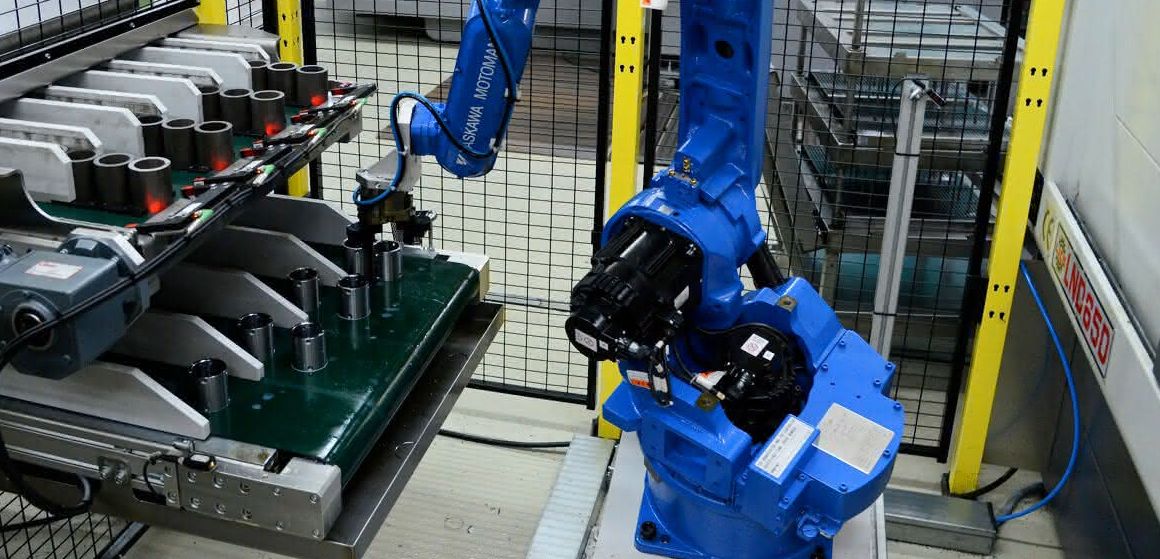
Various technical aspects and solutions must be considered for efficient set-up concepts. First, the actual robot sequence program should be considered: Once created for each new sequence variant, it only needs to be called up when the variant returns. Setting up a new component for the first time is no problem thanks to the flexibility and free programmability of a robot; depending on the robot, it may not even be necessary to intervene in the robot program. Only the parameters of a new workpiece are transferred and the robot sequence program is designed accordingly.
For workpiece-guided processes - i.e. the robot moves the workpiece - the gripper tool usually has to be converted. In the case of tool-guided processes - where the tool moves - the workpiece holder in which the workpiece is provided is converted. There are various options and strategies for converting the tool, often a gripper tool, depending on the conversion frequency and budget. The most favorable solution is one with exchangeable or adjustable gripper jaws. In this case, they are designed as interchangeable parts that can be changed using screws or quick-release fasteners or can be adjusted in stages or continuously. It is also possible to use a servomotor-driven gripper tool that can move the jaws into different positions. In these cases, no retooling is usually necessary. Cleverly designed stepped jaws may also mean that the gripping tool does not need to be converted.
Manual or automatic changing systems
It is also possible to change the entire tool. Gripper changing systems are used for this purpose, which are either operated manually by an operator or automatically. With automatic systems, the robot has access to all of the changeable tools in a magazine, a kind of gripper rack. The robot itself fetches the appropriate tool for the selected program.
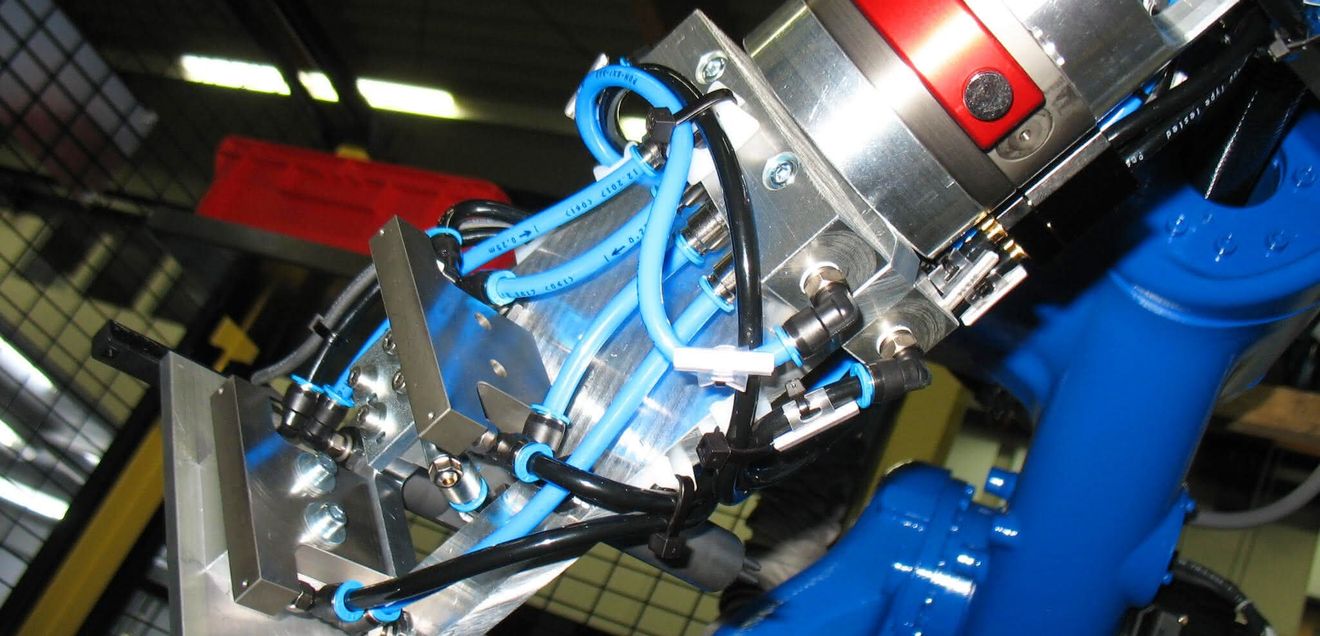
In addition, the raw and finished part storage systems usually need to be converted or equipped with the correct component variant. If components are supplied and removed in workpiece carriers, the carriers are almost always component-independent. They are identical in terms of the fixture and only differ in terms of component-specific inlays. In the case of bulk material feeders or other magazines, the conversion of the raw and finished part storage systems is more complex, unless this can be avoided by a clever choice of universal holders.
Of course, the actual machining or production process must also be converted. This refers to the tool or plastic injection molding machine itself, for example. Before the actual manufacturing process can begin, a plausibility check is carried out via the electrical interface. This ensures that the robot sequence and all assembled parts of the machine match. When changing grippers, RFID chips are often used on the change parts to prevent the sequence program from starting if the gripper is incorrectly fitted. Other common safety precautions include obtaining explicit confirmation from the operator before restarting the machine and starting the robot at a reduced speed.
Set-up includes many parameters
The procedure for retooling is described in the system documentation, which must be supplied in the national language in accordance with the Machinery Directive. When new systems are handed over, EGS Automation carries out a detailed operator briefing in which, among other things, the topic of system conversion is trained and practiced using the documentation. For larger systems, step-by-step operator guidance via the system screen is also possible.
Good set-up concepts include durable and low-wear fastenings and fits. This ensures that the contact points still fit exactly even after many set-up processes. Ergonomics is also an important issue for the set-up process. If the gripper exceeds a certain weight, a manual tool change is only practical with aids, or an automatic change is carried out directly by the robot. The accessibility of the positions to be set up must also meet ergonomic requirements. An efficient set-up concept is rounded off by details such as clear identification of the change parts and the option of tool-free retooling or no need for special tools.


You might also be interested in
5 Challenges for AI Projects in Manufacturing
Manufacturing companies have high hopes for AI. IFS highlights the five most common reasons why AI projects fail.
 read more...
From Theory to the Factory Floor
IT and OT are converging, thereby laying the foundation for the smart factory. Only through seamless data integration can AI, digital twins, and flexible production processes become a reality. Why IT/OT convergence is becoming a competitive...
read more...HIMA Is Growing Despite Challenging Markets
The HIMA Group will increase its revenue to 190.5 million euros in 2025. International business, digitalization, and partnerships are driving this growth.
read more...International Federation of Robotics
U.S. Robotics Industry Sees Double-Digit Growth
In the U.S., sales of industrial robots rose by 11% compared to the previous year: 38,000 units were newly installed in 2025. This significant recovery is driven by robust growth in the food industry and other non-manufacturing sectors. However, the...
read more...In-house exhibition Bielefeld 2026
How DMG Mori thinks about the factory of the future
DMG Mori will be showcasing turning and milling expertise, automation solutions and additive manufacturing along the Machining Transformation (MX) at the Bielefeld 2026 in-house exhibition.
read more...Benoît Thooris takes over the presidency
Benoît Thooris takes over the management of UniversalAutomation.Org and the organization expands its Board of Directors with two new members.
read more...Five security risks and how companies can protect themselves
Physical AI in industry: NTT DATA explains five critical security risks in sensor technology, AI models and networking as well as suitable countermeasures.
read more...Vertiv and Nvidia link physical infrastructure with digital twins
Digital twins instead of a flood of documents: Vertiv integrates 'SmartRun' into 'Nvidia Omniverse DSX' to accelerate the planning and implementation of AI factories.
read more...From sensor to intelligent system
Sensors, measurement technology and artificial intelligence are merging to form intelligent systems. From June 9 to 11, 2026, Sensor+Test in Nuremberg will showcase the most important trends in a changing industry.
read more...