

An industry that organizes itself
Agentic AI, digital twins and new manufacturing technologies in response to an industry in transition
At Hannover Messe 2026, Bosch will be showing how agentic AI, digital twins and new production technologies are transforming industry. The focus will be on efficiency, automation and battery recycling.
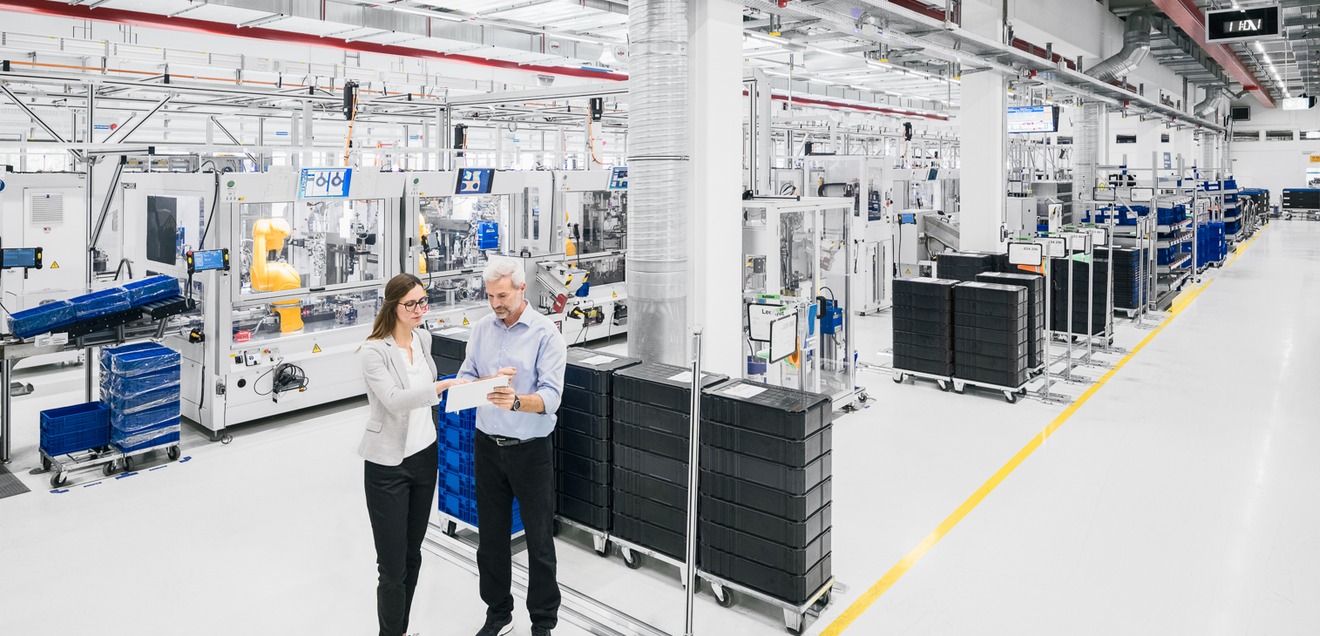
In times of increasing complexity and noticeable demographic change, resilience and competitiveness are considered key factors for industrial success. At Hannover Messe 2026, Bosch will be demonstrating how these abstract requirements can be translated into concrete production reality. At the heart of this is the idea that the combination of people, software and artificial intelligence not only supports manufacturing, but fundamentally restructures it.
The company is announcing a range of technologies spread across the entire exhibition grounds - from approaches for recycling vehicle batteries to new processes in industrial 3D printing and scalable solutions for increasing production efficiency. Bosch Connected Industry will be represented in Hall 14, Stand J17, while Bosch Rexroth will be showcasing industrial technology solutions in Hall 26, Stand E69.
The factory as a networked space for action
The trade fair presentation will focus on the question of how agent-based AI can be established as an active part of everyday industrial production - especially on the store floor.
Bosch uses the term "Manufacturing Co-Intelligence" to describe an approach that aims to achieve closer collaboration between humans, machines and digital systems. The starting point is an industrial reality that is still often fragmented: data is stored in separate systems, processes in planning, production, quality and maintenance are not consistently connected, and employees manually compensate for a lack of integration.
This is precisely where the approach comes in. The aim is to link existing systems, bring data into a common context and create an end-to-end operational view of production - both during ongoing operations and across the entire product life cycle, from development to use.
This requirement becomes clear in a typical industrial scenario: if a machine breaks down, maintenance teams often have to intervene outside of regular working hours. In a more AI-supported system, such situations would not only become visible in the event of a malfunction, but would be detected at an early stage through continuous monitoring. Deviations could be identified and countermeasures initiated before a breakdown occurs.
If a malfunction does occur, the exchange between human and system should take place via chat or voice input. The AI agent evaluates manuals, analyzes shift logs and generates specific recommendations for action. At the same time, the incident and solution are automatically documented and forwarded to other sites in the case of comparable systems.
Bosch also points to the role of integrated domain knowledge: according to Bosch, AI systems with this context answer questions correctly up to three times more often than isolated models and reduce the effort required for documentation and data reconciliation by up to 50 percent.
Digital twins as a data structure for the industry
Another focus is on digital, AI-supported twins of products and components. In industrial applications, the increasing amount of data over the entire life cycle of a product represents a key challenge.
Bosch's digital twin concept involves creating a digital representative for each real component, which bundles all relevant data and transfers it into a structured context. This creates end-to-end transparency across the entire life cycle - from development and production through to use by the customer.
This concept is complemented by the use of artificial intelligence. The digital twins should not only map the current status, but also enable forecasts to be made. This allows potential failures to be detected at an early stage, downtimes to be reduced and energy consumption to be optimized. This gives companies more predictable maintenance and more efficient systems in the long term.
Between additive manufacturing and industrial recycling
In addition to data and software-driven approaches, Bosch will be showcasing specific applications from manufacturing and production systems.
One example is a pellet-based 3D printer from the field of additive manufacturing. It processes industrial plastic granulate from injection molding and uses it to produce components that closely resemble series products in terms of their material properties. The mechanical strength corresponds to that of injection-molded parts, and can even exceed it with optimal process control. This means that functional prototypes, components for installation tests and small series can be produced more quickly, flexibly and cost-effectively.
A second area of focus is the recycling of electric vehicle batteries. Their volume is expected to increase tenfold over the next five years, while the variety of battery types is also increasing significantly. This poses considerable challenges for existing recycling structures.
Bosch Rexroth offers a scalable technology portfolio of drive, control, assembly, linear and screwdriving technology for this purpose. It ranges from manual processes and semi-automated solutions to fully automated systems. The aim is to reduce safety risks, make processes more efficient and improve cost-effectiveness in the areas of diagnostics, unloading and disassembly.
Brazil as industrial partner country
The partner country of Hannover Messe 2026 is Brazil, which is presenting itself as a driving force for sustainable industrial transformation. Bosch has been active there for more than 70 years and is therefore part of a long-standing German-Brazilian industrial relationship. With around 11,000 employees, the company is firmly anchored in the Brazilian industrial landscape.
Bosch has also been operating its global competence center for agriculture in Brazil since 2025. There, the company concentrates on the development of intelligent agricultural technologies with a focus on cultivation and fertilization, while also driving forward digitalization and Industry 4.0 applications.
One example is a solution developed jointly with BASF that enables the precise and intelligent application of herbicides. According to preliminary figures, Bosch generated sales of 1.78 billion euros in Latin America in 2025.
Expert contributions and discussions at the trade fair
Bosch is also represented with several contributions as part of the conference program.
On Monday, April 20, 2026, Norbert Jung and Deb Cupp (Microsoft) will take part in a panel discussion at the Microsoft trade fair stand in Hall 17, Stand G06.
On Tuesday, 21 April 2026, Tanja Rückert will speak from 10:00 to 12:00 in the Center Stage in Hall 25 as part of the Leaders' Dialogue of the Industry 4.0 platform. In the afternoon, Josepha Pfeiffer will lead the masterclass "From scalable data and digital twins to value creation in industry" from 15:30 to 16:30 in the Masterclass room (Solution Lab Automation and Digitalization) in Hall 26, Stand E43.
On Wednesday, April 22, 2026, from 10:00 to 10:20 a.m. in Hall 26, Stand E43 (Expert Stage 2), Michael Kolb will give a presentation entitled "Agentic AI is easy - the path to productive application is not". Josepha Pfeiffer will then speak from 11:40 to 12:00 at the Expert Stage Energy and Industrial Infrastructure in Hall 12, Stand F56 on "Digital product twins: life cycle data for product passports and other regulations".
The event will conclude on Thursday, April 23, 2026, with a presentation by Dr. Birgit Boss from 11:15 to 11:35 a.m. on Expert Stage 1 in Hall 26, Stand E43 entitled "Semantic digital twins: The key to new industrial value beyond data silos".
Bosch Connected Industry: Hall 14, Stand J17, Bosch Rexroth: Hall 26, Stand E69


You might also be interested in
Rohde & Schwarz and NVIDIA combine measurement technology with digital twin for AI-supported wireless networks
Rohde & Schwarz and NVIDIA present an AI-supported test system for 5G-Advanced and 6G at MWC 2026 Hardware-in-the-loop, ray tracing and a digital twin enable realistic radio tests in the lab.
 read more...
Performance up, costs down
A transparent overview of the devices actually installed is the prerequisite for targeted maintenance, forward-looking risk management and reliable investment planning. The dynamic analysis of the installed base creates this basis by creating...
read more...Increased efficiency through simulation...
Assembly lines optimized for automotive displays
Schnaithmann Maschinenbau has planned and implemented three assembly lines for the automated production of automotive displays. Together with Schnaithmann's customer, a German automotive supplier, various system concepts were simulated, validated...
read more...Digital twin meets product passport
Future-proof end-to-end solution at SPS 2025
At SPS, conplement and R. STAHL will present how the digital twin works end-to-end along the entire value chain: from creation and provision to productive use.
read more...The digital twin becomes a game changer
The digital twin opens up opportunities that will have a lasting impact on production. The technology has the potential to take products, services and supply chains to a new level.
read more...Performance-aided design and AI
Closing the gap between product design, simulation and performance
Autodesk presents new perspectives for production at EMO in Hanover The focus is on innovative approaches that combine design, manufacturing and operating cycles for more efficient production and smarter products in a seamless digital thread.
read more...StarterSET compact and digital twin
Realize compact machines quickly
By simulating and testing applications before they are physically implemented, errors can be detected at an early stage. The packaging machine that SEW-Eurodrive is presenting at Automatica also underwent virtual commissioning using a digital twin.
read more...Virtual commissioning
SEW-Eurodrive offers comprehensive support for the commissioning of machines. With the "Digital Twin as a Service" service, applications can be simulated and tested before they are physically implemented and errors can be detected at an early stage....
read more...Shaping the future of the industry
Autonomous robots in industry are now very reliable and efficient. Modern hardware and software are required to make this possible.
read more...