

Industrial robots
Automate surface processing
The Chair of Machine Tools of the WZL at RWTH Aachen University is developing a framework for the automated programming of industrial robots for surface processing.
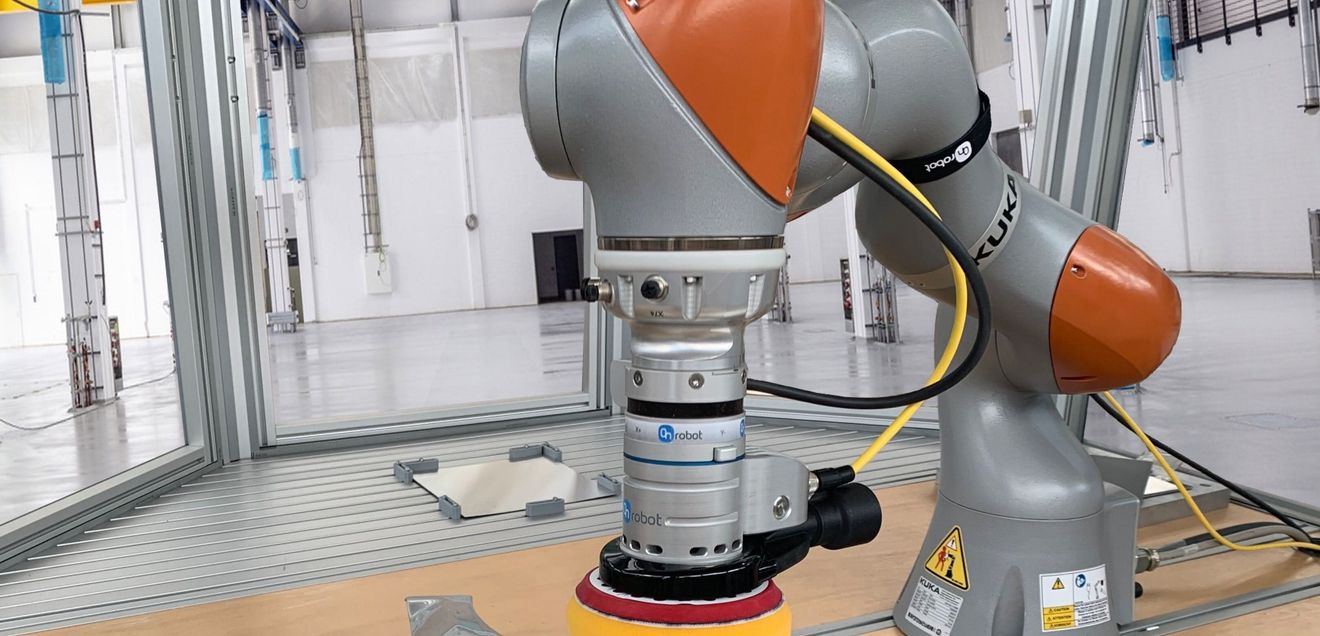
The surface treatment of components is an important step in the manufacture of many products. This includes, for example, the finishing of cast parts or weld seams, preparation for coating or polishing scratches. While robots are increasingly taking over these tasks in the automotive and aviation industries, they are still carried out manually in many small and medium-sized companies. These activities are often physically strenuous and harmful to health due to grinding dusts or forced postures, so it is to be expected that the shortage of skilled workers will have a particularly strong impact in these areas. At the same time, the demands on product quality and process efficiency are increasing. Robot-based automation of grinding and polishing processes therefore offers great potential, but often poses a major challenge. Low quantities and high product variability lead to a potentially high programming effort when reconfiguring the system. Many machining tasks require inspection of the workpieces, which requires sensory and cognitive skills such as human vision and touch. This domain knowledge of skilled workers on how to perform a task is difficult to transfer to a robot program, as machining tasks are usually performed intuitively and iteratively.
In view of these challenges, a human-centered approach is required that allows the knowledge of skilled workers to flow into the system via intuitive interfaces. In addition, a modular concept enables the system to be divided into three process steps, from the inspection of the workpieces and the selection of suitable processing parameters to the path planning of the robot.
I. AI-based component inspection
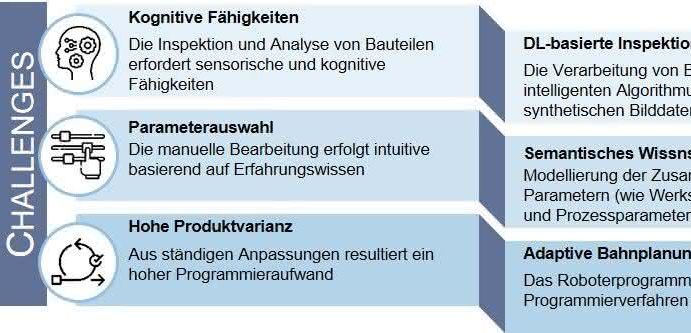
Automated detection of surface defects such as scratches requires flexible kinematics for different lighting and camera angles as well as an intelligent algorithm for image processing. Conventional image processing is uneconomical due to the large number of components and varying conditions, as it requires time-consuming, manual parameter tuning. This is where deep learning models such as Yolo come into play. However, these require a large amount of image data, the labeling of which involves a great deal of manual effort. This problem can be solved by using synthetic data. An automated pipeline enables the modeling of workpieces based on CAD models and other production data.
II. Processing strategy
After inspecting workpieces, decisions are made about the machining process, such as the choice of tool and machining strategy (tool path, contact pressure, angle). In manual processes, this is based on the knowledge and experience of the operator. In automated systems, a process control system takes over this task. This system requires a knowledge base so that the required machining processes, including the necessary parameters, can be suggested based on an actual and a target state.
III Railway planning
The generated machining strategy includes the position of the machining points, a list of machining steps as well as tools and parameters. However, the exact trajectory that the robot will follow is not yet defined. Normally, tool paths are programmed using CAM software based on CAD data. However, this method is an offline programming process and therefore not suitable for adaptive trajectories. Therefore, a process-parallel, automated generation of machining paths is necessary. This can be realized on the basis of various libraries, especially motion planners, which are integrated into robotics frameworks.
The role of man
Depending on the application, the automation of surface treatment operations places different demands on the three main topics mentioned. A human-centered approach makes it possible to flexibly integrate people into the system, check processes and successively improve the individual modules. For example, real images can be labeled in the first model and used to enrich the synthetic image database in order to improve the image processing algorithm. Adjustments can be made to the knowledge model with regard to suitable parameters or trajectories can be modified. This creates a basis for automated programming that can be successively adapted to individual use cases.
Josefine Monnet, M. Sc., Oliver Petrovic, M. Sc., Dr.-Ing. Werner Herfs


You might also be interested in
Greater Transparency in the Robotics Market
RoboFinder Launches as an Independent Comparison Platform
Launch at Gitex Europe: 'RoboFinder' aims to bring more transparency to the professional service robotics market. In this interview, founder and CEO Brian Engels discusses market potential, challenges, and the goals of the new platform.
 read more...
Artificial Intelligence for the Physical Space
Alibaba Expands Qwen Model Family with a Robotics Suite for Physical AI
Alibaba is expanding its Qwen model family with a robotics suite for Physical AI. The three models—for manipulation, navigation, and simulation—are designed to assist autonomous robots with complex tasks in real-world environments.
read more...Highly Automated Injection Molding
Six-axis robots automate the entire handling process
From part handoff to loading and unloading the injection molding machine to quality inspection: Yaskawa six-axis robots automate the entire handling process in a highly integrated production line for safety-critical sight domes.
read more...Humanoid robotics from Germany
Igus launches service robots for everyday industrial use
Humanoid robotics: With the Iggy Rob Home, igus presents a service robot for industry and everyday life. What's behind it.
read more...6 Criteria for the objective comparison of humanoid robots in industry
A new benchmark from Fraunhofer IPA is intended to enable the first standardized and neutral analysis of humanoid robots for industrial use based on six key criteria.
read more...New sales and service unit in Gurugram
Yamaha Motor expands robotics business in India
Yamaha Motor is opening a new Robotics Business Support Division in India to strengthen sales and service in the growing robotics market. The unit will support SMT systems and industrial robots, among other things, and will be complemented by a...
read more...A robot for all occasions
Industrial robots take on many tasks. Even milling with accuracies in the sub-millimeter range is now possible.
read more...Why stator and rotor laminations are becoming a performance factor
Why the future of robotics depends not only on software, but also on high-precision stator and rotor laminations inside the motor.
read more...Aachen-based start-up transfers AI robotics to industrial applications
Many developments in the field of artificial intelligence have so far failed to be transferred from the research lab to industrial practice. The spin-off Athenyx Robotics from RWTH Aachen University aims to change this: The start-up transfers...
read more...