

TwinCAT HMI components
Intuitive CNC HMIs with simulation functionality
With CNC HMI Base (TF5310) and CNC HMI Simulation Server (TF5320), the TwinCAT 3 automation software from Beckhoff offers two new function libraries for CNC-specific user interfaces, which can be used to create a modern, intuitive HMI application specifically for CNC applications and to simulate part machining using real-time data.
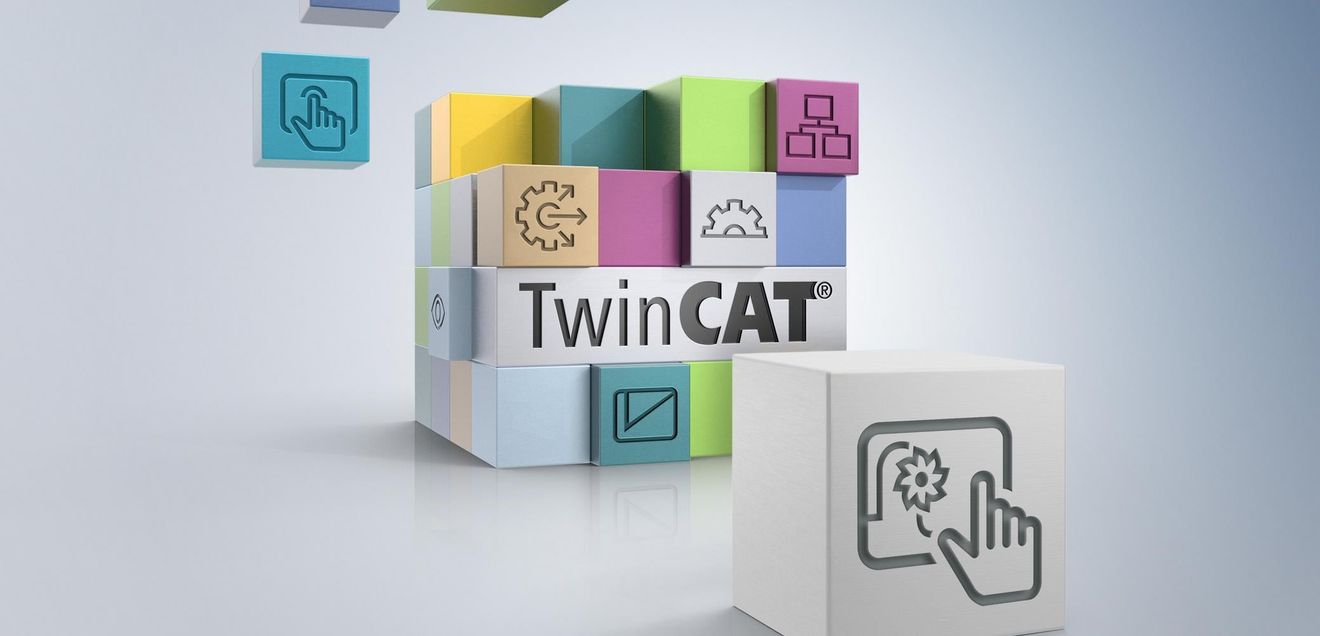
The TwinCAT 3 CNC HMI Base software package is based entirely on the proven TwinCAT 3 HMI Server (TF2000) and therefore integrates seamlessly into the TwinCAT HMI product family. It includes a large selection of technology-specific control elements, such as axis display, spindle and speed override, jog and jog functions, contour editor as well as tool data and zero offset table. The included G-code editor supports cycle-based CNC programming in conjunction with the TwinCAT cycle products CNC Measurement (TF5225), CNC Kinematic Optimization (TF5245) and CNC Milling Base (TF5293).
The package also includes a soft keypad (MCP) that can be configured at runtime. The real-time connection is established via a separate TwinCAT HMI server extension. This aggregates data from TwinCAT PLC and CNC into a common data model and makes it available to the client components. The use of TwinCAT 3 CNC HMI Base enables the free design of user interfaces, taking customer-specific design rules into account. Directly usable templates are also available to facilitate the engineering process.
The TwinCAT 3 CNC HMI Simulation Server links the 3D simulation control element contained in the TwinCAT 3 CNC HMI Base package to the real-time data of TwinCAT CNC. The data of the current tool and the blank definition stored in the NC program are used. The simulation runs either synchronously with real machining (real-time simulation) or in fast forward mode (without real axis movement using the contour visualization modes available in TwinCAT CNC). This enables the NC program to be checked visually in advance. Currently, 3- and 5-axis milling processes are supported; further technologies are in preparation.


You might also be interested in
Hands-free calling and signal processing
At embedded world, Voice Inter connect presented a kit developed in-house for industrial voice control and intercom modules for crystal-clear hands-free communication, even in noisy environments.
 read more...
Systems and customized solutions
Voice control and industrial communication
At embedded world 2023, the Hy-Line Group presented innovations and systems through to complete customer-specific solutions with hardware and software development.
read more...Operating safety thanks to LED technology
As a system provider, the enclosure specialist Bopla also has particular expertise in the development and assembly of human-machine interfaces.
read more...Solutions for production flexibility
The latest programmable automation controllers and SCADA/HMI software will be presented at the Emerson stand.
read more...Modular industrial PCs with new functionalities
Industrial computers for process visualization, automation and quality assurance are now called Assembly Control Node, or AC Node for short, at Atlas Copco Tools. The newly developed and robust series currently consists of four devices and follows...
read more...Digital twin for pumps
The digital twin processes sensor data generated from a system in operation and uses simulation to predict errors and diagnose inefficiencies.
read more...Interview with Dr. Clemens Eckert,...
Digitization not for the sake of digitization
How can the digitalization of your own company succeed? Many decision-makers in industry are asking themselves these questions. We asked Dr. Clemens Eckert, Partner at management consultancy maexpartners, what the biggest sticking points are on the...
read more...Steute foot controls do without cables
The latest generation of safety wireless foot switches from Steute do without a cable connection to the press and communicate via a safety-oriented wireless protocol.
read more...Pick & place as fast as lightning
Machine manufacturer Paro has developed a pick & place system that works with electric direct drives. It is more efficient and requires less assembly and maintenance than systems with pneumatic or cam drives.
read more...