

Future-oriented cobot projects
Three pillars of successful cobot initiatives
What is important if cobot projects are to be future-oriented? Automation and robotics expert Omron has identified three aspects for human-machine collaboration.
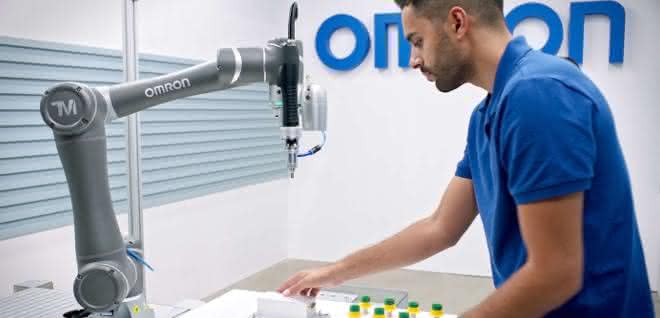
In order to position themselves for the future, industrial companies must rely on harmonious interaction between man and machine (keyword: Factory Harmony). To achieve this, the automation and robotics experts at Omron recommend a three-stage cobot strategy: approaches and solutions should be characterized by powerful functions, safe application and flexible adaptability to new requirements. Omron has compiled the following tips on what German industrial companies should pay more attention to in the future when it comes to cobots.
Cobots, also known as collaborative robots, are a trending topic in the industrial environment. According to the Robotic Industries Association (RIA), this area of industrial automation is expected to represent a market option worth around seven billion US dollars by 2025. In addition, this type of automation, with an average cobot sales price of between 15,000 and 45,000 US dollars, is increasingly possible outside of large industrial manufacturing applications; cobots will therefore be used in more and more factories and the like. In order not to fall behind, companies need to focus more intensively on innovative robotics concepts. In order to be able to act flexibly and easily adapt production lines and layouts to changing customer requirements, Omron advises a combination of mobile robots and cobots paired with integrated apps, camera and vision technology, support and risk assessment, and it is also advisable to rely on an experienced partner instead of many different providers, whose approaches and solutions are often difficult to reconcile, complex and cost-intensive. Omron also recommends: "No complex programming should be necessary. Simple installation and changes are essential in order to be able to act proactively. "

The three pillars of successful cobot projects:
1. safety is key: rely on cobots with support and service
Ideally, cobots help to minimize risks in the production process. They should therefore be equipped to work safely and efficiently alongside human workers. They should be ISO10218 certified and offer investment security. It is important that they can be put into operation within one or a few days. Comprehensive software tools can facilitate the settings for implementing ISO/TS15066 during commissioning. Another tip from Omron is comprehensive feasibility analyses as well as safety and support services as part of the overall cobot package from a single source - customers do not have to switch to another service provider.
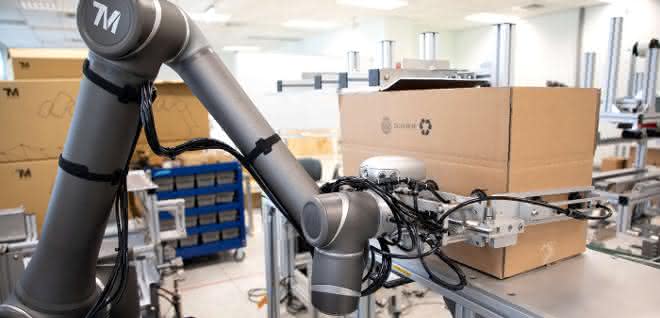
2. ensure scalability and data transparency through integrated camera and vision technology
In application scenarios where flexibility is more important than speed, cobots close the gap with user-friendly software tools and integrated sensor functions. These include, for example, machine vision systems with localization capabilities. Companies need easy-to-use camera and image processing systems to recognize patterns, perform quality checks, place objects and identify barcodes. Additional AI functions at machine level ("AI at the edge") expand the possibilities. In this context, Omron offers integrated cobot solutions to interactively support employees and optimize production processes. A vision system integrated into the cobot helps to improve reliability, consistency and precision in a cost-efficient manner. Scalability is also essential: for example, it should be possible to start with a simply integrated system and expand it as required.
3. use the cobot and mobile robot as a team
Cobots can help to overcome the challenge of the technical skills shortage. They are faster, easier and safer to program, install and integrate with other systems - for an intelligent production environment in which man and machine work together in harmony. The interaction between mobile and collaborative robots gives companies added flexibility, as they can adapt their production lines much more quickly and cost-effectively to new requirements, changing business needs and ever faster product cycles.
Peter Lange, Business Development Manager Robotics at Omron Electronics, comments: "Cobots in combination with mobile robots will play a central role in streamlining logistical processes in the future. Manufacturing companies that integrate cobots into flexible, ever-evolving production environments will gain efficiency with minimal programming and installation effort and without the need for robotics expertise. Omron is the only global full-service provider that offers both collaborative and mobile robots and also combines them as a solution. Only by working with a provider like Omron, who ensures successful projects from planning to implementation and support through a network of scalable system integrators, can risks, errors and complexity be minimized and growth supported."


You might also be interested in
From risk to resilience
NIS2 significantly increases the requirements for industrial security concepts. In addition to cyber resilience, physical access protection is becoming increasingly important.
 read more...
Security Operations Center module
When cyber attacks reach production
Adlon is further developing its Security Operations Center and adding another module to the existing Managed SOC for Microsoft 365 environments (based on Managed XDR): Managed SOC Advanced.
read more...Lifecycle management and safe IO-Link communication
At SPS, Pilz will be presenting solutions that combine safety and security in production. The focus is on the digital Myzel Lifecycle Platform, a SaaS offering for the management of machinery and personnel over the entire lifecycle.
read more...The basics of warehouse safety
Safety in the warehouse primarily relates to the employees. However, goods must also be transported safely and transport equipment must not be damaged.
read more...Environmental containers and fire protection
Companies can choose from a wide range of environmental containers for storing chemicals and other hazardous substances.
read more...Secure focus on access
To ensure comprehensive safety, holistic safety concepts for safety and industrial security on machines are required. Authorizations and access must be clearly regulated.
read more...Added value through safety and productivity
Machine malfunctions can have serious consequences and put people's health at risk. Functional safety therefore plays a central role in industry. With control and inverter technology including integrated safety functions from ABB, plant operators...
read more...Protect Ethernet interfaces
Pilz is expanding its portfolio of operating and signaling devices with the control element PIT oe ETH. It is equipped with an Ethernet port that can be activated and protects freely accessible Ethernet interfaces in industry against unauthorized...
read more...Protective tool in everyday life
Cybershield is a company founded in 2021 with a focus on operational technologies and has set itself the goal of significantly advancing IT security in the OT sector and supporting customers.
read more...