

Material flow
Inloader improves apple crate transportation
To make the material flow in its apple warehouse in Val Venosta more efficient, the Mivor fruit cooperative relies on an inloader from Hubtex. By switching from tractors to the KTR 120 box transporter, Mivor is relieving its employees and increasing capacity.
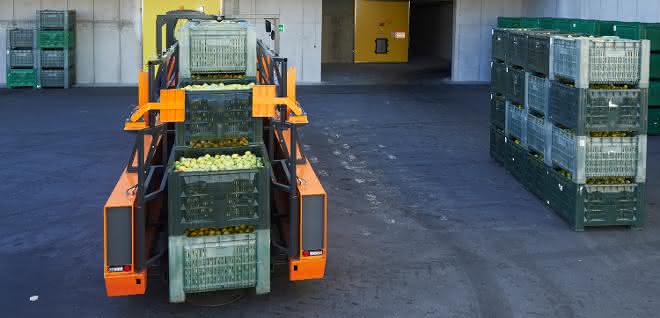
Founded in 2007, the Mivor fruit cooperative from South Tyrol is the largest fruit processing company in Europe. In the Venosta Valley region, the 373 members cultivate around 1,000 hectares of land and produce around 85,000 tons of apples per year. The fruit is stored, sorted, inspected and prepared for the food trade in the production warehouse in Latsch, which covers around eleven hectares. After the harvest in autumn, the farmers bring the apples to the fruit cooperative in standardized crates.
The fruit is initially stored there in around 200 cold storage cells, each with a capacity of up to 3,000 crates. At a temperature of four degrees Celsius, oxygen is removed from the room climate and nitrogen is added. This slows down the ripening process and allows the apples to be stored all year round. From the cold store, the apple crates are transported to an automatic sorting system, where the fruit is identified by a camera system, sorted according to quality, color and weight and checked for characteristics such as sugar content and internal damage. This is where Hubtex comes into play.
Long transport routes, limited space
The cold storage cells are spread over a wide area on Mivor's eleven-hectare site and connected to each other by main aisles. Until now, the fruit cooperative has relied on a tractor with trailer and several forklift trucks to load the up to 500-metre-long routes from the cells to the sorting plant. The packing system can process 120 crates of fruit per hour. In the past, Mivor needed up to four employees and numerous trips to transport the crates to ensure optimum capacity utilization. The forklifts were used to pick up the crates from the side aisles and then load them onto the trailer from both sides. The tractor then transported the crates to the plant, the forklift drivers unloaded the apple crates and placed them on the conveyor belt.
However, in the case of more distant cold storage cells, not enough goods were delivered to the system despite a high level of personnel deployment, while nearby cells resulted in overcapacity. "In addition to the high organizational effort, the use of the diesel-powered tractor in enclosed spaces also presented us with a challenge. With the health of our employees and the quality of our food in mind, we looked around for alternatives," says Kurt Wellenzohn, Technical Manager at Mivor.
Contact with Hubtex was established via partners LTW Intralogistics and Schmid Anlagenbau, both manufacturers of conveyor technology. "The requirement for us was to develop a vehicle with compact dimensions that could drive through the side aisles and pick up 28 crates from the floor at the same time," recalls Kai Hofmann, Country Sales Manager at Hubtex.
KTR 120 crate transporter
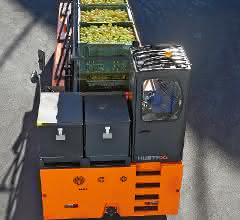
Hubtex developed the KTR 120 inloader to meet the requirements of the fruit cooperative. With a load capacity of twelve tons, the apple crate transporter can hold seven stacks of four crates each and transport up to 144 crates per hour. Hubtex equipped the vehicle with a battery drive to meet hygiene requirements during operation. With two large lead-acid batteries, the inloader can cover distances of 50 kilometers per day.
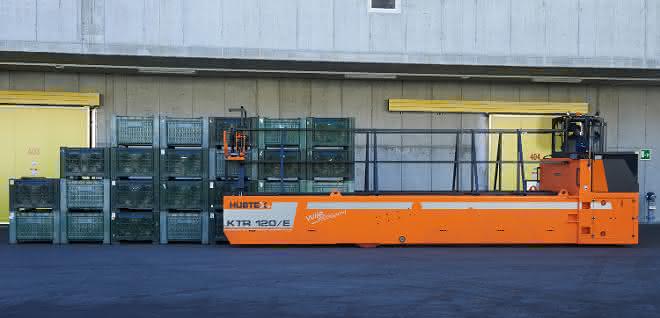
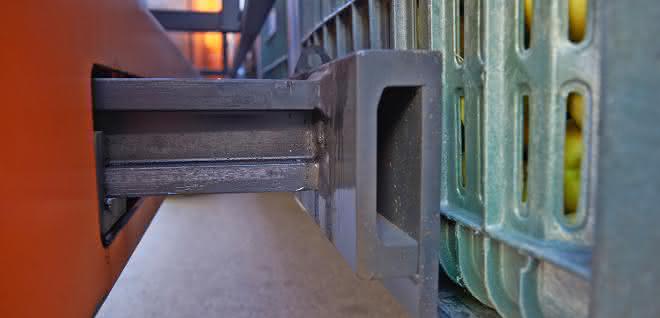
Thanks to its dimensions of ten meters long and 2.40 meters wide, it is also possible to drive into the side aisles directly in front of the cold storage cells. The load is picked up by synchronized lifting of the chassis with lifting rail. Each stack of crates is gripped and lifted by a pair of forks in the wheel arms, eliminating the need for additional transport pallets. The sensitive load is also carefully secured during transportation: Two hydraulic securing devices hold the apple crates firmly in place on the KTR.
Once at the sorting plant, the driver places the crates on the floor without any further assistance. On the way back to the cold stores, he picks up empty crates, further reducing the number of trips. The ergonomics of driving have also improved: while the employees in the forklifts often had to drive backwards due to the confined space caused by the tractor being used at the same time, the driver in the KTR sits at 90 degrees to the direction of travel. "Since we have been using the KTR, our work processes have become much more efficient and flexible at the same time," reports Wellenzohn. By only needing one employee to transport the crates and another to prepare them in front of the cold storage cells, staff resources can be better allocated. "During peak periods, we can cover peaks better and at the same time, the driver of the apple crate transporter can regulate the flow of materials, for example by leaving empty crates on the return journey."
After the harvest, operations at Mivor run at full speed: every day, the employees open a cold storage cell and take the apples to the sorting system. The goods are then transported fully automatically to the high-bay warehouse and stored until they are ready for sale. Every day, Mivor processes up to 1,300 crates and around 30 tons of apples per hour. as


You might also be interested in
Source of raw materials instead of hazardous waste
With the increasing use of lithium-ion batteries in industry, for example in driverless transport systems or as an emergency power supply for control systems, the volume of used batteries is also growing - and with it the challenge of recovering...
 read more...
Intelligent clutches
In many cases, a torque transducer is oversized for measuring torque and speed. A new intelligent clutch from R+W could be an alternative: it enables measurement data to be recorded directly in the drivetrain, measurements to be taken with high...
read more...Music of the future
The Blechexpo and Schweisstec trade fair duo took place in Stuttgart at the beginning of November. Like other industries, sheet metal workers and welding technicians have mixed feelings about the future.
read more...Early warning through interactive warning vest
The interactive warning vest from Linde Material Handling protects pedestrians in storage and production areas from approaching industrial trucks at an early stage with a tactile, audible and visible warning function.
read more...When is maintenance due?
The Brady inspection timer can save lives by clearly indicating when machines, equipment and tools need to be serviced. The LED indicators are clearly visible to operators and maintenance technicians, even from a distance.
read more...For one-hand installation
Desoutter is launching a one-handed angle screwdriver for the assembly of critical screw connections. With a length of around 30 centimetres and a weight of one kilogram, the transducer-supported EABS facilitates assembly processes.
read more...Process-accurate screw connections in series production
The power tool manufacturer Fein has launched three versions of the ASM 18 mid-handle screwdriver. They are identical in shape, but differ in terms of their torque output.
read more...Getting to the clamping point
Hermos Schaltanlagen in Mistelgau works with Desoutter screwdriving tools in production. Using the ergonomic cordless screwdrivers from the Elit series, the employees tighten the sensitive connections to the exact torque specified by the customer.
read more...1,400 variants, one line
I4.0 assembly line. With an assembly line from Bosch Rexroth, SFB manufactures hydraulic valves 20 percent more productively. A digital assistance system guides the workers through the entire assembly process, reduces errors and increases...
read more...