
Connection technology
Robot-based friction stir welding
Experts are certain that fully electric vehicles will replace combustion engines in the future. The large and heavy battery housings are subject to special requirements. Kuka has developed three systems for a global automotive supplier. Robot-based friction stir welding (FSW for short) with the Kuka FSW application module and Kuka cell4_FSW not only takes production to a new level in terms of quality, but also economically and ecologically.
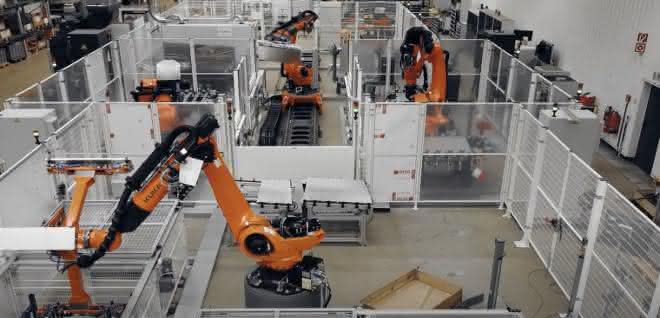
Eight robots from Kuka, including three FSW application modules with the KR Fortec in three cell4_FSW cells, have been in operation at a major automotive supplier in Portugal since 2022. They take care of the battery housings for fully electric vehicles. Friction stir welding technology is of particular importance here. This is because the robot-based process not only delivers high welding quality with good cost-effectiveness, but is also considered a "green technology" due to its low energy consumption. According to the customer, the cost of one meter of friction stir welding is already cheaper than the equivalent wire consumption for arc welding.
The number of all-electric vehicles is increasing worldwide. Their core component, the battery, is attached to the floor of the vehicles with a housing consisting of an inert gas-welded frame made of extruded profiles, which are closed with a sheet metal plate or with double-walled extruded profiles. Kuka has been supporting the customer in the manufacture of these housings for several years and has already supplied three different systems. "We have grown together with the customer's requirements - from the individual welding task to the fully automated production line," says Patxi Blanco, Global Key Account Manager at Kuka.
It all started in 2019, when the customer was still using a system from another manufacturer and was not satisfied with the welding quality. This is because the demands placed on the seams in the battery housings of electric vehicles are extremely high. In contrast to hybrid vehicles, the battery systems of fully electric vehicles are larger and heavier. "This requires a high level of rigidity and, due to their integration into the floor, the housings are crash-relevant. This means they have to withstand enormous forces," explains Stefan Fröhlke, Senior Manager Process Solution at Kuka.
More units, more systems
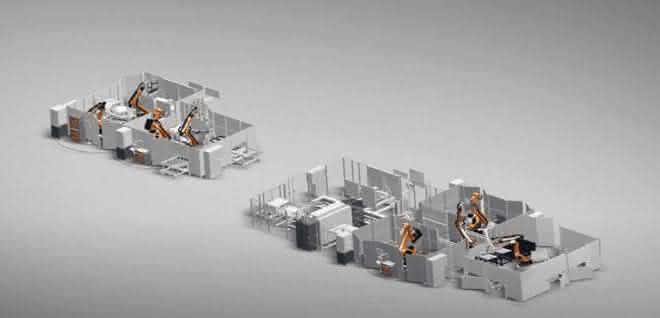
Friction stir welding is ideally suited to these requirements. In order to improve the welding quality at the automotive supplier, Kuka initially developed a system with two cells and one KR Fortec each. Due to the flexibility of being able to weld different battery boxes on one system, the customer was so satisfied that he ordered another system from Kuka in the same year. This time a cell with a robot that could now operate three fixtures instead of the previous one. This allows three different welding tasks to be completed, which would otherwise require three non-robot-based systems. "This solution saves two systems and the associated costs for personnel and production space for the same output quantity," says Blanco.
Kuka's solution is very economical: the friction stir welding robot can be utilized up to 95%, as the fixtures can already be loaded and unloaded in a separate safety area during the welding process. The process also requires a smaller footprint. This is why the two systems were not all that was needed. Three years later, the entire production process has been automated. In three Kuka cell4_FSW cells, eight robots now work in four steps to produce the battery housings. First, the base plate is welded and deburred in the second step. Once the plate is finished, the robots weld the frame to the base plate and finally deburr the entire battery box in step four. "We carried out the assembly and commissioning at our plant in Augsburg. The customer approved the system there, which is why the installation on site went quickly and smoothly," says Blanco.
High accuracy and precise web guidance
Specially developed for the growing e-mobility market, the cell4_FSW friction stir welding cell offers versatility and many configuration options in addition to economic efficiency. "Thanks to a path accuracy of less than 0.5 mm, highly precise and perfect weld seams are possible," explains Stefan Fröhlke. The precise web guiding is based on the use of the KR Fortec 500 R2830 MT with its high rigidity and long service life. On the other hand, the laser-supported web calibration plays a significant role in ensuring that the weld seam meets the high requirements for tightness and crash procedures.
The service life of the friction stir welding tools proved to be a particular challenge. By continuously improving the shoulder and pin on the robot through the use of new materials and coatings, it was possible to significantly extend the service life. "This doubled productivity for the customer. By building up additional stocks, we can also ensure supply within a few days if required," says Patxi Blanco. The long-term project has created a good partnership between Kuka and the automotive supplier, and they are in talks for new battery platforms. Kuka is therefore not only supplying the system and engineering, but also the necessary process expertise to actively support the new developments. After all, the demand for electric vehicles will continue to rise in the future. And this will also increase the need for battery housings.
Sebastian Schuster, Kuka


You might also be interested in
Housing and inserts for plenty of power
Lapp presented the expansion of its Epic Power series at SPS 2023: four new M23 circular connector inserts and three new M23 housings. The special feature: all housings can be combined with any of the four inserts.
 read more...
News and product updates from Smartgas
Portable gas analyzers for outdoor use
Smartgas is starting the second half of the year with a series of updates to existing products and a number of new products. Portable analyzers expand the range of applications, while new accessories such as protective housings and heating modules...
read more...Everything accurate in switch cabinet construction
To ensure smooth work processes, tools for processing enclosures and housings must function flawlessly and reliably. Häwa rounds off its punching range with the Multi-Press 500.
read more...Shafts and conversion parts
The Rodriguez range includes ball bushings including matching housings, shaft brackets, crossbars and supports.
read more...Cooling and temperature control units
Hygienic packaging sells safely
In few industries are the requirements for hygiene in the production process as strict as in the food sector - the health of consumers has top priority. This results in enormous challenges for all machines and components involved, especially in...
read more...Simple tool change in seconds
With the CMS, Schunk is launching a user-friendly, manual change system for quick component replacement. In addition to its simple and convenient operation, the CMS also stands out with its extensive range of optional modules and complementary end...
read more...Motion controller for small drives
Medium power range covered
Faulhaber has another housing-less and compact motion controller in its range, which is particularly suitable for integration in device construction and medical technology applications.
read more...Welding solutions in the name of resource efficiency
At the Welding & Cutting trade fair in Essen (September 11-15), Fronius will be focusing on the major drivers in welding technology. Quality requirements are increasing in all industries, but the required welding specialists are scarce. In...
read more...Safe solutions for cable installations
From thick power cables to thin sensor lines, cables and lines must be routed safely through systems and machines. A challenge that should not be underestimated, explains Jörg Sokat, Head of Product Management at Pflitsch.
read more...