

Know-how
Wind power - a pillar of the energy transition
Fossil fuels (lignite, hard coal, etc.) are destroying the environment and forcing the unconditional use of renewable energies (wind, sun, water, biomass, geothermal energy, ambient heat/harvesting, hydrogen as a secondary source for the fuel cell).
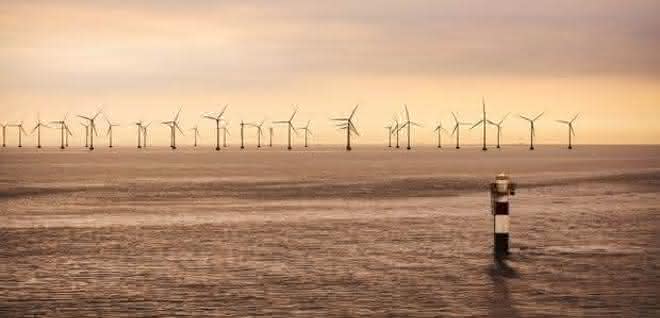
The urgency of this turnaround is underlined by the latest report from the Intergovernmental Panel on Climate Change (IPCC). According to this report, there is an acute risk of global warming of ≥ 3 °C (Paris target ≤ 2 °C). According to the EEG, the share of renewable energy should therefore reach 40 to 60% of the electricity consumed in Germany by 2025 in order to be able to stop using coal completely by 2050 at the latest. This corresponds to a reduction in industrialCO2 emissions of up to 90% in the same period (compared to 2010).
The most important driver of this change is wind energy, which is available in unlimited geographical, renewable and cost-effective quantities. With efficiencies of 45 to 60 %, wind turbines transform the flow energy of the wind into electrical energy. Large wind farms and small plants (e.g. there are several hundred community wind farms) with compatible locations can be used by connecting them to the grid. Shutting down wind turbines due to a lack of power lines, even to keep coal-fired power plants in operation, is counterproductive.
Grid connection and locations
This form of energy is usually available decentrally in areas that do not usually coincide with the location of demand. It must therefore be transported there. Digitally controlled "MS/HS electricity highways" that are available or need to be built (China is already using UHV-AC/DC for transmission) are therefore a prerequisite for a successful energy transition. The existing backlog must be made up as quickly as possible.
The focus is on off-shore and on-shore locations for large wind turbines. As even these are already becoming scarce, positions should also be developed for small producers. They can be connected to the distribution grid and also allow decentralized consumers to supply themselves (e.g. stand-alone grids for small groups of households). Special solutions are available for high energy yields with low maintenance requirements and great flexibility(http://www.s4e-online.de, http://www.baumueller.de).
The clear specifications of the EEG must be used for the grid connection.
Structure
Wind turbines are available for a wide range of rated outputs and wind speeds (blade diameter ≤ 130 m, hub/tower height ≤ 160 m, rated output ≤ 8 MW). Depending on the wind location, the annual energy of a large turbine can reach 7-10 million kWh. Wind turbines generate the energy required for their production and construction within a few months, so their environmental balance is positive. The efficiency reaches values of up to around 60 %.
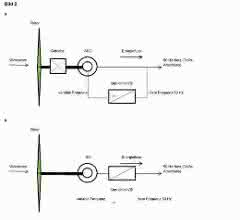
The design is power-independent. The wind drives a double-fed asynchronous generator, more recently a synchronous generator, via up to three rotor blades. The azimuth drive optimizes the alignment of the turbine to the wind direction. The pitch control adjusts the angle of attack of the rotor blades depending on the wind speed in order to control the power output. A storm control system for power-reducing operation prevents storm-related downtime.
Power is fed into the public grid at all AC grid levels by means of a transformer and switchgear. The VSI connected downstream of the motor ensures a constant grid frequency despite fluctuating rotor speeds. Several wind turbines - grouped together in a wind farm - feed in at MV/HS level. The location of the wind turbines is generally inaccessible. Therefore, modern communication technologies must allow remote access, maintenance, alarms, parameterization, etc.
Wind farms form a virtual power plant. If there is insufficient storage capacity, additional costs may arise due to the fact that a backup supply using conventional technology is required due to the dependence on weather conditions and that generation far from the place of consumption forces high transmission costs.
Wind turbines with synchronous generators
Since the early 1990s, externally or more advantageous permanently excited synchronous generators have dispensed with the primary gearbox due to their higher speed or number of pole pairs. Directly coupled rotor and generator lead to increased reliability, reduced maintenance costs, high efficiency and excellent grid compatibility. This is offset by higher investments for marginal power systems. The frequency inverter for full power in the stator circuit (only approx. 30 % rated power for asynchronous generators) decouples the generator and feed-in. The grid-connected inverter of the VSI generates the grid voltage from the induced voltage at a speed-dependent frequency.
Availability
Security of supply with high yields is ensured by well-known measures such as
- Preventive (remote) condition monitoring with reliable diagnostics,
- open system networking with monitoring/protection in real time (use of Internet, Ethernet),
- Automation and investment security (modular software/hardware with security function),
- Combined systems with storage,
- Overvoltage protection (against thunderstorms),
- Noise protection (distance, WHO recommendation daily average 45 dB),
- compliance with EEG subsidies.
Outlook
In order to use this form of energy sustainably, periods of low wind must be bridged economically. In addition to conventional options such as compact vanadium redox flow batteries and home storage systems (www.senec.ies.com; possibly with solid-state batteries in the future), the efficient, environmentally friendly short-term storage of generated surpluses can be achieved using
- Pumped storage plants
- H2 generation (power-to-gas)
- Wind-heat storage (power-to-heat)
- Compressed air storage for small systems combined with a gas turbine (CAES).
The latest developments at RWTH Aachen University use a hydraulic drive train to drive a synchronous generator at a constant speed, eliminating the need for a frequency converter.
Upwind/thermal power plants use solar energy to move the wind, but remain insignificant. With the growth of RE, the importance of electric infrared heaters is also increasing.
In principle, however, the diametrically opposed assessment of the energy transition between the Federal Audit Office and the government/BMWi must be clarified positively(http://www.bundesrechnungshof.de).


You might also be interested in
Source of raw materials instead of hazardous waste
With the increasing use of lithium-ion batteries in industry, for example in driverless transport systems or as an emergency power supply for control systems, the volume of used batteries is also growing - and with it the challenge of recovering...
 read more...
Intelligent clutches
In many cases, a torque transducer is oversized for measuring torque and speed. A new intelligent clutch from R+W could be an alternative: it enables measurement data to be recorded directly in the drivetrain, measurements to be taken with high...
read more...Music of the future
The Blechexpo and Schweisstec trade fair duo took place in Stuttgart at the beginning of November. Like other industries, sheet metal workers and welding technicians have mixed feelings about the future.
read more...Early warning through interactive warning vest
The interactive warning vest from Linde Material Handling protects pedestrians in storage and production areas from approaching industrial trucks at an early stage with a tactile, audible and visible warning function.
read more...When is maintenance due?
The Brady inspection timer can save lives by clearly indicating when machines, equipment and tools need to be serviced. The LED indicators are clearly visible to operators and maintenance technicians, even from a distance.
read more...For one-hand installation
Desoutter is launching a one-handed angle screwdriver for the assembly of critical screw connections. With a length of around 30 centimetres and a weight of one kilogram, the transducer-supported EABS facilitates assembly processes.
read more...Process-accurate screw connections in series production
The power tool manufacturer Fein has launched three versions of the ASM 18 mid-handle screwdriver. They are identical in shape, but differ in terms of their torque output.
read more...Getting to the clamping point
Hermos Schaltanlagen in Mistelgau works with Desoutter screwdriving tools in production. Using the ergonomic cordless screwdrivers from the Elit series, the employees tighten the sensitive connections to the exact torque specified by the customer.
read more...1,400 variants, one line
I4.0 assembly line. With an assembly line from Bosch Rexroth, SFB manufactures hydraulic valves 20 percent more productively. A digital assistance system guides the workers through the entire assembly process, reduces errors and increases...
read more...