

Sensor systems
Keeping an eye on the dirt
Contactless intelligent cleaning. The Fraunhofer IVV has developed a mobile cleaning device that uses Baumer sensors and cameras to detect soiling in processing systems and then carries out the appropriate cleaning in a hygienic manner.
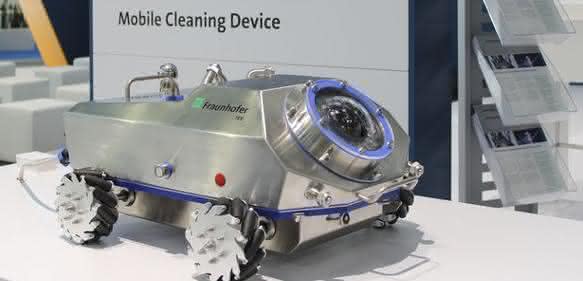
The Fraunhofer IVV Dresden is developing a mobile cleaning device that uses an optical sensor system for dirt detection to recognize the need for cleaning in systems, then individually determines the parameters for cleaning and then carries this out autonomously. To do this, the mobile cleaning device (MCD) is moved through the machine on the conveyor belt. In this way, the researchers combine the flexibility of manual cleaning processes with the advantage of reproducible results from automated cleaning-in-place (CIP) systems. They rely on sensors and industrial cameras from Baumer.
The idea for the first prototype of the MCD came about as part of the EU "PicknPack" project to develop a flexible and modular packaging system. "Our task was to develop a cleaning system. However, due to the modularity of the system, the integration of a conventional CIP system was not expedient," explains Roman Murcek, project manager for the MCD at the Fraunhofer IVV. A mobile, flexible cleaning device that cleans all surfaces of the systems that come into contact with the product in a hygienic manner without the risk of cross-contamination was the obvious solution.
Today, the MCD is equipped with seven nozzles that can apply different cleaning media such as water or foam at up to ten bar, depending on the type and degree of soiling. In the processing plants, it follows the product path and is moved through the machine on the existing conveyor system. A self-propelled system was designed for other cleaning tasks without a conveyor belt. Either a self-propelled additional module is used or motors and wheels are mounted directly on the cleaning device.
As it passes through the object to be cleaned, the MCD emits UV light in order to detect the usually fluorescent organic dirt particles, such as grease residue, using a camera. "In most cases, we generate the best contrasts with the UV light used, as the excitation produces hardly any visible light components," explains Murcek. The MCD cleans according to the registered soiling and spatial dimensions, for example by foaming heavily soiled areas more intensively. Each nozzle can be controlled individually.
Cleaning media, water pressure and temperature can be varied and also used precisely to achieve the best result. After pre-rinsing, foaming and rinsing, the appliance checks and records the cleaning result. The MCD is controlled via WLAN and powered by rechargeable batteries. "The only physical interface is a hose for supplying the cleaning medium," explains Murcek. This is connected to a supply station and supplies the MCD with water, foam or other cleaning media - simply by using the same nozzles without having to change over.
Its design makes the MCD flexible for use in different systems and increases food safety. Compared to manual cleaning processes carried out by humans, it works more efficiently, reliably and reproducibly. "It can also clean areas that a person cannot easily reach without dismantling parts of the machine," says Murcek, explaining another advantage. The researchers also expect significant time savings. Initial cleaning tests by the Fraunhofer IVV have also shown that around 20 percent of cleaning media can already be saved compared to conventional CIP systems. Finally, the image processing used enables seamless quality control and documentation of the cleaning process.
At the heart of the optical system's hardware for dirt detection and on-demand cleaning is a GigE camera from the CX series with five megapixels. "For years, we have been using Baumer cameras in various test rigs to monitor and quantify cleaning processes or to detect soiling on surfaces. Based on our positive experience, we have also opted for Baumer for the MCD," explains Murcek. Good image quality and high light sensitivity of the camera are important for the detection of weakly fluorescent soiling under UV light. With a resolution of five megapixels, the camera is also suitable for detecting small contaminated areas in a large image area without any loss of information. Image analysis is currently carried out via Matlab and Labview thanks to third-party compatibility.
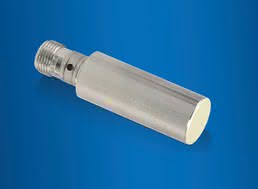
Selecting the correct cleaning parameters requires spatial orientation of the MCD in the machine. An inductive proximity switch from Baumer from the IFBR 17 series with suitable mounting is used to determine the exact position - all in a hygienic design made of stainless steel. Baumer has been supporting the Fraunhofer IVV for three years with sensors that are optimally designed to meet the high requirements of the food and beverage industry thanks to the consistent specialization for the food and beverage industry. The sensors used have protection class IP 69K and are protected against water jets, corrosion and high-pressure cleaning. The EHEDG-certified and Ecolab-tested hygienic housing design is resistant to chemicals, even aggressive cleaning and disinfection media, free of dead spaces and has smooth surfaces that prevent contamination from sticking. The inductive sensor therefore enables the MCD to reliably determine position in a hygienic, cleaning-resistant manner. as


You might also be interested in
Source of raw materials instead of hazardous waste
With the increasing use of lithium-ion batteries in industry, for example in driverless transport systems or as an emergency power supply for control systems, the volume of used batteries is also growing - and with it the challenge of recovering...
 read more...
Intelligent clutches
In many cases, a torque transducer is oversized for measuring torque and speed. A new intelligent clutch from R+W could be an alternative: it enables measurement data to be recorded directly in the drivetrain, measurements to be taken with high...
read more...Music of the future
The Blechexpo and Schweisstec trade fair duo took place in Stuttgart at the beginning of November. Like other industries, sheet metal workers and welding technicians have mixed feelings about the future.
read more...Early warning through interactive warning vest
The interactive warning vest from Linde Material Handling protects pedestrians in storage and production areas from approaching industrial trucks at an early stage with a tactile, audible and visible warning function.
read more...When is maintenance due?
The Brady inspection timer can save lives by clearly indicating when machines, equipment and tools need to be serviced. The LED indicators are clearly visible to operators and maintenance technicians, even from a distance.
read more...For one-hand installation
Desoutter is launching a one-handed angle screwdriver for the assembly of critical screw connections. With a length of around 30 centimetres and a weight of one kilogram, the transducer-supported EABS facilitates assembly processes.
read more...Process-accurate screw connections in series production
The power tool manufacturer Fein has launched three versions of the ASM 18 mid-handle screwdriver. They are identical in shape, but differ in terms of their torque output.
read more...Getting to the clamping point
Hermos Schaltanlagen in Mistelgau works with Desoutter screwdriving tools in production. Using the ergonomic cordless screwdrivers from the Elit series, the employees tighten the sensitive connections to the exact torque specified by the customer.
read more...1,400 variants, one line
I4.0 assembly line. With an assembly line from Bosch Rexroth, SFB manufactures hydraulic valves 20 percent more productively. A digital assistance system guides the workers through the entire assembly process, reduces errors and increases...
read more...