

Cleanroom automation
Robot welding and testing
Martinmechanic dealt with delicate parts handling when building an automation cell for medical technology. Two Omron XG600 Scara robots in cleanroom design and five image processing systems are used to weld and inspect a catch basket.
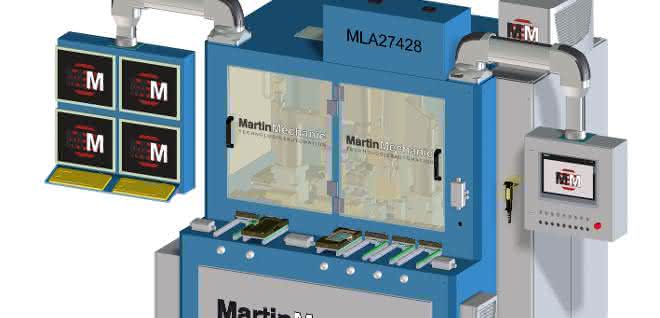
The catch baskets, in which the finest concretions from all layers can be collected during surgery, are welded to a shaft that must be absolutely rigid, but also has a hyper-flexible distal end. This is why all work steps are precisely defined. The MLA27428 automation cell achieves a cycle time of 25 seconds. It is important that the fine titanium wires of the catch basket are aligned so that the axial and radial alignment is exact.
As the parts must not be poured due to their sensitivity, they are provided in plastic trays. The worker places these in a drawer. The magazine automatically pulls itself into the working position. A camera above the plastic tray, which is illuminated from below, shows the robot the exact position of the four millimeter long shaft. The handling robot then picks up the shaft and moves it to the alignment station, where it inserts it into the cavity, which is mounted on a servomotor. The robot then picks up the basket, which has been placed in the second drawer in a plastic tray, and places it in the alignment station. Before further processing, the parts are checked axially and rotationally for positioning accuracy.
As it has two grippers, the robot picks up both parts at once in order to insert them into the chuck holder of the shuttle table. Once the clamping device has automatically closed, the handling robot returns to its home position. The shuttle table rotates to the laser welding station, where the alignment of the components is checked again with the help of further image processing. If necessary, the position can be corrected using the servo rotary unit.
The light-tight welding protection hood is now lowered over the parts using a lowering axis so that the basket and shaft can be joined. Five-fold spot welding is carried out under inert gas in order to obtain an even, homogeneous weld seam. For this purpose, an extraction nozzle and a supply air opening with filter were installed in the roof of the automation cell to clean the air inside the work cell immediately. As soon as the welding protection hood is raised again, the oscillating table is released. This then rotates 180 degrees so that the test robot can pick up the finished part and place it in the test station. The tensile test ensures that the weld seam holds. The parts are then checked again in the concentric run.
The finished parts that pass the test are placed in blister trays. The worker uses two drawers to do this so that the trays can be removed in rotation. Parts that are not in order are placed in a separate magazine. In addition, finished parts can be ejected from the ongoing production process at any time via a request switch. They are then also placed in a blister, which is accessible via the side door.
All process data is monitored and archived, as this involves the production of surgical instruments. Sensors provide information about the production quantity, the ejected SPC parts and the parts found to be defective at 20-second intervals via the system's open interface. The machine status, order, batch and identification numbers, current quantities, gas flow and laser power are also recorded. The MLA27428 is controlled via a Siemens SF15090F. The 19-inch operating display, on which the camera and tensile test are also visualized, is mounted in a fixed housing on the articulated arm. The development time for this system was around one year until commissioning at the customer's site. Pre-zero series production took place at Martinmechanic. pb


You might also be interested in
Filtration and sound attenuation in circuits
In liquid or air circuits, filter housings and silencers protect measuring devices, ensure particle-free vacuum and pneumatic systems, keep cooling circuits clean and reduce noise.
 read more...
KSS ultrafine filtration for grinding oils
Modular concept for pure oil
In order to grind economically, reliably and with the highest quality, extremely clean grinding oils are required. Filter manufacturer Vomat offers the metalworking industry high-performance and customized concepts for the filtration of cooling...
read more...Up to 95 percent less flue gas thanks to direct extraction
The requirements for occupational safety measures and safety technology are also constantly increasing in welding technology. The Technical Rules for Hazardous Substances (TRGS) stipulate that welding fumes and harmful substances must be extracted...
read more...Everything accurate in switch cabinet construction
To ensure smooth work processes, tools for processing enclosures and housings must function flawlessly and reliably. Häwa rounds off its punching range with the Multi-Press 500.
read more...Cooling and temperature control units
Hygienic packaging sells safely
In few industries are the requirements for hygiene in the production process as strict as in the food sector - the health of consumers has top priority. This results in enormous challenges for all machines and components involved, especially in...
read more...Efficient and sustainable
Rotary screw compressors are the reliable backbone of industrial compressed air generation. The innovative CSD/CSDX series from Kaeser Kompressoren with its numerous features produces them efficiently and saves energy costs. This also reduces theCO2...
read more...Healthy air during welding
Welding produces fumes and gases that are hazardous to health. Extraction is necessary to comply with the occupational exposure limits and is even mandatory when welding high-alloy steels.
read more...Wire mesh filters in medical technology
In hardly any other industrial development sector are the demands placed on products as high as in medical technology. After all, human lives depend on the performance and reliable quality of medical devices.
read more...Energy efficiency and sustainability in the smallest of spaces
With the StingR ultra-fine filter system, Lehmann-UMT has created a solution for the energy-efficient and precise treatment of fluids during tool grinding for extended tool life and high tool quality.
read more...