

Ring roller
Schuler establishes itself in the manufacture of seamless rings
It was around five years ago that Schuler decided to enter the rolling sector. In the meantime, the forming technology specialist has already realized and delivered three projects, enabling the company to make the leap from machine to system supplier to provider of turnkey systems. With a newly developed machine, Schuler now also offers complete systems for the production of seamless rings.
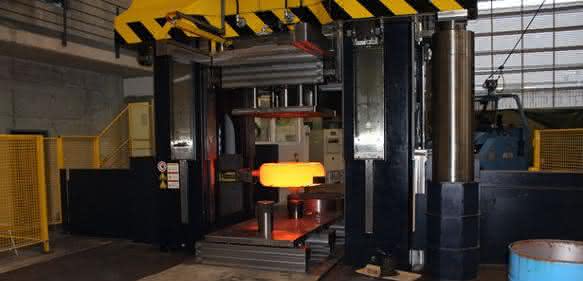
What makes rings special? They are infinite and stand for durability and eternity. However, rings must not have any imperfections. This is also the aim of the rolling process: a component that is not joined at any point by a weld seam that could crack. The forming process produces a very good microstructure without defects with an uninterrupted grain flow and small grain size. As a result, the rings manufactured in this way are characterized by high strength and toughness and are suitable for the highest loads in everyday use - for example in wind turbines. Rings with a small cross-section and low weight are produced with low material usage and low production costs.
During the manufacturing process, sections are first sawn, heated and partially descaled. Depending on the required quality, this is followed by forming processes in a press, known as preforming. The preliminary conclusion is rolling to give the ring the desired final geometry, diameter and shape. Heat treatment may then be required before final machining.
There are two basic methods for preforming. On the one hand, a multi-stage process is possible in the press, in which three stages are installed: Upsetting, pre-punching and through-punching. On the other hand, there is a wide variety of applications in which forming takes place in a single stage in the center of the press. Several actions are required to produce the ring preform. For example, there are various concepts for swiveling in tools or moving lower tools in the machine. To do this, the parts must be centered and lifted.
This means that the press concept is very complex and the necessary processes are very varied. Last but not least, there are many different forming processes: Punching from above, punching from below, punching in the die - depending on what the component is ultimately needed for and what the desired fiber flow should look like. The larger the ring and the higher the requirements for the fiber flow, the more likely it is that the single-stage press concept will be used.
Of course, an entire line consists of more than just a ring roller and a press. For example, there are also heating systems for which Schuler has worked together with Andritz Metals. Schuler also offers the necessary automation such as robots and charging machines: The components are too hot and often too heavy to be transported manually.
Improved cooling
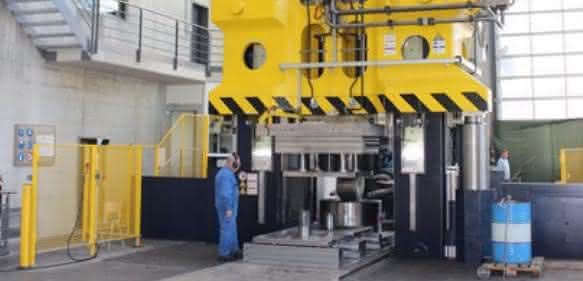
In addition, the company has implemented an advantage in the wheel roller line: a rolling mandrel that also rotates when there are rings in the machine. The fact that only one side can be cooled unevenly leads to deflections in conventional machines in practice, the so-called bimetal effect. This means that the mandrels are already subjected to bending stress just by the cooling. This is why the forming technology specialist has integrated a motor into the upper bearing of the wheel roller, which can also rotate the mandrel and all other forming tools during downtimes. This allows them to be cooled evenly from all sides.
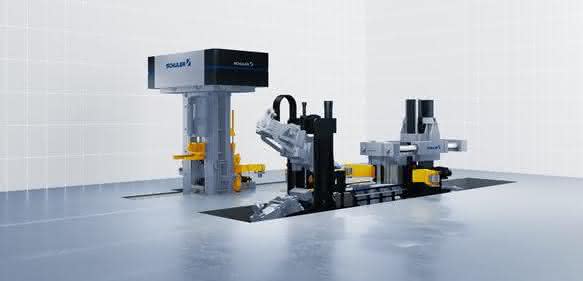
Another - patented - advantage lies in the design of the machine itself. With conventional wheel rollers, the mandrel has to be pulled out to get the component in and out of the machine. This mandrel lifting device determines the machine height. However, it represents an interfering contour when changing tools weighing several hundred kilos, which have to be laboriously installed and removed using the overhead crane. Schuler has therefore deliberately dispensed with a conventional mandrel lifting device in its design. Instead, the entire upper bearing was installed on a travel rail so that the entire structure can be moved upwards to create space for changing the rings. At the same time, the height of the machine is reduced, which improves accessibility.
The mandrel roller is also designed as a cassette that can be clamped hydraulically or mechanically in the machine, depending on customer requirements, and can therefore be easily replaced with pre-equipped tools. The same applies to the main roller, which can be completely removed from the machine and replaced with a pre-equipped main roller.
The movable upper bearing can also be used to adjust the mandrel bearing downwards for lower rings. As a result, the length of the mandrel is considerably shorter and the bending stress caused by the process is significantly lower. The main wear and tear on previous machines is the breakage of the mandrel if it is subjected to too much stress due to the large support distances and high bending stresses. By adapting the mandrel bearing to the ring height, the company achieves significantly longer service lives in comparison.
All machines integrated in this process run under the same control system. Thanks to a holistic system concept including dies, forming machines and heating technology, Schuler now also offers a one-stop solution for the production of rings. ee


You might also be interested in
Clever solutions for sensitive gripping
Innovative systems and exciting world premieres? That's what visitors will find at productronica in Munich from November 18 to 21. In Hall B3 at Stand 301, vacuum specialist Schmalz will be showcasing efficient and future-oriented handling systems -...
 read more...
Proprietary plastic compounds for extreme conditions
Cables must reliably transmit energy, data and signals, even in extreme cold or heat or under heavy mechanical stress. Specially developed plastics ensure that the cables remain robust and resistant. Lapp produces its own plastic compounds.
read more...Efficiency comparison of 3D printing, CNC manufacturing and injection molding
3D printing, CNC manufacturing or injection molding? When designers are looking for the most suitable manufacturing process for an individual component, they often lose time and also quickly lose track. Igus is changing this with the Triboteile...
read more...Heat transfer and additive manufacturing
Conflux Technology enters the hypercar sector
Pagani has announced the signing of a six-year contract with Conflux to integrate Conflux heat exchangers into the transmission of its latest exclusive model, the Pagani Utopia, further advancing additive manufacturing in the hypercar industry.
read more...Metal foam and PFAS replacement improve environmental balance
Metal foam contains up to 90 percent air and has amazing properties. In the factory, it ensures greater sustainability and helps to improve the environmental balance in industrial production.
read more...PFAS alternatives with high performance
Igus wants to set an example for innovation and sustainability and will be presenting new products at HMI 2025, including PTFE-free materials and products made from recycled material.
read more...No splinters, no maintenance
New properties also apply to load carriers in logistics and intralogistics processes. Craemer's portfolio includes high-quality returnable load carriers that are hard-wearing, versatile, maintenance-free and recyclable.
read more...Tensile strength of 3D components
Voxelfill strategy overcomes inhomogeneous strengths in 3D printing
The company AIM3D has succeeded in demonstrating the advantages of the patented voxelfill process. Strength tests now prove that this process can overcome inhomogeneous strengths of 3D components in the X, Y and Z axes and thus comes close to...
read more...Lubrication-free plain bearing materials...
Igus focuses on the development of PFAS-free materials
And again the topic of PFAS: The new "endurance material" Iglidur JPF complements the wide range of wear-resistant PFAS and PTFE-free polymer bearings. Igus is thus preparing for new regulations.
read more...