

High-voltage component protection in Formula Student
Flex Locs from ACE play a key role
The fact that the smallest, weight-saving details are important in racing is demonstrated by the Speeding Scientists Siegen. The racing team from the University of Siegen, which takes part in the Formula Student racing series for young academics with its racing car called "Molly", uses quick-fastening elements from ACE to effectively decouple the power electronics from the chassis vibrations of the electrically powered racing car.
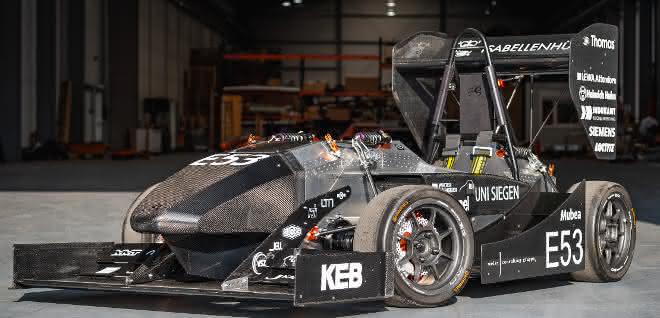
In 2019, the Siegen team, which is organized in a club and has around 30 members, opted for the first monocoque construction made of aluminium in more than 10 years of racing activity. The decision to use the light metal monocoque was made not only for economic reasons but also because of its better torsional rigidity compared to conventional tubular frames. Many parts are made of carbon and unique 3D printed parts and were analyzed in CFD simulations. They contribute to the fact that Molly accelerates from 0 to 100 km/h in less than 3 seconds and generates a downforce of up to 2,700 newtons at a top speed of 130 km/h.
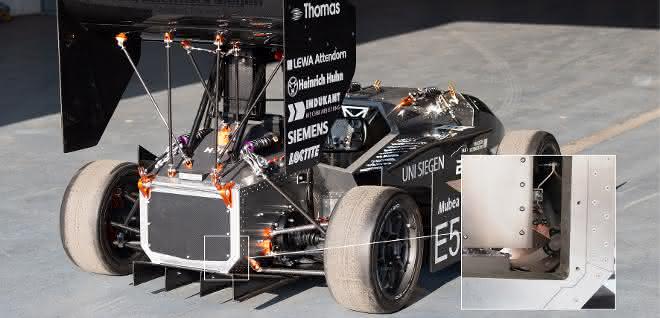
Self-developed electric motors with 29 kW and 46 Nm provide the drive, and the inverters installed in the racing car are designed to save space and weight.
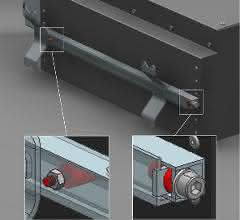
The students from Siegen turned to ACE shock absorbers for vibration damping of the power electronics and to protect all high-voltage components. There, the team learned that the Flex Locs, which are suitable for a load range of 0.4 kg to 28 kg, effectively decouple two components from each other. In this case, four of these detachable blind rivet connections were then installed to decouple the inverter from the body. With their help, the chassis can be pushed to its limits in both test and racing mode.

So far, the vibrations and shocks caused by this have not affected the electronics themselves. Tom Kellmann, 2019 member of the chassis team and team leader until 2018, sums up with satisfaction: "The quick-fastening elements from ACE are of good quality, easy to handle and, what is particularly important in racing: they are light!"
The Flex Locs are fixed in place using standard screws in sizes M3 to M8, whereby they tighten like rivets between the front and clamping side. The elastic connecting elements can also be fastened by screwing them into blind holes, for example to connect them to existing building structures. They isolate structural resonances down to 150 Hz. The degree of isolation that can be achieved against normal structural vibrations is up to 80 percent. When not used in racing, the main areas of application for these little helpers include power units and machines, cladding, sheet metal and flanges, as well as attachment elements on buildings, vans and construction machinery.


You might also be interested in
Assembly processes seamlessly monitored
Tox Pressotechnik is expanding its range of standard presses.
 read more...
Automated production
From self-learning robots for the field and factory to state-of-the-art cleanroom technologies, methods for the explainability of machine learning and software tools for optimized production, Fraunhofer IPA will be showcasing applications and...
read more...Many components lead to the desired product
Safe and healthy working is Hymer's central theme at the A+A occupational health and safety trade fair in Düsseldorf in October. The company will be presenting step and platform ladders there.
read more...With water cooling system for multiple rivet joints
A Slovakian automotive supplier uses a stable C-frame press with electromechanical servo drive from Tox Pressotechnik for the precise riveting of clutch components in large-scale production.
read more...Clean connection
Clinching has proven itself in the assembly of household appliances thanks to its efficiency and reliability. On a new clinching system, a Swiss manufacturer joins the guide plates for crockery and cutlery drawers to the side panel of the high-end...
read more...Intelligent drives improve riveting technology
Together with automation specialist Sigmatek, Swiss company BalTec has developed an innovative drive module for efficient and precise riveting and cold forming.
read more...Gun with integrated cooling line
Maschinenbau Technologie Herrde (MTH) presents the further developed USH 40E and USH 30E manual welding machines.
read more...Pneumatic riveting tools from Chicago...
Repairing metal structures in aircraft construction
Chicago Pneumatic has launched a new range of riveting tools for the repair and maintenance of metal structures in the aerospace industry.
read more...Conveyor chain for overhead conveyors
Conveys twice as long
Conveyor chain for overhead conveyor. A British car manufacturer was looking for a maintenance solution for the overhead conveyor driven by a conveyor chain for transporting car parts.
read more...