
Joseph von Fraunhofer Prize 2024
Simulation methods: time-saving mapping of complex processes
Whether in the automotive sector or in production, simulations and digital twins are indispensable for many companies. Because highly dynamic processes often cannot be mapped satisfactorily with conventional software, researchers at the Fraunhofer Institute for Industrial Mathematics ITWM have developed the MESHFREE tool, a solution that works without a rigid computational grid and is able to simulate complex processes with great time savings and thus cost-effectively. They have been awarded the Joseph von Fraunhofer Prize 2024 for their work.
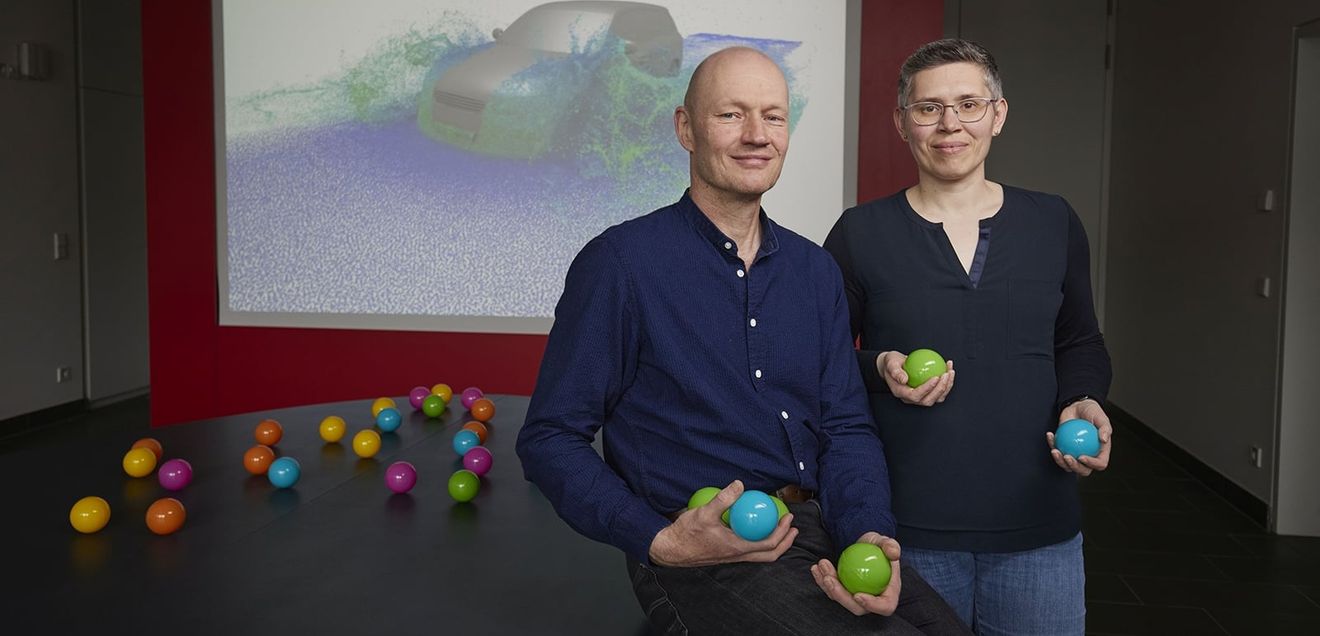
Rigid specifications rarely fit agile processes - what applies to organizations also applies to simulation methods. If complex processes such as aquaplaning or the machining of metal are to be mapped virtually, it is not possible to predict all the movements of the components in advance and create them in a suitable calculation grid, as is usually used for simulations.
Meshfree replaces the real test
This was the challenge faced by a research group at the Fraunhofer ITWM more than 20 years ago. "Our very first task in the project team was to simulate the deployment of an airbag during a vehicle crash," reports Dr. Jörg Kuhnert, who was already part of the group at the time. "Apart from cost-intensive crash tests carried out in real life, there was no way of quickly testing the safety of new developments in this area at the time." This is because the more objects that move and interact with each other in a situation, the more difficult it is to reliably reproduce them at a reasonable cost using conventional simulation methods.
Based on Jörg Kuhnert's dissertation, the team developed the grid-free approach - since 2012 also with the collaboration of Dr. Isabel Michel in the area of free jet turbines. In some cases, this makes it possible for the first time to show particularly complex and dynamic situations in the simulation. All of the research results achieved since then have been incorporated into the Meshfree software tool. The result is a simulation tool with a truly unique selling point: no other simulation tool in the world makes the Generalized Finite Difference Method (GFDM) available for industrial use.
Flexible method for dynamic processes
Traditionally, the finite element method is used for simulations: engineers construct a grid suitable for the respective geometry and calculate the changes in each individual element based on this. Even setting up the grid structure is time-consuming; it also has to be repeatedly adapted during the simulation. In contrast, the Meshfree software combines the generalized finite difference method for solving the conservation equations for mass, momentum and energy with efficient algorithms for solving linear systems of equations, which were co-developed by the Fraunhofer Institute for Algorithms and Scientific Computing SCAI - a huge advantage, as the numerical point cloud used can adapt flexibly to moving geometries. There is no need for time-consuming corrections in the computational grid. Dr. Jörg Kuhnert and Dr. Isabel Michel have been awarded the Joseph von Fraunhofer Prize 2024 for their development, which can replace real experiments.
From automotive to process engineering - and beyond
The excellent methodology can be used for a wide range of applications. One current focus is in the automotive sector: in addition to airbag simulation, the researchers have so far been able to support their industrial partners with modeling water crossings or the behaviour of vehicles on sand or gravel, among other things. In process engineering, Meshfree has helped companies to optimize process parameters in the processing of molten glass and the production of plastic parts.
In principle, the method can be used wherever measurements or experiments need to be replaced or only work poorly or not at all. Isabel Michel summarizes: "We are not fixated on the classic applications of numerical fluid mechanics. Meshfree can do much more: the tool is deliberately kept generic." The software has great potential to save costs, time and materials in many other fields of application in the future.


You might also be interested in
AI automation specialist reorganizes...
Generation change at Insiders Technologies
After almost 30 years at the helm, Werner Weiss is handing over the management of Insiders Technologies. Andree Albrecht takes over the management after a transition phase.
 read more...
Intelligent brownfield networking
Many industrial companies are struggling with established plant structures and proprietary interfaces. Stefan Klaus' presentation will show in a practical way how brownfield environments can be efficiently networked with open technologies and made...
read more...Factory-X in practice
How can set-up processes in highly variant production be automated efficiently? Markus Benndorff from soffico shows how Factory-X, industrial data rooms and modular architectures create new possibilities for flexible production concepts.
read more...Quality controls in production
Robots check car floor pans fully automatically
How can complex components in automotive production be inspected fully automatically and in real time with the help of machine vision and robotics? The case study shows how floor pans are measured and inspected fully automatically.
read more...Measurement software with integrated calibration wizard
The WinControl measurement software from Ahlborn is designed for the acquisition and processing of measurement data with Almemo measuring devices and offers functions for complex calibration tasks. A graphical user interface and context-sensitive...
read more...New platform facilitates chip design
Siemens opens access to EDA software in Europe
Siemens is cooperating with the Chips JU within the framework of EuroCDP and is facilitating access to modern EDA software for chip design, development and innovation for European companies. The aim is to strengthen start-ups, SMEs and research...
read more...AI and virtual twins for the industry
Dassault Systèmes confirms annual forecast after solid start to 2026
The French software group Dassault Systèmes has made a solid start to 2026 and is continuing to focus on artificial intelligence, cloud applications and virtual twins as growth drivers in its industrial business.
read more...Use data consistently and uniformly
New connectors and an app solution for the IIoT framework from PLCnext Technology make it easier to collect data from controllers, sensors and field devices - especially in existing systems.
read more...How companies can prevent cyberattacks
Instead of using traditional malware, attackers use legitimate programs and system tools within their victims' IT environments. Malicious behavior can hardly be distinguished from normal user behavior. For companies, this means that security...
read more...