

Process monitoring in robotics
The goal: Holistic control
With solutions based on piezoelectric sensors, Kistler can efficiently monitor industrial robots and further optimize assembly and handling processes. Thanks to miniaturized and integrated systems, robots will become more precise, more flexible, more efficient and safer in the future.
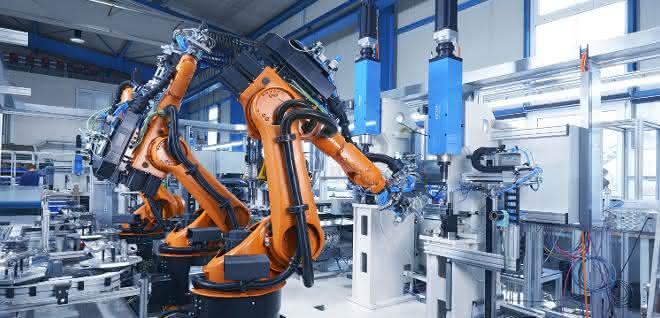
Robotics is playing a growing role as part of modern industry; the number of industrial robots in use worldwide is increasing. Industrial robots are established and increasingly in use, particularly in sectors where high quality components and systems are required - such as the automotive industry, medical technology and electronics manufacturing.
Kistler, which specializes in piezoelectric measurement technology and process monitoring systems, provides technologies and solutions to make robots more flexible, precise and safe - for example, integrated force-displacement monitoring can be used to optimize assembly processes and make them significantly more efficient.
Frank-Peter Kirgis, Head of the Industrial Process Control (IPC) Division at Kistler, explains the opportunities: "In future, we want to work more closely with manufacturers of robot peripherals, such as grippers, assembly technology and tools. But robot manufacturers will also benefit from our solutions, not least in the area of human-robot collaboration." According to Kirgis, the aim is to develop complete application packages that offer the most seamless integration possible into the respective automation environment.
Bringing robotics and process monitoring together
The conditions for this are ideal: both robotics and process monitoring and sensor technology are already well developed and in widespread use - the task now is to bring the two closer together. Kistler has expertise in the entire measurement chain, from crystal to sensor production and electronics to signal evaluation and software development.

"Piezoelectric sensor technology has a number of advantages over the strain gauge technology that has been predominantly used on robots to date: higher accuracy, enormous robustness, larger and switchable measuring range, to name just a few - this significantly increases the precision and flexibility of a robot system," explains Kirgis. "If you look at our measuring chains for force sensors, many of the technical challenges have basically already been solved. When it comes to robotics, the technological basis is the same, only the form factor changes: of course, the systems on the robot arm are smaller - miniaturization is crucial - and suitable interfaces and software solutions are needed to communicate signals and data directly to the controller."
Various systems from Kistler are already in use on the robot. In car body construction, for example, Kistler sensors monitor the spot welding guns on the robot to ensure that the welding points are set correctly - because the quality of the welding process and therefore the cohesion of the car body depend on this. The technological approach can be transferred to other assembly techniques such as riveting, screwing and clinching, where processes are monitored directly on the robot arm.
Kistler's electromechanical joining systems will also be available for use on robots in the future. "We are starting with the niches where we are already active and gradually expanding these to include additional applications. As a partner to mechanical engineering and system integrators, we want to develop further, from the periphery to the robot system. In the future, Kistler will offer application-oriented robotics solutions that make it easy for customers to integrate these systems into their plants," emphasizes Kirgis.
Development potential for MRK
Kistler also sees development potential in the field of HRC. With image processing technology from Vester, the appropriate means exist to monitor and control robots in a targeted manner and to use them in an optimized and safe manner. "When it comes to HRC, it's important to keep an eye on the entire application, not just the robot. We want to ensure overall process safety through holistic monitoring - that means machine safety and quality assurance in one," explains Kirgis.
The focus is on close cooperation with the customer and joint development work. Key topics are user-friendliness and software development in order to make new solutions ready for the market that offer the greatest possible added value and can be fully integrated. With its in-house software expertise, which extends from the field level to the MES level and beyond, Kistler aims to develop the systems to such an extent that they can be seamlessly integrated into the customer's production environment. pb


You might also be interested in
Assembly processes seamlessly monitored
Tox Pressotechnik is expanding its range of standard presses.
 read more...
Automated production
From self-learning robots for the field and factory to state-of-the-art cleanroom technologies, methods for the explainability of machine learning and software tools for optimized production, Fraunhofer IPA will be showcasing applications and...
read more...Many components lead to the desired product
Safe and healthy working is Hymer's central theme at the A+A occupational health and safety trade fair in Düsseldorf in October. The company will be presenting step and platform ladders there.
read more...With water cooling system for multiple rivet joints
A Slovakian automotive supplier uses a stable C-frame press with electromechanical servo drive from Tox Pressotechnik for the precise riveting of clutch components in large-scale production.
read more...Clean connection
Clinching has proven itself in the assembly of household appliances thanks to its efficiency and reliability. On a new clinching system, a Swiss manufacturer joins the guide plates for crockery and cutlery drawers to the side panel of the high-end...
read more...Intelligent drives improve riveting technology
Together with automation specialist Sigmatek, Swiss company BalTec has developed an innovative drive module for efficient and precise riveting and cold forming.
read more...Gun with integrated cooling line
Maschinenbau Technologie Herrde (MTH) presents the further developed USH 40E and USH 30E manual welding machines.
read more...Pneumatic riveting tools from Chicago...
Repairing metal structures in aircraft construction
Chicago Pneumatic has launched a new range of riveting tools for the repair and maintenance of metal structures in the aerospace industry.
read more...Conveyor chain for overhead conveyors
Conveys twice as long
Conveyor chain for overhead conveyor. A British car manufacturer was looking for a maintenance solution for the overhead conveyor driven by a conveyor chain for transporting car parts.
read more...