
Study at KIT
Waste incineration destroys PFAS chemicals
PFAS chemicals are contained in countless products. Many of them are highly toxic. Researchers at the Karlsruhe Institute of Technology (KIT) have tested what happens to them during waste incineration. The result: no significant PFAS emissions are produced.
PFAS chemicals (perfluorinated and polyfluorinated alkyl compounds) are often used in products such as coated pans, rainwear, baking paper or pizza boxes due to their water and dirt-repellent properties. This group of substances comprises more than 10,000 compounds with different properties. They are extremely persistent, hardly degradable in nature and accumulate in groundwater and soil. Many of them are highly toxic, especially for the development of children, and are associated with the development of organ damage and cancer, for example.
Researchers investigate the effectiveness of combustion processes
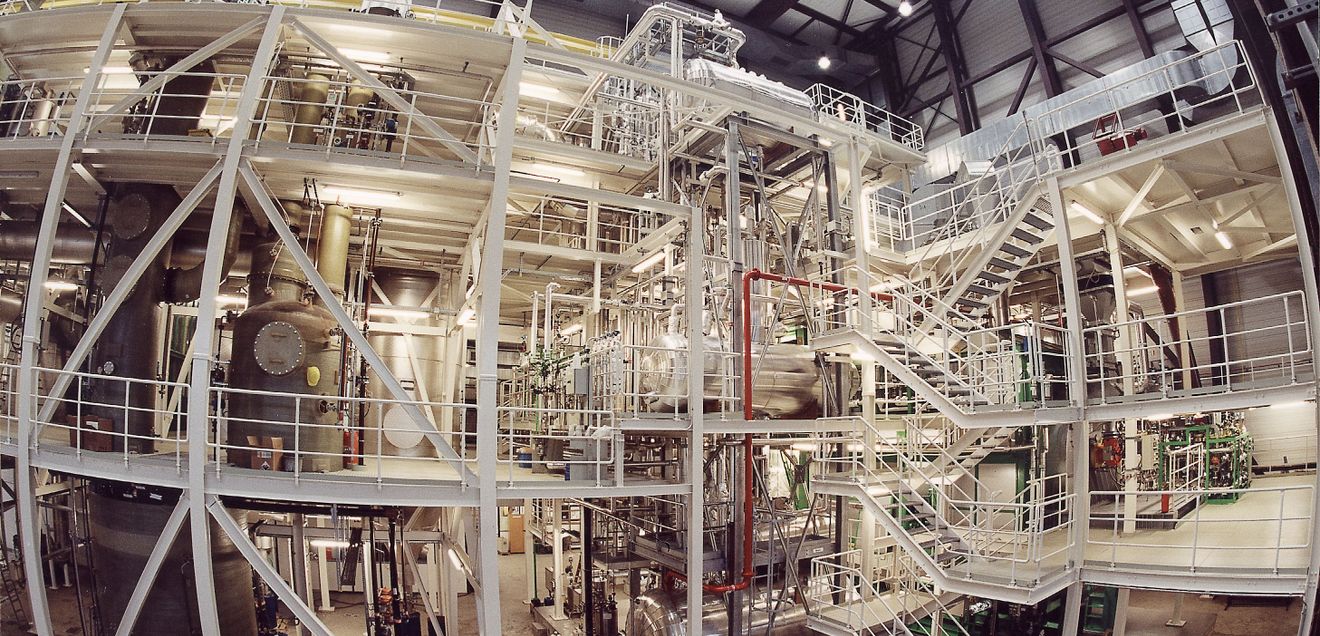
A research team led by Dr. Hans-Joachim Gehrmann from the Institute of Technical Chemistry (ITC) at KIT has now investigated whether and to what extent the compounds are also released into the environment via waste incineration. In cooperation with the Indian company Gujarat Fluorchemicals, a manufacturer of fluoropolymers, the scientists carried out tests on the power plant pilot combustion chamber Brenda (combustion chamber with steam boiler) at KIT. Fluoropolymers were burned and the PFAS concentrations in the wash water, ash and exhaust gas were subsequently determined. The tests were intended to clarify at which combustion temperatures and conditions the most complete destruction of PFAS can be achieved.
Representative mixture of fluoropolymers
The researchers tested two different temperature conditions: 860 degrees Celsius, corresponding to the European standards for household waste incineration, and 1,095 degrees Celsius, as in the incineration of hazardous waste. In both cases, the minimum residence time for the exhaust gases in the combustion chamber was two seconds. "We were able to show that at combustion conditions of 860 degrees Celsius and two seconds dwell time, a fluorine-related degradation rate of more than 99.99 percent can be achieved. This means that almost complete mineralization of the fluoropolymers was achieved under conditions similar to those in household waste incineration," reports Gehrmann. "Incineration at 1,095 degrees Celsius did not significantly increase the degree of degradation. This suggests that a higher temperature has no significant influence on the mineralization of the fluoropolymers."
For the experiments in the combustion chamber, the team selected a representative mixture of fluoropolymers covering 80 percent of the fluoropolymers used commercially worldwide, including polytetrafluoroethylene (PTFE, also known as Teflon), polyvinylidene fluoride (PVDF), perfluoroalkoxy polymers (PFA) and fluorororubber (FKM).
Samples were taken at several points in the combustion process: at the exit of the post-combustion chamber, after the boiler and in the flue gas at the chimney. The team also analyzed samples from the wash water and the ash. Using analytical methods such as coupled gas chromatography-mass spectrometry, PFAS were precisely identified and quantified. "The results are good news for the virtually residue-free disposal of fluoropolymers via household waste incineration in accordance with European standards," says Gehrmann, assessing the research results. "However, PFAS also enter the environment in other ways that still need to be investigated and evaluated."
The study was published in the journal Chemosphere. DOI: 10.1016/j.chemosphere.2024.143403


You might also be interested in
New Center for Circular Economy
Resource efficiency through additive manufacturing
Making process chains in additive manufacturing more resource-efficient - that is the goal of the new CZS Center for Circular Economy and Resource Efficiency using Additive Manufacturing Technologies (Center KRAFt).
 read more...
Sustainability is digital
The motto of Hannover Messe 2024 was Energizing a Sustainable Industry. With numerous research projects, the FZI Research Center for Information Technology presented the possibilities of digitalization on the way to a sustainable and more...
read more...Digital twin in battery production
Faster to more powerful batteries
The battery factory of the future is increasingly working digitally: simulations accompany the development of new cells, and intelligent sensors monitor production in real time. Researchers at the Fraunhofer Institute for Industrial Mathematics ITWM...
read more...Giving lightweight construction a profile
Pultrusion: A process that forms fibers under tension
Pultrusion is developing from a niche process into a key process for lightweight construction and sustainable fiber composite structures. The Fraunhofer IWU shows applications from energy to mobility.
read more...Infineon Startup Challenge 2026
Focus on humanoid robotics
Infineon brings together young deep-tech companies worldwide to drive innovation in humanoid robotics. The focus is on hardware and system solutions from sensor technology to motor control. Applications are still possible until May 27, 2026.
read more...Students at Darmstadt University of Applied Sciences test driverless racing system
The student racing team at Darmstadt University of Applied Sciences is developing an autonomous driving system for the electric racing car "F26" with expertise in image processing and computer science.
read more...Real-time control to make recycling materials economical
The Fraunhofer IAPT is researching AI-based closed-loop processes for industrial 3D printing with recycled plastics. The aim is to achieve less waste, greater process stability and profitable printer farms.
read more...Automated restoration of windows from old buildings
The Chair of Production Systems at Ruhr University Bochum is working with the company Kilivations to develop a robot-based process for the restoration of windows potentially contaminated with asbestos in old and listed buildings. The aim is to make...
read more...Leadership as a bottleneck
Leadership determines whether production areas deliver stable results under pressure or remain in reaction mode. Clear management tasks, roles and routines ensure performance and turn deviations into results instead of crises.
read more...