
Corporate management
Leadership as a bottleneck
Leadership determines whether production areas deliver stable results under pressure or remain in reaction mode. Clear management tasks, roles and routines ensure performance and turn deviations into results instead of crises.
Production areas can only remain efficient if leadership works. For it to be effective, it must be clearly aligned within the company and consistently implemented on a day-to-day basis. Leadership is not a soft additional skill, but a management task. It determines how data, deviations and conflicting objectives are turned into concrete priorities and effective measures. Quality and performance in production are the result of decisions in day-to-day business, not concepts. Management determines whether information is used or remains inconsequential.
Production managers today are under great pressure. Quality, reliability, speed, flexibility and cost efficiency must be achieved simultaneously - in shift operation, with a high number of variants and increasing uncertainty. With increasing complexity, management decides whether the operation remains stable in time or whether it goes into reaction mode. Disruptions cannot be avoided. However, management determines whether they are controlled or become a permanent problem.
In many production areas, management itself becomes a bottleneck. Key figures and information are often available in real time, but do not automatically lead to decisions. It is often unclear who decides in the event of conflicting objectives, what has priority at the moment and who is responsible for implementation. Deviations are reported but not decided; measures are initiated but not consistently pursued. Leadership then depends on individuals instead of being reliably anchored in the company. If leadership becomes a bottleneck, this is rarely due to the commitment of individuals. The decisive factor is whether leadership is clearly defined, coordinated and effectively anchored in the system.
What effective leadership must achieve
Leadership is effective when it sets priorities and enables decisions to be made on a day-to-day basis. It translates deviations into concrete decisions and actionable measures. Above all, this includes regularly checking whether employees and managers have everything they need to perform at their best. At the same time, management shapes the framework conditions within which production takes place. As the area of responsibility grows, the focus shifts from individual decisions to the design of structures.
Individual training courses, new terms or short-term initiatives hardly change management in the company. Reliability is only created through a common understanding of leadership in the form of company leadership principles that provide orientation in everyday life and facilitate decision-making. Leadership is understood as the targeted exertion of influence on structures and people - with the aim of enabling reliable performance. This understanding describes what leadership should achieve in the company - independent of individuals. This makes leadership comprehensible and verifiable. Without such guidelines, different experiences lead to different decisions. Conflicts of objectives escalate and leadership always starts all over again.
Complementary leadership: tasks, roles, routines
The complementary leadership model provides a proven and easy-to-implement basis for this. It structures leadership along three elements.
Management tasks:
They describe what leadership has to achieve in day-to-day production. Firstly, employees must be able to do their work well. Goals and priorities are clear, qualifications and feedback are right, cooperation works. Secondly, performance requires stable framework conditions - such as a clear business strategy, sustainable processes and an organization that enables decisions to be made. Leadership does not ensure execution, but rather the conditions under which execution succeeds.
Management roles:
You clarify who is responsible for these tasks. In everyday life, employees manage their own work as far as possible. The manager supplements where there is a lack of self-control. They are also responsible for the overarching rules and structures. Roles change depending on the perspective. Managers who lead a team are themselves part of the system that they lead in relation to the next level up.
Management routines:
They make leadership concrete. This refers to fixed, scheduled formats in which priorities are clarified, decisions are made and measures are pursued - from short shift talks to strategy meetings. They ensure that deviations do not remain unresolved and that solutions take effect in the company. The decisive factor is not the number of meetings, but whether they lead to clear decisions and binding implementation.
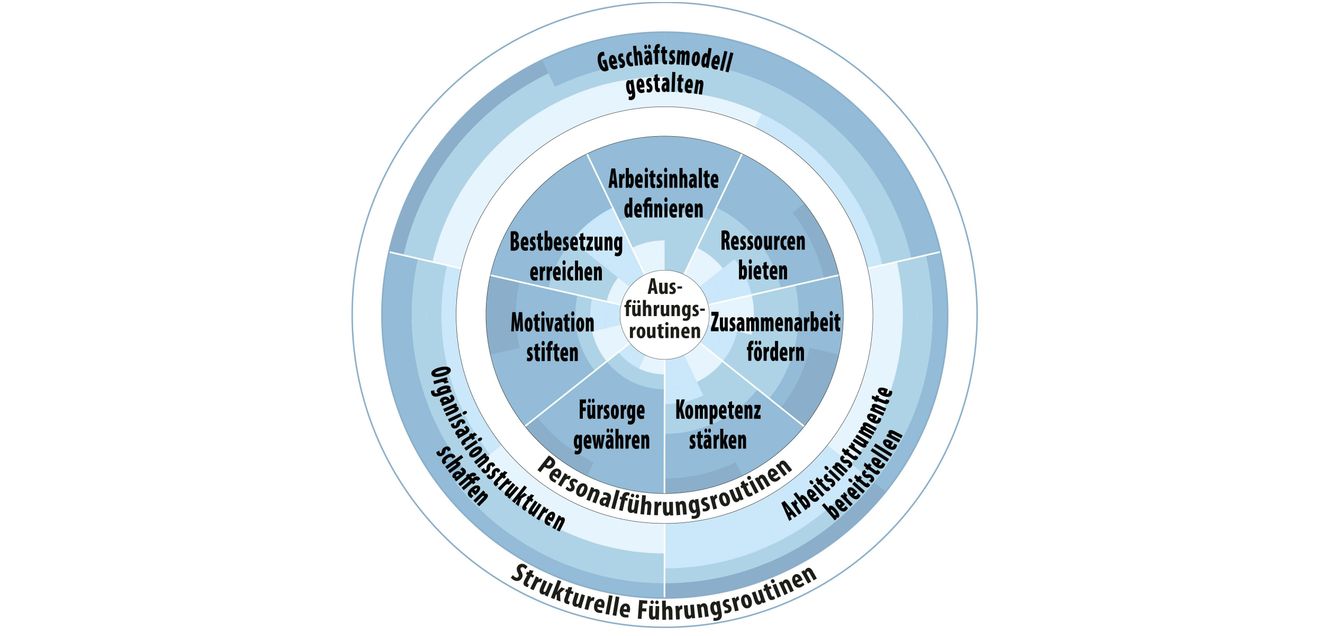
Together, this creates a resilient management system: it is clear what needs to be done, who is responsible and how management works on a daily basis.
Leadership in everyday life: a practical example
Short stoppages accumulate on a bottleneck line and performance drops. In the shift meeting, the problem is jointly classified and clearly prioritized. An immediate measure is defined as binding. A clear escalation is defined for any further deviations. The measure is effective and downtimes are reduced. The solution is firmly established in everyday life so that the problem does not recur. Leadership here does not ensure actionism, but clear priorities, binding decisions and stable implementation.
Leadership as a stabilizing performance factor
Better managed production areas do not have fewer disruptions, but they deal with them in a more structured way. Clear priorities, unambiguous decisions and consistent follow-up prevent deviations from escalating and ensure that improvements take effect. Leadership thus becomes a stabilizing performance factor. It sets clear priorities under pressure, enables quick decisions and ensures implementation on a day-to-day basis. Whether production systems remain stable under increasing complexity or run in crisis mode is decided right here.
Dr. Philipp Egger, Head of Production, Rosenberger Hochfrequenztechnik, and Prof. Dr. Boris Kaehler, Human Resources Management and Leadership, Merseburg University of Applied Sciences
Merseburg University of Applied Sciences, http://www.hs-merseburg.de
Rosenberger High Frequency Technology, http://www.rosenberger.com


You might also be interested in
Increased revenue and expanded production capacity
The Fraba Group, a manufacturer of sensors for industrial motion control, looks back on a successful 2025, a year in which both revenue and the number of employees increased.
 read more...
Markus Grabmeier becomes CEO Electrical Products
Siemens has appointed Markus Grabmeier as CEO of the Electrical Products (EP) business unit at Smart Infrastructure as of June 1, 2026. He succeeds Andreas Matthé, who has led the business since 2010 and will retire at the end of September 2026.
read more...AI automation specialist reorganizes...
Generation change at Insiders Technologies
After almost 30 years at the helm, Werner Weiss is handing over the management of Insiders Technologies. Andree Albrecht takes over the management after a transition phase.
read more...New representative of the Siemens branch in Mannheim
Carsten Koch has taken over the role of representative of the Siemens AG Mannheim branch. He succeeds Jürgen Britzius, who is taking early retirement after 37 years with the company.
read more...Why stability is becoming a brand again
Wuppertal-based specialist financier focuses more strongly on Vorwerk affiliation
Rebranding at akf group: the Wuppertal-based bank will in future more clearly demonstrate its affiliation to the Vorwerk Group and position itself as a specialized financing partner for German SMEs.
read more...Jens Hunecke becomes Chief Business Officer
Jens Hunecke will become Chief Business Officer of the Interconnection division at Wago from May 2026. He brings with him many years of international experience in the electronics industry and will support the strategic development of the division.
read more...Generational change in mechanical engineering
ASS Maschinenbau arranges succession
Andreas Külschbach will take over the management of ASS Maschinenbau GmbH on April 1. The planned generational change is intended to ensure continuity, innovation and sustainable growth in the company.
read more...Yaskawa restructures top management in Europe
Yaskawa, a Japanese manufacturer in the fields of automation and drive technology, made new appointments to the management of its European headquarters at the beginning of the financial year.
read more...Demir Imeroski takes over management of the Hamburg branch
With effect from September 1, 2026, Demir Imeroski will take over the management of the Hamburg branch of Assa Abloy Sicherheitstechnik in addition to his role as Head of Client Operations. He succeeds Klaus Germer, who is taking his well-deserved...
read more...