

Compound Fluoroxprene
New material reduces fuel vapors
One of the biggest challenges is the transition to a resource-saving economy. With its new development Fluoroxprene, Freudenberg shows how materials can contribute to this. Originally designed for fuel lines, the compound has the potential for future-oriented sealing solutions.
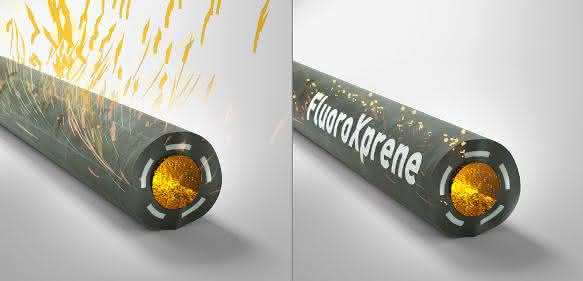
Fluoroxprene was developed to reduce the permeation of fuel vapors through the walls of the supply lines. This permeation also contributes to a vehicle's emissions, but is often overlooked when considering overall emissions. Fluoroxprene reduces fuel vapors escaping into the atmosphere through the walls of the fuel hoses to a fraction of the usual quantities. And not only with standard fuels - aggressive, alternative plant-based fuels such as E10 or E85 are also safely contained. Fluoroxprene also optimizes safety in fuel systems. The electrical conductivity of the material helps vehicle manufacturers to protect the fuel system against static discharge.
Attempts to use so-called FKM/TPE materials in the automotive sector have been underway for some time. With Fluoroxprene, the sealing experts at Freudenberg have now succeeded in developing a processable compound of two highly fluorinated materials. It combines the high chemical resistance of fluororubber (FKM) with the easy processability of thermoplastic elastomers (TPE). Thanks to its outstanding properties, fluoroxprene also has the potential for completely new solutions in industry - far beyond its use in fuel hoses. By changing the proportions of the two components or constituents, the product properties can be adapted to a wide range of complex requirement profiles.
As the new material is very easy to process, it can be used in an innovative manufacturing process developed by Freudenberg. It combines proven injection molding technology with a mold design consisting of individual cavities, saves material and energy and helps to reduce waste. Fluoroxprene is therefore a good example of how companies can produce in a way that conserves resources while also increasing sustainability and efficiency on the customer side, says Freudenberg. as


You might also be interested in
Electromobility and the supplier industry
Bosch wins major order from Mercedes-Benz for electric motors
Bosch receives a major order from Mercedes-Benz to supply electric motors for new electric drives until the 2030s. The supplier is thus further expanding its position in the growth market of electromobility.
 read more...
Production of high-voltage batteries
Electrically mobile - sustainable on the road
High-voltage batteries for electric cars are produced at the BMW plant in Leipzig. SEW-Eurodrive supplies proven and new drive solutions from the Movi-C modular system for all process steps - from cell preparation to end-of-line testing.
read more...Thyssenkrupp and Novelis cooperate
Platform for the circular economy
With a platform for the circular economy in the automotive industry, the two companies Thyssenkrupp Materials Services and Novelis want to set new standards for the recycling of used materials. The open platform will enable access to larger...
read more...85 years of precision technology from the...
Anniversary at Kammerer Gewindetechnik
Kammerer Gewindetechnik, manufacturer of screw drives in Hornberg in the Black Forest, is celebrating its 85th anniversary this year. The family business was founded in 1938 and is now managed by the third generation with 160 employees.
read more...Hydraulic brake cylinders from ACE: Easier handling even in critical environments
For active air sampling in highly sensitive cleanroom areas, special samplers are used for maximum protection of people and materials. The British company Pinpoint Scientific, which specializes in laboratory equipment, uses hydraulic brake cylinders...
read more...Expansion of the business units
Ulrich Engenhardt new CBO at Rittal
New on the Rittal Management Board: Ulrich Engenhardt has been responsible for the business units at the enclosure, IT and energy system specialist since June 1, 2023.
read more...Lifting oven grates
Bharat Forge CDP is a supplier of forged chassis and engine components as well as non-automotive systems. Since 2020, the company has been working with Kito-ER2 electric chain hoists to lift furnace grates in the production hall.
read more...Digital twins are the key to sustainability
Altair has published the results of an independent survey that shows a high level of acceptance of digital twin applications in the automotive industry. Furthermore, the use of these technologies is expected to increase as a means of achieving...
read more...Balluff remains consistently on course for growth
Balluff achieves a record result for the second time in a row. Total sales in the 2022 financial year amounted to 567 million euros. The sensor and automation specialist sees further growth opportunities for products in the field of image processing.
read more...