

Pelletizing
Networking for energy-efficient production
Industrial companies around the world are looking for ways to reduce energy consumption in their production processes. In the field of wood pelleting, biomass processing and animal feed production, machine manufacturers and customers are also aiming to optimize the energy efficiency of individual process steps.
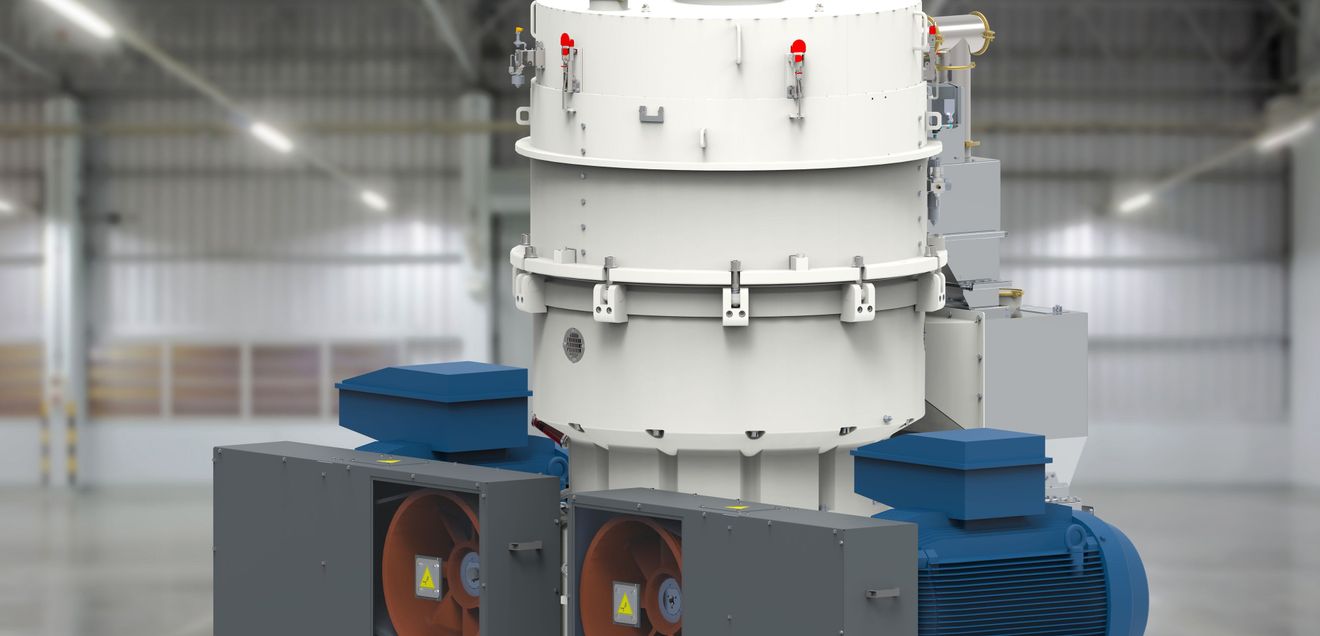
A number of process steps are required to produce high-quality wood pellets. Since wood as biomass has a high moisture content, processing is more complex compared to materials with a lower moisture content. In the conventional production process, the wet wood chips are first crushed in the wet hammer mill. They are then dried and ground a second time. Only then are they pelletized. Olaf Nährig, Senior Area Manager at machine manufacturer Amandus Kahl, explains: "Our systems are characterized by the fact that they achieve high throughput rates with low wear part and maintenance requirements in addition to energy-efficient construction and operation. As the respective grinding steps account for a large proportion of the total electrical energy required, we have focused on identifying potential savings in these process steps in particular."
Wet shredding of the material for easier dry grinding
The pan grinder is suitable for shredding wet wood chips to produce industrial pellets with a specified particle size. Compared to the wet hammer mill, it defibrates the wood more evenly and energy-efficiently by defibrating it at right angles to the fiber direction. The wet shredding of the material facilitates the subsequent dry grinding. The material that comes out of the wet milling process is heated and fed into the drying process. This saves around 3 to 5 % energy and ensures a homogeneous degree of drying. By using the pan grinder, around 40 to 50 % of the wood particles after wet grinding and drying are small enough for standardized pelleting. These particles can be fed into the pelleting plant directly after drying. This reduces the amount of material and the effort required for dry grinding - a significant saving. Dry grinding can be completely dispensed with for domestic fuel and pellets without particle size specifications. If this step is omitted, this saves 25 to 35 kWh/t, depending on the raw material.
Various production steps are also required in the manufacture of animal feed. As a crushing machine for grain and pulses, for example, the crushing roller mill is used as an alternative to the hammer mill. The power requirement here is reduced by up to 70 %. Amandus Kahl has developed a variant of the crushing roller mill for increased energy efficiency. Instead of the usual central drive with fixed speeds, this has frequency-controlled individual drives including energy feedback, which achieve a throughput rate of around 20 to 80 t/h with 22 to 55 kW. In addition, there is a low use of wear parts, low maintenance requirements and selectively adjustable grinding results.
The expander, a pressure conditioner for mixing and kneading, homogenizing, agglomerating and short-term conditioning, is suitable for refining feed components. By using it before pelleting, the output of the pellet press can be increased by 25 to 30 %, and even doubled for certain types of feed.
Maximum production flexibility
Pellet presses also process large-volume materials into compact, meterable pellets, including mineral mixtures, straw and biomass. This reduces transportation costs and makes handling easier. "As a specialist in the manufacture of flat die pellet presses, we have continuously optimized our pellet presses to achieve the highest possible energy efficiency. The most important aspect here lies in their design principle," says Nährig.
The presses have a flat die with holes of various sizes and rotating rollers that roll on the die. The material is pressed through the holes in the die with the help of the rollers and formed into pellets. Compared to other methods, flat die presses enable a more efficient conversion of the raw material, as the energy is better utilized by the special pan grinder. At the same time, Kahl flat die presses process larger particle sizes and fiber lengths.
In addition to efficient processes to save energy, it pays to rely on automation. With the EAPR pellet press control system and the Distamat automatic roller gap control system, Amandus Kahl has developed two intelligent control systems that adapt the energy supply to requirements. EAPR controls the automatic operation of flat die presses. These are already equipped with switching and control systems. Consisting of a control cabinet with a graphic touch panel and intuitive software, such a system enables simple control of all relevant process parameters such as press, dosing screw, mixer, associated auxiliary units and cooler. Once these parameters have been set, operation is fully automatic, including error and alarm messages and system diagnostics. Distamat ensures that a specified roller gap is maintained, thereby contributing to quality assurance. The process pressure and thickness of the material layer on the die can be automatically adjusted during operation. This means that less manpower is required, downtimes are increased and energy consumption is reduced.


You might also be interested in
Real-time control to make recycling materials economical
The Fraunhofer IAPT is researching AI-based closed-loop processes for industrial 3D printing with recycled plastics. The aim is to achieve less waste, greater process stability and profitable printer farms.
 read more...
How start-ups are bringing AI and biotech into industrial processes
From microplastic detection to robotic e-waste sorters: at IFAT Munich, start-ups will be demonstrating how AI, sensor technology and biotechnology are making industrial processes more efficient, safer and more sustainable.
read more...Recycling cycle from residual waste to new abrasives
Used abrasives are often disposed of as residual waste. Norton now offers a sustainable and economical recycling service for vitrified bonded abrasives.
read more...Recycling old electrical appliances with AI
In the Kikerp project, researchers at Fraunhofer IPK are developing an AI assistance system that evaluates disused appliances for refurbishment: are they suitable for repair or do they need to be recycled? Integrated into a cloud-based management...
read more...Fully automated mechanical disassembly
At the Hannover Messe, Festo presented a portfolio of solutions for the clean and economical dismantling and recycling of used batteries.
read more...A century and a half of international mechanical and plant engineering
Amandus Kahl celebrates its 150th anniversary in 2026. The article highlights the company's development from a Hamburg-based craft business to an internationally active manufacturer of machines, process technology and complete production systems for...
read more...Machine Tool Manufacturing Offers Hope
New orders are rising significantly again for the first time
New orders in the machine tool industry are rising significantly again for the first time. However, production, exports, and employment continue to decline.
read more...Thousands of Jobs Under Scrutiny
Evonik's Mass Layoffs: A Warning Sign for the Chemical Industry?
Evonik is restructuring the group and downsizing: The Essen-based specialty chemicals company is cutting thousands of jobs. But there is more to these job cuts than just a cost-cutting program.
read more...Partnership Sealed on the Sidelines of the...
North Rhine-Westphalia and Siemens are collaborating on the planned Production Launch Center Defense
On the sidelines of the ILA 2026, the state of North Rhine-Westphalia and Siemens have agreed to collaborate on the planned Production Launch Center Defense (PLCD), an industry-driven platform designed to accelerate the transition of innovations...
read more...