
Component manufacture
Fiber composite components from the thermoforming process
One way to reduce vehicle weight is through the use of fiber-reinforced plastics. As part of the ProVorPlus research project, a method was developed for the systematic development of an automated thermoforming process for fiber composite structures using active material guidance.
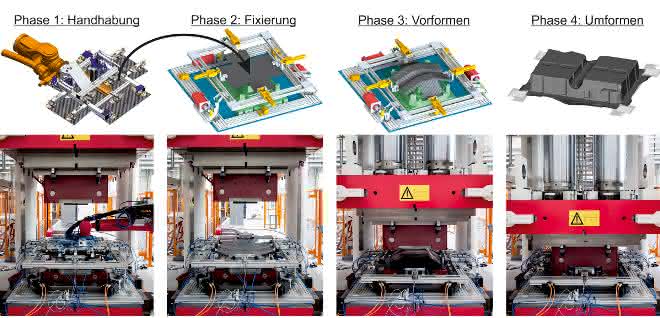
The aim of the research project at Leibniz Universität Hannover was to overcome automation obstacles such as robot-assisted handling of dimensionally unstable FRP blanks (organic sheets), which are usually also large and can take on complicated shapes. Organo sheets consist of a thermoplastic-glass or carbon fiber fabric composite, which is melted for processing. As the organic sheet undergoes rapid cooling in the ambient air after heating and shaping must take place before the melting point is reached again, a fast process time of around 15 to 20 seconds must be maintained. Otherwise, the solidifying thermoplastic matrix will hinder the draping process (forming process of a textile), resulting in quality losses or rejects.
Another challenge is that FRP tends to wrinkle early on even under low loads and subsequently leads to rejects during pressing. The Institute of Assembly Technology has therefore developed an active material guidance system for the automated processing of organic sheet. It consists of a fixed base frame to which three electric drive units are attached. The drives are connected to a movable upper frame via articulated chains. This makes it possible to raise, lower and tilt the upper frame for a draping movement. Servo-pneumatic drives with two-jaw parallel grippers can be attached to the top frame. These force introduction elements (KEE) induce a membrane tension in the fiber fabric to prevent wrinkles during forming and in the finished part. Thanks to its high modularity, the system can be adapted to different cutting and forming tool geometries. The number and position of the KEE are adapted to the specific task with the aid of simulation and parameterized via the control system.
In the process chain of automated large-scale production of lightweight components made from organic sheet metal, the organic sheet metal is first heated in the oven. The flexible blank is then gripped by a robot gripper and transferred to the forming stage. To minimize cooling in the gripping contact zone, the robot gripper is equipped with heatable needle grippers from Schmalz. In the forming stage, the flexible organic sheet is transferred to the material guidance system. The KEE are first controlled in positioning mode for the organo sheet transfer from the robot gripper and then switched to force control mode for the preforming movement (phase 3) in order to introduce the required membrane tension. In phase 4, the forming tool is closed while the membrane tension is maintained by the KEE and the organo sheet part is consolidated under pressure.
An FEM-based model for the draping process was developed to calculate the material guide configuration, which is used to determine the required number and positions of the KEE for specific component geometries. These draping simulations can also be used to predict the expected product quality, for example based on the criterion of fiber flow quality, or any defects that may occur, such as wrinkling and fiber tears.
The thermoforming process with active material management was implemented in the joint project ProVorPlus using the example of a battery tray for a plug-in hybrid vehicle. The production process was designed in two stages. First, the draping process of the organic sheet shell is followed by an injection molding process. Once the battery tray geometry has been draped, it is trimmed for further processing in the subsequent injection molding process. Further mold elements in the form of ribs in the tunnel, flange and base area are then injected in the injection mold. An aluminum support structure for the battery modules is then mounted in and a crash frame on the lightweight battery lower shell.
With the help of active material guidance and the simulation-supported determination of a suitable material guidance strategy, it was possible to produce defect-free specimens of the geometrically complex lower battery shell in a short cycle time, which is 22 percent lighter than the mono-material variant made of die-cast aluminum.
The ProVorPlus project was carried out with partners from universities and industry in the Open Hybrid LabFactory in Wolfsburg. This research and development project was funded by the Federal Ministry of Education and Research (BMBF) as part of the "Open Hybrid LabFactory" research campus and supervised by the Project Management Agency Karlsruhe (PTKA). The authors are responsible for the content of this publication.
S.Ibrahin/as

Briefly explained: The MHI e.V.
The Wissenschaftliche Gesellschaft für Montage, Handhabung und Industrierobotik e.V. (MHI e.V.) is a network of renowned university professors - institute directors and chair holders - from German-speaking countries. The members conduct both fundamental and application-oriented research on a wide range of current topics in the fields of assembly, handling and industrial robotics. Further information on the society, its members and activities: www.wgmhi.de.
Briefly explained: The match
The Chair of Assembly Technology (match) at Leibniz Universität Hannover was founded in 2013 by Prof. Dr. Annika Raatz. Since then, ideas for automated and robot-assisted assembly and handling in production have been pursued. The research focuses on collaborative assembly, soft material robotic systems, handling and control technology and precision assembly.
www.match.uni-hannover.de


You might also be interested in
Highly Automated Injection Molding
Six-axis robots automate the entire handling process
From part handoff to loading and unloading the injection molding machine to quality inspection: Yaskawa six-axis robots automate the entire handling process in a highly integrated production line for safety-critical sight domes.
 read more...
Conveyor systems that adapt
Modern conveyor systems must reliably transport different product sizes, shapes and materials. The new modular product system from Kipp offers flexible, modular solutions for this: Adjustable side guides ensure precise alignment and gentle...
read more...Handling and production logistics
Speed beats planning
Unpredictable fluctuations in demand pose new challenges for fulfillment logistics. Viral trends, political decisions and changing customer behavior are making traditional planning models obsolete.
read more...Loading and unloading machines
Artificial intelligence and ergonomic lifting
Loading and unloading machines ergonomically and efficiently - Schmalz supports metalworking companies in this. At Euroblech, the company will be presenting solutions for intelligent and ergonomic handling with vacuum.
read more...Products of the year 2025: the competition starts again
The INDUSTRIAL Production Products of the Year are entering a new round. This year, our readers can vote in eight categories. We are also awarding a special prize.
read more...Josko relies on vacuum technology from Schmalz
Lifting 80 kilograms 80 times in 8 hours: Vacuum expert Schmalz has developed a solution for the highly automated industrial company Josko that solves this task in the blink of an eye with the help of a suction spider.
read more...Interview with Dietmar Schlenker from Indeva
"Logimat is our in-house exhibition"
Indeva presents its latest products at Logimat 2024. However, Managing Director Dietmar Schlenker also looks further into the future in an interview.
read more...Efficient palletizing and depalletizing of KLT boxes
At Logimat 2024, the company from Gescher-Hochmoor in Münsterland will be demonstrating the palletizing and depalletizing of KLT containers within a line.
read more...INDUSTRIAL Production Products of the year...
3rd place, metalworking category: Schmalz
Schmalz automates sheet metal handling with the ivOS Sheet Metal Solution Kit. Companies can use it to automate the loading of machines - simply, flexibly and economically. The kit was awarded 3rd place in the metalworking category.
read more...