
Research at the Fraunhofer IWS
The 3D printing robot hand learns to feel
To make harvesting robots or submarine grippers more universally applicable and autonomous in the future, researchers at the Fraunhofer IWS are teaching them to feel: They are working on artificial grippers modeled on nature. The combination of 3D and dispensing printing with other technologies is helping here.

The concept: flexible grippers from the 3D printer use sensors to recognize how firmly they can grip without damaging anything. Technical systems such as robots or other machines should learn to grip "sensitively" in a similar way to a human hand. Future applications include harvesting robots that pick strawberries without crushing them, or autonomous rovers that safely retrieve unknown samples. In publicly funded projects such as "BioGrip", researchers are inspired by nature to solve problems. They try to understand the underlying biological principle, imitate it technologically and develop it further. This approach is known as bionics or biologization.
"Technological advances in additive manufacturing now make it possible to adapt many more biological concepts than before," emphasizes mechatronics engineer Hannes Lauer from the Fraunhofer Institute for Material and Beam Technology IWS, who is supervising the BioGrip project. "Nature is full of solutions. If we as engineers get stuck, it's always worth looking at their concepts." Moritz Greifzu, Group Manager Process Chains and Product Design, adds: "Bioinnovation processes often take several years and currently still require a lot of support and, above all, interdisciplinary collaboration. The aim here is to train a new generation of bionic engineers who have a strong network and experience with complete innovation processes."
Finray effect: Fin encloses object
In this specific case, the project partners are making use of the ability of the fins of certain fish to react to pressure with a counter-movement rather than an evasive one, i.e. to enclose the attacking force. The fish themselves use this to move more easily. The engineers used this effect, known as finray, as part of the BioGrip project from mid-2021 to early 2023. They printed grippers equipped with sensors that can gently grasp objects thanks to Finray technology. To do this, the Fraunhofer IWS first created a gripper base structure - similar to the fin skeleton of fish - from flexible polyurethane. A 3D printer was used, which works according to the additive principle of fused filament fabrication (FFF).
Silver sensors sense curvature, touch and pressure
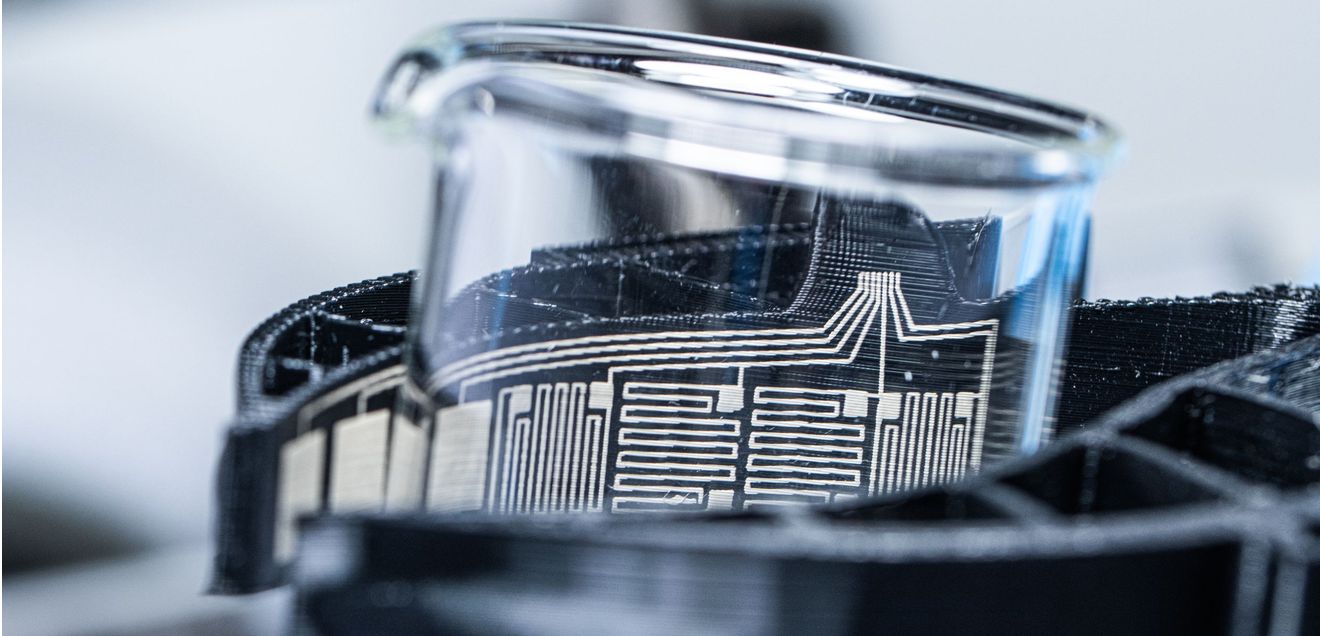
A dispensing printer then applies fine structures made of silver paste to the surface of the gripper using cannulas. The patterns generated in this way are then functionalized using infrared radiation. These functional structures include, for example, a meander pattern of 250 micrometer narrow conductor paths. If the individual finger bends or stretches, the electrical resistance of the meander changes. This allows the gripper curvature to be determined at any time.
The printer also generates thin layers of silver and insulators on top of each other on the gripper fingers, creating a flat capacitor. If the two silver layers are pressed together by an external force, the capacitance of the capacitor changes. This allows the force acting on the gripper to be determined. The dispensing printer can also produce touch-sensitive and other surface sensors. Combined with microsystems in the integrated control and evaluation electronics, a variety of other functions of the human hand can be simulated. It would be conceivable, for example, to estimate the weight of the object being gripped by gently shaking it.
Bionic grippers for Mars and the seabed
This combination of several additive printing processes and other technologies creates autonomous grippers that can "feel" what they are gripping, so to speak. Interest is already growing in industry and research. Among other things, the collection of samples with unpredictable shapes on Mars is under discussion. Food companies could use such retrofitted robots to gently sort and pack apples or other fruit. Biologists could use "tactile grippers" to collect small sea urchins, sea cucumbers and other ocean dwellers without injuring them. Further application scenarios are likely to follow.


You might also be interested in
UltiMaker Doubles Speed in Industrial 3D Printing
With the Factor 4 Plus, UltiMaker is introducing a new version of its industrial desktop 3D printing platform, which operates at up to twice the print speed of the standard model. The platform is designed for use in manufacturing and defense...
 read more...
In-house exhibition Bielefeld 2026
How DMG Mori thinks about the factory of the future
DMG Mori will be showcasing turning and milling expertise, automation solutions and additive manufacturing along the Machining Transformation (MX) at the Bielefeld 2026 in-house exhibition.
read more...Stratasys takes over MarkForged
Stratasys is acquiring MarkForged from Nano Dimension for USD 42.5 million, thereby expanding its portfolio in the field of fiber-reinforced composites. The acquisition also strengthens the company's software and materials expertise in industrial 3D...
read more...Timo Göbel, Head of BMW Additive Manufacturing
"Clearly on course for broad industrialization"
The BMW Group's Additive Manufacturing Campus (AMC) is setting the course for the next stage of industrialization. Under the leadership of Timo Göbel, additive manufacturing is being further integrated into all stages of the vehicle life cycle. In...
read more...Real-time control to make recycling materials economical
The Fraunhofer IAPT is researching AI-based closed-loop processes for industrial 3D printing with recycled plastics. The aim is to achieve less waste, greater process stability and profitable printer farms.
read more...Forum Solutions 4AMIndustry shows ways into industrial application
Additive manufacturing has developed dynamically in recent years and has long outgrown its status as a purely innovative technology in many industries. Nevertheless, companies still face the challenge of integrating AM into their production...
read more...Alliance aims to drive forward industrial 3D printing
Machine components, electrostatically shielded transport containers, large components for the automotive, rail and aviation industries or specific medical products straight from the printer - the potential applications of additive manufacturing are...
read more...Stratasys simplifies post-processing for 3D printing
Stratasys has launched a partner program for post-processing solutions to facilitate the creation of end-to-end AM workflows. The first partner is PostProcess Technologies, whose automated systems for FDM, PolyJet, SLA and P3 can now be purchased...
read more...Formnext 2026 puts UK and key industries in the spotlight
Formnext 2026 will focus on the United Kingdom as the official partner country. At the same time, the leading trade fair for additive manufacturing is further expanding its involvement in key user industries, including orthopaedics, aerospace and...
read more...