

Sensors
Vision sensors with a clear view
The camera-based vision sensors of the VOS series from Pepperl+Fuchs can identify, measure, align and help position objects as well as read codes and recognize texts.
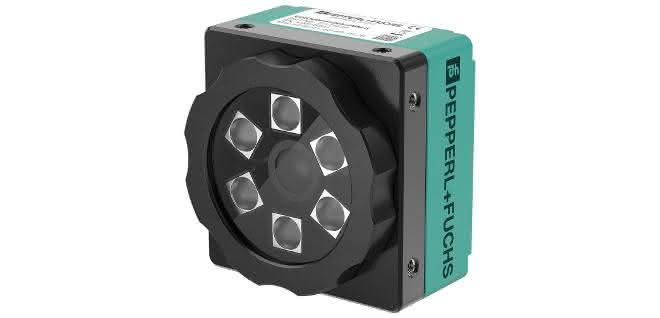
With their wide range of possible applications, the VOS devices from Pepperl+Fuchs offer much more than simple vision sensors, but do not require the major integration effort of complex vision systems. Four basic devices differ in their increasing range of functions: VOS Ident, VOS1000, VOS2000, VOS5000. They are all housed in the same compact housing, which contains the image acquisition chip, adjustable lenses, lighting, integrated evaluation, digital outputs and communication interfaces. A wide range of equipment options is available for customization to a specific application.
Basic function code reading
Data matrix and bar codes are used for object identification in many automated processes. With high throughput and variable target objects, seemingly simple code reading can become a difficult task that overwhelms simple scanners. The codes reach the reading area in chaotic alignment and at high speed; there are very different code symbologies; optical interference effects such as irregular color contrasts or shiny surfaces make detection difficult.
The sensors in the VOS series can deal with such difficulties and offer a wide range of functions for code reading. Filters compensate for shiny and reflective surfaces; detection works with different symbologies and regardless of the placement of the code. Several codes can be detected simultaneously and their quality evaluated. The VOS Ident model is optimized for these tasks; when using several sensors, one device takes over the primary function and sorts the signals from other devices. This scenario ensures reliable detection when the codes can appear on different sides of the objects and multiple sensors are required. The additional devices are assigned to the secondary circuit and the control system only receives valid data from one source.
Simple solutions for complex tasks
The other device versions in the series - the VOS models 1000, 2000 and 5000 - are also suitable for code reading, but can also perform numerous other tasks. These include the identification of objects based on shapes and contours, for example for pick & place applications or for positioning components in an assembly process.
As long as similar products always arrive on the conveyor belt in the same orientation, relatively simple sensors are sufficient for this task. However, the more variability comes into play, the more differentiation is required from the sensor. Different objects in random orientations on the belt require "intelligent" detection, which until now has usually been achieved with complex and costly vision systems. The technically more compact and much easier to integrate VOS devices have a sufficient range of functions and numerous ready-made vision tools for such tasks.
One of these, for example, provides data for determining the position of objects that are used during sorting and packaging with the help of robots. This also works with different types of objects in the same process. New object shapes are introduced with the dynamic teach-in function or zero point referencing; the
Data output can be formatted flexibly. The comprehensive, license-free software package is part of the scope of delivery. Its vision tools cover practically all possible applications; no additional software is required for a fee. These algorithmic tools can be combined: for example, code reading can be combined with shape recognition or tolerance measurement.
Flexible software, modular hardware
The software opens up many possibilities for parameterization. For example, it allows the device to be set graphically using a reference image or logical links to be created. Interfaces, switching outputs, data format and data output can be specifically set up and adapted to the application. Saved jobs can be transferred to a newly installed sensor in just a few steps. Dynamic switching is possible for different jobs in the same application. The intuitive user guidance on the user interface makes sensor replacement, commissioning and job management quick and easy. Remote access allows you to choose between the parameterization monitor and the application monitor. In addition to the live image, the latter also displays the respective measurement result. The camera can store process and error images temporarily or transmit them automatically. This enables diagnostics, optimization and a view of the history via remote access.
A modular component portfolio includes high-precision industrial lenses with a C-mount connection and various focal lengths. The appropriate option can be selected according to measuring distance, object size and inspection criterion. The devices can be equipped with an integrated ring light or with external lighting. Options include side and rear, bright and dark field illumination as well as different aperture angles for wide and small fields of view. The integrated flash controller ensures ambient light-proof detection. Polarization and diffusion filters make shiny and transparent surfaces visible.


You might also be interested in
Filtration and sound attenuation in circuits
In liquid or air circuits, filter housings and silencers protect measuring devices, ensure particle-free vacuum and pneumatic systems, keep cooling circuits clean and reduce noise.
 read more...
KSS ultrafine filtration for grinding oils
Modular concept for pure oil
In order to grind economically, reliably and with the highest quality, extremely clean grinding oils are required. Filter manufacturer Vomat offers the metalworking industry high-performance and customized concepts for the filtration of cooling...
read more...Up to 95 percent less flue gas thanks to direct extraction
The requirements for occupational safety measures and safety technology are also constantly increasing in welding technology. The Technical Rules for Hazardous Substances (TRGS) stipulate that welding fumes and harmful substances must be extracted...
read more...Everything accurate in switch cabinet construction
To ensure smooth work processes, tools for processing enclosures and housings must function flawlessly and reliably. Häwa rounds off its punching range with the Multi-Press 500.
read more...Cooling and temperature control units
Hygienic packaging sells safely
In few industries are the requirements for hygiene in the production process as strict as in the food sector - the health of consumers has top priority. This results in enormous challenges for all machines and components involved, especially in...
read more...Efficient and sustainable
Rotary screw compressors are the reliable backbone of industrial compressed air generation. The innovative CSD/CSDX series from Kaeser Kompressoren with its numerous features produces them efficiently and saves energy costs. This also reduces theCO2...
read more...Healthy air during welding
Welding produces fumes and gases that are hazardous to health. Extraction is necessary to comply with the occupational exposure limits and is even mandatory when welding high-alloy steels.
read more...Wire mesh filters in medical technology
In hardly any other industrial development sector are the demands placed on products as high as in medical technology. After all, human lives depend on the performance and reliable quality of medical devices.
read more...Energy efficiency and sustainability in the smallest of spaces
With the StingR ultra-fine filter system, Lehmann-UMT has created a solution for the energy-efficient and precise treatment of fluids during tool grinding for extended tool life and high tool quality.
read more...