

Networked production
The role of the employee in Industry 4.0
The adoption of IoT and AI in the manufacturing industry is seen as the most important driving force for success and growth. But which solutions make a factory smart and how has the role of the employee changed in the age of Industry 4.0?
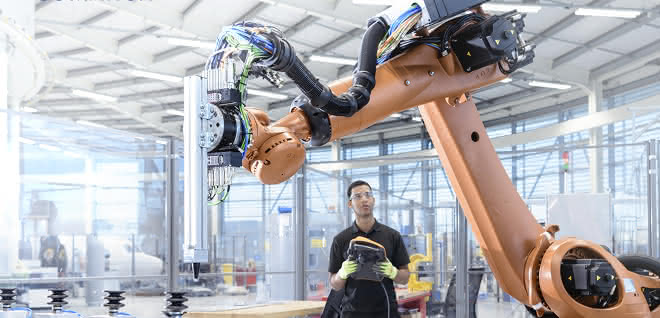
When robots take over repetitive tasks, work loses its routine character and people lose some of their previous activities. Does this mean that digitalization and automation will soon lead to an unprecedented number of job losses, particularly in mid-level positions such as production planning and control?
People in a digital factory
The answer is no - in fact, quite the opposite! Human intelligence is regarded as the decisive basis for the success of a smart factory. According to the new production model, people are at the heart of an intelligent production system. As routine tasks are increasingly taken over by robots and machines, employees can devote themselves to more demanding tasks such as development work, solving problems and evaluating information. The task of technology is to support the cognitive and physical abilities of the employee. This creates so-called super jobs, whose task is to increase overall efficiency with the help of technology.
In a study conducted by Telekom in Germany, 23% of industrial companies reported that they already rely on robot-supported process automation and 25% are planning to enter this area. This is still an increase, but compared to China and the USA, Germany and Europe are still slow. "Germany must finally change its conservative attitude. Many are waiting for the right time to enter the market. That is wrong. Companies need to internalize that when it comes to digital products, waiting is much more expensive than sometimes making a bad investment.
It's not about entering the market at the right time, but about being in the market for a long time! In addition, the expenses for a digitalization project are often manageable compared to the ROI that companies can achieve through the investment," explains IoT expert Timm Huber from Comarch. This is confirmed by a study by Roland Berger: by 2035, a potential return on capital employed of 28% is expected in Western Europe as a result of investments in Industry 4.0, compared to 18% today.
The first step is the digital recording, storage and processing of data. Production processes can then be monitored and analyzed on this basis. This also makes it possible to calculate the overall equipment effectiveness (OEE) and ultimately make optimizations. "When it comes to digitalization, many companies still need to focus on the basics, such as getting rid of mountains of paper and removing bottlenecks in production. To do this, the production processes need to be digitally analyzed," adds Timm Huber.
Beneficial for people, profitable for companies
Companies benefit from the introduction of Industry 4.0 and the associated valuable data, particularly in the areas of waste minimization, machine availability, efficiency and energy consumption. Read the new Industry 4.0 white paper to find out how these areas can be optimized through the interaction between man and machine: Man vs. machine? The challenges and opportunities of Industry 4.0 in terms of optimizing production and human resources. The white paper also reports on the role of managers 4.0 and presents exciting data, facts and forecasts on the topic of Industry 4.0.


You might also be interested in
Gateway with improved fault diagnosis
Schmersal is launching a new version of the SD gateway for its SD bus. According to the group, users benefit in particular from the improved fault diagnostics that the new SDG Fieldbus Gateway enables.
 read more...
AI trends for engineers: where is the journey heading?
According to Gartner, companies that have adopted AI engineering practices have a competitive advantage: by 2026, they could outperform their competitors by around 25 percent in terms of the number and time required to operationalize AI models....
read more...Industrial-grade version of the Raspberry Pi
"The more performance, the more use cases"
The new version 4 of the open source IPC "Revolution Pi" (RevPi) from Kunbus is set to be launched as an industrial-grade version of the Raspberry Pi in mid-2023.
read more...Digital assistance systems make manual production easier
Increasing productivity in the face of a shortage of skilled workers and a growing number of product variants is a challenge for many medium-sized industrial companies. Software-based assistance systems such as elution two assembly from Elabo offer...
read more...Platform for hydrogen and fuel cells
Around 500 companies presented their solutions for the production, transportation, infrastructure, storage, refuelling and consumption of hydrogen at the Hannover Messe.
read more..."Using DC technology consistently"
The DC-Industrie2 project recently came to an end and the follow-up project, ODCA, has been launched. In an interview with Andrea Gillhuber, Dr. Hartwig Stammberger and Dr. Jan Stefan Michels spoke about the potential of DC technology and its...
read more...Artificial intelligence in Germany
AI arrives in the industry
At the start of the Hannover Messe, Microsoft's Head of Germany Marianne Janik called for greater use of artificial intelligence (AI) in Germany.
read more...Feinmess Suhl at the Control 2023
High-precision testing equipment and monitoring systems
At the Control international trade fair for quality assurance, Feinmess Suhl will be presenting innovations in the field of test equipment for product measurement and systems for test equipment monitoring.
read more...Continuously developing innovations
In the run-up to the Hannover Messe, Andreas Mühlbauer spoke to Oliver Winzenried, CEO of Wibu-Systems, about the innovations the company is presenting in Hannover and the technological trends at the trade fair.
read more...