
3D printing
Generate and optimize lightweight structures iteratively
In the latest version of the 3D printing software 4D_Additive, CoreTechnology adds a Nastran interface and makes it possible to quickly create a wide range of lattice structures and validate them with simulation tools.
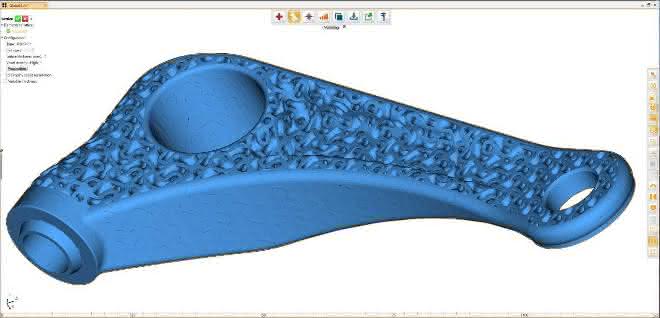
In the latest version of CoreTechnologie's 4D_Additive software, the additive manufacturing tool supports a new approach to the creation, optimization and validation of lightweight structures. With the Advanced Lattice module, lattice structures are generated quickly and easily and transferred directly to the calculation software for optimization using a new Nastran interface.
Optimization at the touch of a button
The integration of the Nastran interface as a standard format in the 4D_Additive software makes it possible to seamlessly send the grid structures, alternative component designs and complex 3D geometries generated with just a few clicks within seconds to the calculation software.
The 4D_Additive software offers tools for the automatic generation of 20 different 3D grid structure types. CAD solids can be filled with internal structures and parts of the solids can be replaced with external structures. In particular, gyroid patterns and trabecular structures for simulating natural lattice networks, such as those found in bones in nature, are used to generate innovative designs for optimizing the weight, stability, stress distribution and shock absorption of components.
The use of different grid types and the variation of the density as well as a variable cell size over the course of the component allows the geometry to be adapted to the required properties while at the same time optimizing the component properties. In contrast to topology optimization, this approach allows classic component designs to be quickly optimized iteratively and validated using simulation tools.


You might also be interested in
UltiMaker Doubles Speed in Industrial 3D Printing
With the Factor 4 Plus, UltiMaker is introducing a new version of its industrial desktop 3D printing platform, which operates at up to twice the print speed of the standard model. The platform is designed for use in manufacturing and defense...
 read more...
Stratasys takes over MarkForged
Stratasys is acquiring MarkForged from Nano Dimension for USD 42.5 million, thereby expanding its portfolio in the field of fiber-reinforced composites. The acquisition also strengthens the company's software and materials expertise in industrial 3D...
read more...Timo Göbel, Head of BMW Additive Manufacturing
"Clearly on course for broad industrialization"
The BMW Group's Additive Manufacturing Campus (AMC) is setting the course for the next stage of industrialization. Under the leadership of Timo Göbel, additive manufacturing is being further integrated into all stages of the vehicle life cycle. In...
read more...Real-time control to make recycling materials economical
The Fraunhofer IAPT is researching AI-based closed-loop processes for industrial 3D printing with recycled plastics. The aim is to achieve less waste, greater process stability and profitable printer farms.
read more...Forum Solutions 4AMIndustry shows ways into industrial application
Additive manufacturing has developed dynamically in recent years and has long outgrown its status as a purely innovative technology in many industries. Nevertheless, companies still face the challenge of integrating AM into their production...
read more...Alliance aims to drive forward industrial 3D printing
Machine components, electrostatically shielded transport containers, large components for the automotive, rail and aviation industries or specific medical products straight from the printer - the potential applications of additive manufacturing are...
read more...Photonic microchips with 3D connector
How a 3D system makes photonic chips industrially viable
A research team from Heidelberg is developing a 3D-printed "connector" for photonic microchips. The solution promises a low-loss, standardized coupling of glass fibre and chip - and could fundamentally simplify the production of photonic integrated...
read more...Stratasys simplifies post-processing for 3D printing
Stratasys has launched a partner program for post-processing solutions to facilitate the creation of end-to-end AM workflows. The first partner is PostProcess Technologies, whose automated systems for FDM, PolyJet, SLA and P3 can now be purchased...
read more...Formnext 2026 puts UK and key industries in the spotlight
Formnext 2026 will focus on the United Kingdom as the official partner country. At the same time, the leading trade fair for additive manufacturing is further expanding its involvement in key user industries, including orthopaedics, aerospace and...
read more...