

Sound measurement
The microphone is there for testing
Non-destructive testing. Xarion has developed a new type of optical microphone to enable quality assurance using a non-contact method and at the same time provide a new option for inline process monitoring.
"When carrying out ultrasonic measurements for non-destructive material testing, a coupling agent, such as a gel, usually has to be used," explains Dr. Balthasar Fischer, company founder and CEO of Xarion. "A basic problem here is that non-destructive testing of materials should ideally be carried out without contact, for example to avoid contamination of the material, to avoid damaging the test specimen with water or to facilitate robot-assisted testing. Compared to water or gel, however, air is only suitable as a coupling medium to a limited extent. This is because a lot of ultrasonic signal is lost at the material-to-air interface."
Conventional ultrasonic receivers are generally based on the piezoelectric principle, whereby the ultrasonic wave causes the piezoelectric material to vibrate. To ensure that the sound can couple into the detector with as little loss as possible, the acoustic impedance between the test specimen and the detector is equalized using a coupling agent. This prevents a large proportion of the ultrasound from being reflected and lost at the interface between the air and the piezo receiver, making non-destructive testing more difficult. The optical microphone, on the other hand, detects the ultrasound directly in the air; the sound wave is not first coupled into a solid body and then its vibration is detected. Instead, a laser beam contactlessly measures the change in density of the air caused by the propagating ultrasonic wave. This eliminates the need for an air-to-solid interface and the associated undesirable loss of the test signal.
The optical microphone is also used in another area of application: Camera systems are mostly used in industrial process monitoring today. In manufacturing processes where lasers are used, including laser welding and structuring as well as in additive manufacturing, optical systems can reach their limits due to the strong optical process emissions. The camera can literally be blinded by the laser, or smoke can restrict the line of sight. In addition, a camera cannot be used if the manufacturing process is to be monitored for defects that occur below the surface. Examples of this are cracks or pore formation, or a peeling adhesive layer. Acoustic process monitoring is an interesting alternative here. Analogous to the complementary human sensory perceptions, detection is not only carried out optically with a camera (corresponding to the human eye), but also acoustically via the microphone (corresponding to the ears).
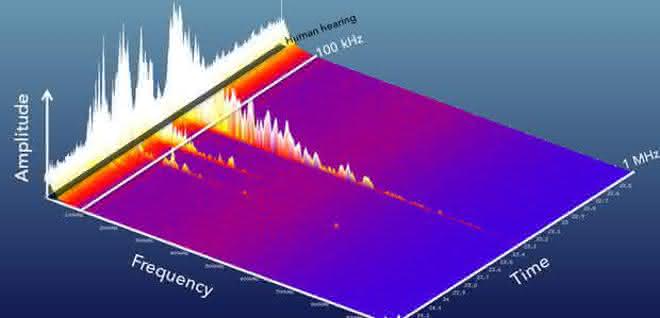
In the case of acoustic monitoring, condenser microphones have been used up to now, but their sensitivity to background noise means that they can only be used to a limited extent for monitoring production and quality control. As the ambient noise in a production hall is often very high, acoustic process monitoring with conventional microphones is out of the question for most processes. The situation is different with optical microphones: The measurable frequency range is so wide that a simple frequency filter can be used to distinguish between background noise (usually below 100 kilohertz) and valuable process signatures (significant portions also above 100 kilohertz).
In order to cover a wider acoustic frequency range, Xarion has opted for an optical rather than electro-acoustic or mechanical approach to sound detection: the company has developed a laser-based measurement method that can be used to carry out material testing and process monitoring in a very wide frequency range from around ten hertz to two megahertz in the air, outperforming conventional sensors by a factor of 20.
Xarion uses an acousto-optical principle with its Eta250 Ultra optical microphone: a laser pulse is first fired at the test specimen to cause the material to vibrate. The signal of this sound-shock pulse, which is then emitted into the air, is then measured. The sound wave vibrations cause a change in air pressure, which in turn influences the wavelength of the laser light in the optical microphone. "The sound wave is sent into a very compact interferometer in the sensor head, which is only two millimetres in size," explains Fischer. "It influences the wavelength and thus changes the brightness of the laser beam in the mini-interferometer, which is then measured." A movable membrane or a deformable piezoelectric material is therefore superfluous. This avoids disturbing natural oscillations, which influence the measurement result in an undesirable way.
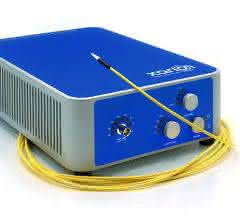
The optical microphone itself requires very little space for the measurements: the sensor head is just five millimetres in size. This means that the device can be mounted on robot arms and integrated into existing inspection processes without a great deal of time and effort or complicated conversion and adaptation measures. This not only facilitates non-destructive material testing, but also inline process monitoring (i.e. quality inspection directly during the manufacturing process). The optical microphone is connected to a control unit via a fiber optic cable; this contains the laser, the detection unit and a preamplifier. The metal-free cabling also enables measurements in difficult environments, such as in the vicinity of electromagnetic fields, and also works over very long distances without measurable signal loss or interference. as


You might also be interested in
Clever solutions for sensitive gripping
Innovative systems and exciting world premieres? That's what visitors will find at productronica in Munich from November 18 to 21. In Hall B3 at Stand 301, vacuum specialist Schmalz will be showcasing efficient and future-oriented handling systems -...
 read more...
Proprietary plastic compounds for extreme conditions
Cables must reliably transmit energy, data and signals, even in extreme cold or heat or under heavy mechanical stress. Specially developed plastics ensure that the cables remain robust and resistant. Lapp produces its own plastic compounds.
read more...Efficiency comparison of 3D printing, CNC manufacturing and injection molding
3D printing, CNC manufacturing or injection molding? When designers are looking for the most suitable manufacturing process for an individual component, they often lose time and also quickly lose track. Igus is changing this with the Triboteile...
read more...Heat transfer and additive manufacturing
Conflux Technology enters the hypercar sector
Pagani has announced the signing of a six-year contract with Conflux to integrate Conflux heat exchangers into the transmission of its latest exclusive model, the Pagani Utopia, further advancing additive manufacturing in the hypercar industry.
read more...Metal foam and PFAS replacement improve environmental balance
Metal foam contains up to 90 percent air and has amazing properties. In the factory, it ensures greater sustainability and helps to improve the environmental balance in industrial production.
read more...PFAS alternatives with high performance
Igus wants to set an example for innovation and sustainability and will be presenting new products at HMI 2025, including PTFE-free materials and products made from recycled material.
read more...No splinters, no maintenance
New properties also apply to load carriers in logistics and intralogistics processes. Craemer's portfolio includes high-quality returnable load carriers that are hard-wearing, versatile, maintenance-free and recyclable.
read more...Tensile strength of 3D components
Voxelfill strategy overcomes inhomogeneous strengths in 3D printing
The company AIM3D has succeeded in demonstrating the advantages of the patented voxelfill process. Strength tests now prove that this process can overcome inhomogeneous strengths of 3D components in the X, Y and Z axes and thus comes close to...
read more...Lubrication-free plain bearing materials...
Igus focuses on the development of PFAS-free materials
And again the topic of PFAS: The new "endurance material" Iglidur JPF complements the wide range of wear-resistant PFAS and PTFE-free polymer bearings. Igus is thus preparing for new regulations.
read more...