

Fraunhofer research
Fuel for digitization
Digitalization needs information - and increasingly powerful sensors, measuring and testing technologies are measuring and testing for this. Nine Fraunhofer Institutes presented their research results at Sensor+Test.
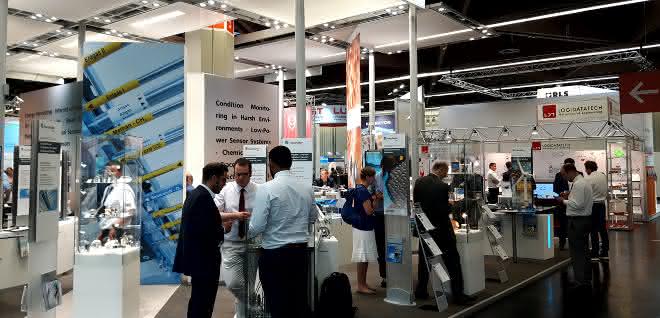
Whether gesture recognition, contactless material testing or artificial respiration - in the age of digitalization, numerous innovations are based on the transfer of information from the real to the digital world. Sensors and measurement and testing technologies therefore have the function of a key and cross-sectional technology that forms the basis for new developments. At this year's Sensor+Test, Fraunhofer once again showcased its technology portfolio from various fields of research.
Expanded spectrum in contactless material testing
Terahertz radiation is increasingly being used in industrial process monitoring and material testing. Paint layer thicknesses, structures of polymer components or defects in non-conductive materials can be examined without contact. The Fraunhofer Institute for Telecommunications, Heinrich Hertz Institute, HHI has presented the next generation of a fiber-coupled terahertz transceiver. This integrated sensor head enables reflection measurements orthogonal to the sample surface and can be operated directly with commercially available terahertz systems.
Machine failures, production errors and test scrap
The Fraunhofer Institute for Digital Media Technology IDMT demonstrated how audible product and process characteristics and machine learning methods can be used to carry out non-contact and non-destructive quality control of workpieces and components. Using interactive exhibits, visitors learned more about the method, which can be used to monitor both production processes and product quality in end-of-line control.
Minimal vibrations for energy supply
Powering wireless sensors is one of the challenges of the Internet of Things (IoT) - which is why the Fraunhofer Institute for Integrated Circuits IIS is working on energy harvesting solutions. Even the smallest vibrations of just 100 mg at 60 Hertz are enough for the vibration transducer to generate enough electrical energy to operate several sensors and transmit data every second. The developed maximum power point tracker effectively controls the control circuits of the voltage converters and thus guarantees maximum power yield. With energy harvesting, the battery is recharged during operation and enables unlimited operating time of IoT sensors without power cables or battery changes.
Optical filters in CMOS
Due to the high cost of multispectral sensors with more than six spectral channels, they are not used in many price-sensitive markets. The nanospectral technology developed at Fraunhofer IIS is based on optical nanostructures and enables very cost-effective monolithic production of the required optical filters directly in CMOS semiconductor processes, together with the optical sensor elements. A chip-size spectrometer was shown at the trade fair, which already has more than 30 channels and is therefore suitable for agricultural applications, analytics, food analysis and medical applications, for example.
Gentler artificial respiration
In order to make artificial ventilation as gentle as possible for a patient, a large number of parameters on the ventilator must be regulated dynamically and precisely for each individual patient. This is particularly critical when ventilating premature babies or infants, where the volume to be ventilated is sometimes only a few milliliters and even slight overpressures can lead to damage to the small lungs. Ventilators must therefore be able to respond to spontaneous breathing impulses from the patient within fractions of a second.
The Fraunhofer Institute for Manufacturing Engineering and Automation IPA presented a new method that allows respiratory movements to be registered virtually contact-free and almost latency-free. This opens up the prospect of highly customized ventilation that is gentle on the lungs, especially for small patients.
Gesture recognition through ultrasound
A team of researchers at the Fraunhofer Institute for Photonic Microsystems IPMS is using a new class of micromechanical ultrasonic transducers to reliably detect three-dimensional changes in distance, movement patterns and gestures in the range of up to half a meter. The very small and inexpensive components generate high sound pressures and offer a flexible frequency design for an optimum balance between distance and sensitivity. Possible fields of application for contactless motion detection can be found in automation and safety technology as well as in medical technology, the automotive industry or entertainment and household electronics. Fraunhofer IPMS presented an initial functional demonstrator at Sensor+Test.
Mini laboratory for monitoring water quality
An autonomous control system detects small quantities of certain chemical substances in wastewater with maximum selectivity and sensitivity in the micromole range. Such a mini-laboratory can be used, for example, to assess water quality. The main component of the mini-laboratory is a chemical sensor, which is very compact due to the microfluidic technology used. The laboratory system has thus been reduced to the size of the palm of a hand so that it can be operated in wastewater without human intervention. In addition to the Fraunhofer Institute for Reliability and Microintegration IZM and the Fraunhofer Institute for Integrated Circuits IIS, nine other consortium partners are involved in the European project.
High-performance hydrogen sensor
The Fraunhofer Institute for Chemical Technology ICT, together with the company Lamtec, has developed a hydrogen sensor with maximum sensitivity as part of a publicly funded joint project. The LHyCon hydrogen sensor (Low Hydrogen Concentration measurement sensor) can replace standard leak detection methods with helium, is highly sensitive and is also significantly cheaper than other methods of comparable performance. LHyCon was supervised by the Karlsruhe Project Management Agency and funded by the BMBF as part of the KMU-innovativ program.


You might also be interested in
Filtration and sound attenuation in circuits
In liquid or air circuits, filter housings and silencers protect measuring devices, ensure particle-free vacuum and pneumatic systems, keep cooling circuits clean and reduce noise.
 read more...
KSS ultrafine filtration for grinding oils
Modular concept for pure oil
In order to grind economically, reliably and with the highest quality, extremely clean grinding oils are required. Filter manufacturer Vomat offers the metalworking industry high-performance and customized concepts for the filtration of cooling...
read more...Up to 95 percent less flue gas thanks to direct extraction
The requirements for occupational safety measures and safety technology are also constantly increasing in welding technology. The Technical Rules for Hazardous Substances (TRGS) stipulate that welding fumes and harmful substances must be extracted...
read more...Everything accurate in switch cabinet construction
To ensure smooth work processes, tools for processing enclosures and housings must function flawlessly and reliably. Häwa rounds off its punching range with the Multi-Press 500.
read more...Cooling and temperature control units
Hygienic packaging sells safely
In few industries are the requirements for hygiene in the production process as strict as in the food sector - the health of consumers has top priority. This results in enormous challenges for all machines and components involved, especially in...
read more...Efficient and sustainable
Rotary screw compressors are the reliable backbone of industrial compressed air generation. The innovative CSD/CSDX series from Kaeser Kompressoren with its numerous features produces them efficiently and saves energy costs. This also reduces theCO2...
read more...Healthy air during welding
Welding produces fumes and gases that are hazardous to health. Extraction is necessary to comply with the occupational exposure limits and is even mandatory when welding high-alloy steels.
read more...Wire mesh filters in medical technology
In hardly any other industrial development sector are the demands placed on products as high as in medical technology. After all, human lives depend on the performance and reliable quality of medical devices.
read more...Energy efficiency and sustainability in the smallest of spaces
With the StingR ultra-fine filter system, Lehmann-UMT has created a solution for the energy-efficient and precise treatment of fluids during tool grinding for extended tool life and high tool quality.
read more...