

Production logistics with Karakuri bridge
Process optimization in production with Karakuri
Toyota Peugeot Citroën Automobile (TPCA) in Kolín, Czech Republic, relies on the concept of Low Cost Automation (LCA). In production, air conditioning systems for small cars are transported over a Karakuri bridge from Item. Tugger trains can pass under the bridge unhindered, while the air conditioning systems are transported over the bridge at the same time. As a result, the Karakuri application leads to an efficient material flow and increased productivity.
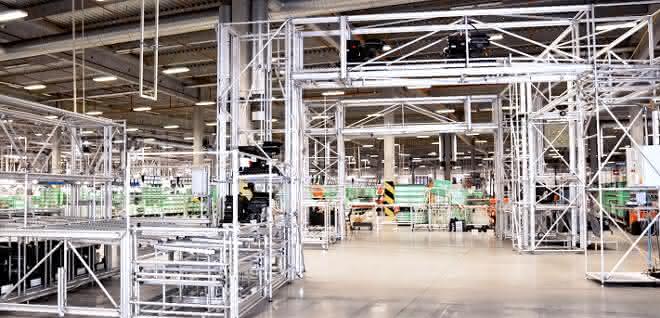
The air conditioning systems for the Toyota Aygo, Peugeot 108 and Citroën C1 models move from one production line to the next at Czech car manufacturer TPCA as if on an assembly line. However, most of the automatic transportation is purely mechanical and uses gravity - a Karakuri application.
TPCA initially used transport trolleys to bring the required air conditioning systems to the production line. However, the transport trolleys crossed the routes of the tugger trains, which meant they had to stop frequently. This interrupted the material flow and made processes inefficient. In search of an economical solution with optimized processes and higher productivity, TPCA turned to Item, a supplier of modular systems for industrial applications. The company has many years of experience in Karakuri/LCA applications and worked with TPCA to develop a customized solution based on the lean production system kit.
The air conditioning units are now transported via a six-metre-long, six-metre-wide and five-metre-high Karakuri bridge. The material is fed in via a shooter. The air conditioning units move upwards one after the other on small load carriers (SLC) via a linear axis in a tower and are transported to the other side on roller conveyors across the track. After a 90 degree change of direction and a further transport distance of three meters, the air conditioning units reach a second tower. There they are transported downwards again purely mechanically and can be removed for further processing. The empty KLTs move to a third tower, where a linear unit transports them upwards. They are first stacked before roller conveyors transport the stacks of four back along the track. After the downward movement in the fourth and final tower, the stacked KLTs can be removed and loaded again. The entire construction consists of the linear technology as well as the D30 profile tube system and suitable connection technology from Item. pb


You might also be interested in
More safety during transportation in lean systems
Item has expanded its Lean Production modular system: New additions include the release unit D30 bolt T2, the flange D30-90x90-80 and the slide rail D30 with guide rail H13.
 read more...
Safe and ergonomic unpacking of sheet metal packages
Kasto is expanding its portfolio with a sheet metal turner for unpacking and storing sheet metal packages. This allows users to reduce the manual handling of heavy sheets - saving time and preventing accidents.
read more...Lifting gear with tipping function for safe filling
Hovmand is expanding its range of lifting equipment. A bucket lifter with a manual tilting unit supports the special handling of buckets and small drums, while a mobile canister filling aid makes it easier to transport and decant canisters.
read more...Vehicles and systems for production logistics 2023
A wide variety of vehicles are used in production logistics: from transport robots and industrial trucks to conveyor belts, cranes and distribution systems.
read more...Radio networks for the flow of information
How do you integrate moving components and load carriers into the internal information flow? A radio-supported automatic material retrieval system (AMS) is available for this task, which also precisely records the stocks of goods in the (material)...
read more...ACE vibration dampers: protected against vibrations step by step
Autonomous driving - what is still being perfected for road traffic is already part of everyday life when it comes to transporting materials from the warehouse to assembly. In fact, manufacturer-independent special kits for converting commercially...
read more...Knoll Maschinenbau optimizes internal transport tasks
Manufacturing companies are constantly confronted with market changes and increasing customer requirements. Digitalization in the wake of Industry 4.0, corona-related material shortages, shorter delivery times and customer audits are just some of...
read more...From electric tug to AGV
Autonomous driving is already part of everyday life when transporting materials from the warehouse to assembly. One innovation is manufacturer-independent special kits for converting standard electric tow tractors into driverless transport systems.
read more...Flexibility for future growth
In a comprehensive concept, Phoenix Contact Connector Technology has restructured production and logistics at its site in Herrenberg, Baden-Württemberg.
read more...