

Ultra-short pulse laser
Cold laser marking for highly sensitive materials
Ultra-short light pulses in the picosecond range achieve precise processing results on a micrometre scale; precise, low-damage material processing can be achieved. ACI offers a solution here with its ultrashort pulse laser DFL Brevis Marker.
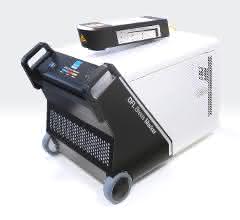
For years, lasers have been firmly established for material processing and marking in many industries. The advantages: Lasers are ideal for precise and intricate marking. In addition, neither paint nor solvents are required. This process enables durable and abrasion-resistant material processing without the use of additives.
Product traceability and protection against counterfeiting are also very important in the value chain. The laser tool is particularly suitable for marking in this regard. The laser beam generates markings such as barcodes or 2D codes with information on serial or batch numbers and expiry dates quickly and precisely in consistent quality on various materials such as metal or plastic, thus ensuring seamless traceability.
The ultrashort pulse laser is used in particular in the field of medical technology, as there are very specific requirements here. For example, the markings must not cause any changes to the surface structure, as otherwise bacteria, viruses or pathogens can settle here. In addition, permanent sterilization processes severely damage the marking. Conventional marking processes with solid-state or fiber lasers, for example, lead to corrosion, flaking and fading of the marking. ACI Laser now offers an ultrashort pulse laser for this special problem. This is suitable for preventing material damage and the resulting corrosion and structural surface changes.
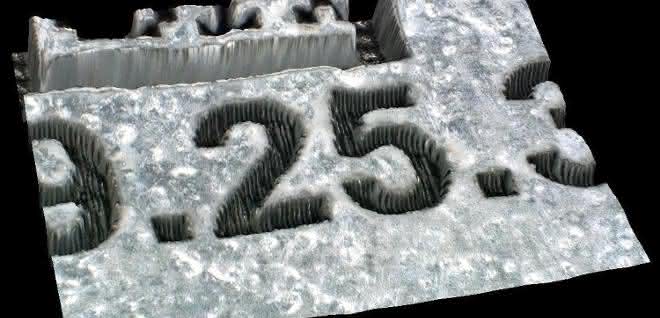
"Cold laser marking"
With lasers in the nanosecond range, however, marking is always accompanied by strong heating of the absorbent material, which makes it difficult or even impossible to mark sensitive materials without structural changes. With pulse lengths in the picosecond range, on the other hand, it is possible to achieve enormous pulse powers with low heat input.
The pulse duration is so short that the inertia of the heat conduction is not sufficient to heat the surface strongly. In the best case, the area of the material on which the laser acts is transferred directly from the solid to the gaseous phase, so that burr formation is drastically reduced.
The extremely low thermal influence is probably the greatest advantage of the ultrashort pulse laser. This "cold laser marking" makes a wide range of applications possible, such as the marking of highly sensitive materials in medical technology, sensor technology and aerospace. Furthermore, the shorter pulses cause less damage to the surrounding material and remove it more precisely, making very delicate markings possible. This is accompanied by increased detail accuracy, precision and surface quality.
Wide range of applications
The DFL Brevis Marker from ACI is suitable for burr-free engraving on stainless steel, hardened steel, aluminum or glass. In addition, black markings can be made on untreated aluminium, stainless steel and HSS steel in a short time and without prior surface treatment. The USP laser can also be used for color changes on plastic, marking silicones and cutting thin materials. as


You might also be interested in
From sensor to intelligent system
Sensors, measurement technology and artificial intelligence are merging to form intelligent systems. From June 9 to 11, 2026, Sensor+Test in Nuremberg will showcase the most important trends in a changing industry.
 read more...
Dr. Volker Frey becomes CTO
On May 1, 2026, there were personnel changes in the top management of the ifm group of companies. Dr. Volker Frey succeeds Benno Kathan as CTO, who has retired.
read more...Sales growth in a turbulent market environment
Thanks to innovations and a focus on strategic industrial markets, Sick was able to moderately increase its sales in the 2025 financial year. In a turbulent market environment, the company was able to maintain its position and gain market share with...
read more...Precise sensor technology for mobile machines
Compact singleturn Hall-effect encoder with IP65
The Megatron MP1612 is a wear-free Hall effect single-turn encoder with 12-bit resolution, IP65 metal housing and extremely compact design (Ø12 mm, depth 11.5 mm). Ideal for joysticks, AGVs and agricultural machinery.
read more...New impetus for ifm sales
Two new positions were filled at ifm at the start of 2026: Markus Wolf becomes Managing Director Sales Germany, Sven Quant takes over the position of Central Managing Director in the Process Sensors division within the ifm Group.
read more...Werner von Siemens Fellows 2025
Five research talents honored
Five outstanding research talents have been honored as Werner von Siemens Fellows 2025. The Werner von Siemens Ring Foundation recognizes researchers whose work has made an exceptional contribution to the advancement of science and technology in...
read more...Biodegradable label makes transportation conditions traceable
Researchers are developing a smart, compostable label that measures temperature and humidity and detects when limit values are exceeded.
read more...Digitization of the entire value chain
At SPS 2025, ifm will be demonstrating how the digitalization of the entire value chain can be implemented in practice. In an interview, Michael Marhofer, CEO of the ifm group of companies, explains which technologies are in focus, which industry...
read more...About AI, autonomous automation and cybersecurity requirements
The increasing importance of AI, autonomous automation and cybersecurity requirements are currently shaping many areas of industrial sensor technology. In this interview, Dr. Henning Grönzin, CTO of Leuze, explains the company's technological...
read more...