

Speed-controlled compressor
Speed control reduces reactive current costs
Even in small companies, it pays to generate compressed air as economically andCO2-neutrally as possible. By switching to a speed-controlled screw compressor, a CNC manufacturer has succeeded in reducing the energy required for compressed air production by more than 20 percent. By Stephanie Banse

Nadine Hausmann, Operations Manager at JH Maschinenbau in Georgensgmünd near Nuremberg, remembers: "The fact that compressed air is expensive and should therefore be used as sparingly as possible was already a topic at the master school." The family business has made a name for itself as a CNC manufacturer and specialist for milled parts. Customers come from the medical, laboratory and measurement technology sectors, among others.
With the guiding principle of her training in mind, the industrial foreman initially replaced compressed air tools with electric tools in order to reduce the need for the costly medium. However, as the company expanded at the same time and increased the number of its CNC machining centers and automation systems, consumption nevertheless turned in the opposite direction. In addition, the compressed air requirement was subject to very large fluctuations, depending on the time of day and the milling task. The existing 15 kW compressor, which operated at a fixed speed, could only cope with these fluctuations by stopping at short intervals and then starting up again. This method of operation was not only inefficient, but also produced a lot of noise and waste heat. A consultation that Atlas Copco offered her on the subject of energy-efficient compressed air generation therefore came at just the right time for Nadine Hausmann.
1,900 start-stop actions per week
"It was clear from the very first glance that efficiency could be improved here," recalls Özkan Demir, Technical Consultant at Atlas Copco, on his first visit. "During a power measurement, I later discovered 1,900 start-stop actions per week. An incredibly high number. You could compare it to a letter carrier delivering his letters in a sports car - starting off at full throttle every ten meters and then braking again immediately."
At that time, the compressor worked with an operating pressure of 10 bar. Once this pressure was reached, the machine ran at idle for another 15 seconds and then stopped. When the pressure dropped to 8 bar after some time, the compressor started again. "At this point, the machine was drawing three to four times the nominal current," explains Demir. "The old system had 15 kW and normally required 30 A under load, but up to 120 A at the start. These current peaks at the moment of start-up are fatal because the energy supplier has to pay extra for them." In addition, every time the compressor starts up, so-called reactive current flows, which is not used but is also reflected on the energy supplier's bill. "The whole situation was predestined for a speed-controlled compressor," says Demir. This is because the speed control avoids power peaks as well as pressure fluctuations. The motor always runs at the speed required for the compressed air demand at any given time. This reduces energy consumption and wear in equal measure.
Speed-controlled machine optimally serves compressed air requirements
The choice fell on an oil-injected GA 15 VSD+ FF screw compressor from Atlas Copco, which is now located in the large production hall. The abbreviation VSD stands for speed control or Variable Speed Drive, FF denotes the "full feature" version, which is already equipped with a refrigeration dryer ex works, and the "+" denotes the compressor's oil-cooled permanent magnet motor. The 15 kW machine is air-cooled, requires no more floor space than a refrigerator and operates particularly quietly.
"In the beginning, I often checked to see if the compressor was running at all, it's so quiet," says Nadine Hausmann. The waste heat, which was sometimes a major problem with the old machine, has also been pleasantly reduced. "The Atlas Copco compressor is designed in such a way that it generates very little heat," explains Demir. "The low noise level is partly due to the speed control and the noise protection hood, and partly to the ventilation fan, which only switches on when it is needed."
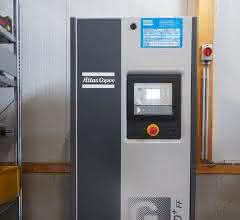
The integrated Elektronikon control system regulates the compressor so that it always delivers the exact amount of compressed air required. The maximum delivery rate is 2.5 m³/min at 7.0 bar. Currently, 0.24 to 1.0 m³/min is required. Any peaks in demand are covered by a 500 liter compressed air tank. The right compressed air quality is ensured by the integrated refrigeration dryer and a particle and coalescence filter. JH Maschinenbau left the old compressor connected to the mains as a redundancy to ensure the compressed air supply in the event of maintenance, for example.
Operating pressure reduced by 2.5 bar
When the new compressor was installed, the operating pressure was gradually reduced from 10 bar to 7.5 bar. The pressure fluctuations are minimal at ±0.1 bar due to the speed control. "We need an operating pressure of 6 bar at our machining centers," explains Nadine Hausmann. "Our compressed air supply is currently still set at 7.5 bar, but we could go down to 7.0 bar, as there have been no problems so far."
Reducing the operating pressure also reduces electricity costs. Around 7 percent of the energy required can be saved per bar. "However, this kind of pressure reduction only works with a speed-controlled machine," emphasizes Demir. "We used to have a cascade of between 8 and 10 bar. With speed control, you only set a target value instead of a loading and unloading pressure. And you can then reduce it step by step, tenth by tenth."
The Atlas Copco expert puts the efficiency improvement from the lowered operating pressure alone at more than 14 percent. Added to this is the reduction in start-stop actions to almost zero, meaning that compressed air generation has become more than 20 percent more efficient overall. "JH Maschinenbau is a prime example of how useful the use of efficient compressors is, even in small companies," concludes Özkan Demir. "We now make our GA-VSD+ machines available from an output of 5 kW."
Stephanie Banse, journalist in Hamburg / am


You might also be interested in
Predictive maintenance in retrofit
Predictive maintenance pays off. This is because early detection of impending failures means that systems can be serviced in a targeted manner before production downtime occurs. But how complex is it to integrate such a maintenance concept into an...
 read more...
Maintenance instead of replacement
The circular economy starts with the machinery
Sustainability in industry starts with machines, says our guest author from Deguma: How maintenance, modernization and the 5R strategy save resources, energy and CO₂.
read more...3D printing for unplanned requirements
The material fails and the machine suddenly stops? Then you need to take the right measures to be able to resume production quickly. Material failure in the form of faulty components or material wear in the frame are a risk for any production.
read more...High demands in terms of safety, application and robustness
Demanding work in the electrical trade and energy supply as well as smooth processes in production require innovative and customized measurement technology that scores points for safety, ease of use and resilience.
read more...Car meets e-bike: riding with lubrication-free polymer bearings
Studies show that the proportion of pedestrian and bicycle traffic is increasing in urban areas. With the JetBike, JetBike GmbH from Braunschweig presents a mixture of e-bike and car and relies on lubrication-free polymer bearings from Igus.
read more...Hydraulic hub for more efficient servicing
Bosch Rexroth presents a digital toolbox for service and maintenance. With a comprehensive range of digital services, the Hydraulic Hub simplifies and accelerates the service and maintenance of hydraulic products and increases machine availability.
read more...Arnold Umformtechnik expands after-sales...
Faster help with VR glasses
Arnold Umformtechnik is expanding the after-sales service for its machines to include digital remote services. The focus is on data security, simple operation and clear processes.
read more...147,000 euros per hour: high costs for German companies due to unplanned downtime
According to the "Value of Reliability" study, 67% of industrial companies in Germany experience unplanned downtime at least once a month. This costs the German economy 147,000 euros per hour. Nevertheless, reactive maintenance concepts are not...
read more...Maintenance starts with a maintenance planner
Legal requirements stipulate that machines and systems must be serviced regularly. The maintenance work serves to ensure occupational safety and economic efficiency.
read more...