

Servo pumps
Reducing costs with the servo pump
Low life cycle costs due to energy efficiency are the main argument for the use of servo pumps. For some years now, the concept of combining hydraulic power transmission with the principle of speed-controlled power supply has been standard in many applications. By Susanne Reinhard
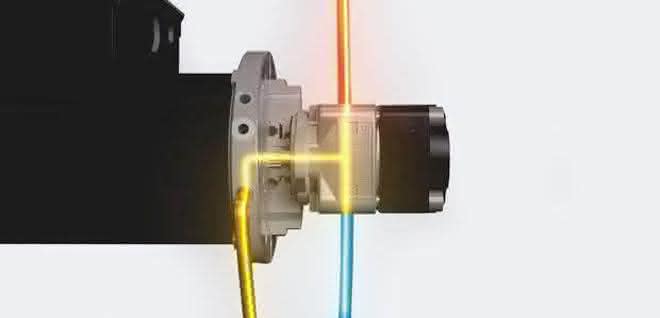
High efficiency, good process performance, low heat generation and low noise levels are the advantages of servo pumps. Many applications with widely varying volume flows and the associated fluctuating power requirements, such as presses or injection molding machines, benefit from the dynamic and precise speed control of a fixed displacement pump using a servo drive. Baumüller has many years of experience in equipping machines with servo pumps and has been able to further optimize the technology in cooperation with mechanical engineers.
The big advantage of the servo pump is the lower life cycle costs thanks to the good energy balance. Depending on the cycle step, the volume and pressure control of the pump can be precisely adapted to the respective requirement by adjusting the motor speed. During process-related cycle breaks of the hydraulic consumers, the drive is shut down and does not consume any energy. During pressure control phases, the motor only rotates at minimum speed and even then consumes very little energy. This in turn is due to the energy-efficient components, as both the compensated fixed displacement pump and the servomotor have very good efficiency levels not only at the nominal point, but also in the partial load range.
Use the leakage current
In addition to energy efficiency, another important factor in life cycle costs is maintenance. To make the pump even more efficient, Baumüller has added connections to both the motor and the fixed displacement pump in the new version, allowing the pump's leakage current to be used for permanent lubrication of the gearing. Grease lubrication of the internal gearing is therefore no longer necessary. As the connection holes are provided on both sides, the motor can be installed vertically or horizontally depending on the application. The motor position is flexible and adapts to the machine design.
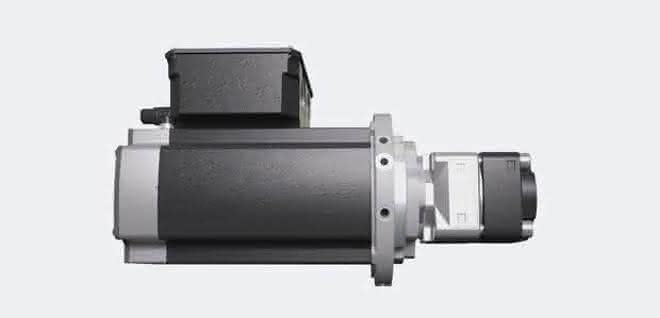
The hydraulic pump can now be attached directly to the engine with gearing. This eliminates the need for a coupling and bellhousing, which has the advantage of a shorter installation length and consequently a smaller machine footprint. By eliminating components, the machine manufacturer benefits from lower storage costs and reduced susceptibility to servicing.
Software features
Baumüller has included controller-integrated software in the package for its servo drives. The current version of the servo pump software V2+ brings improvements in the areas of process monitoring, process optimization and process safety. For example, service intervals can be planned with the speed monitoring and slip speed compensation feature. If leakage increases, monitoring the leakage characteristic curve enables automatic speed readjustment. If measured values are outside the tolerance, the operator is informed and the pump can be replaced in good time. Baumüller has also integrated a pressure sensor monitoring system that initially optimizes sensor values and indicates the need to replace the sensor if the inaccuracy increases.
A new software feature also avoids the risk of thermal overload and thus premature pump wear, especially with long pressure holding times. The thermal pump utilization is calculated from the speed and pressure using the temperature model. When a critical threshold value is reached, for example, a bypass valve can be activated to prevent overheating.
The servo pump is characterized by its low life cycle costs. However, the purchase price is higher. One cost factor is commissioning. Specialist knowledge is required here and setting the servo pump to the individual application is tricky. Baumüller has therefore invested heavily in the further development of the servo pump software in order to simplify parameterization, commissioning, analysis and diagnostics and thus reduce initial costs. A graphically clear wizard guides the user through the individual steps of commissioning. Detailed specialist knowledge for basic commissioning is therefore no longer necessary. Another practical feature is the intelligent control algorithm for adapting to different pressure rise rates. This means that the parameterization only has to be set once and the adjustment is automatic. The software enables an overshoot-free pressure jump in minimum time. Servo pumps were already an attractive option ten years ago for making hydraulic and hybrid machine types more efficient. With the new developments, additional advantages could be worked out, and innovations in the software area in particular bring new possibilities in terms of process monitoring.
Susanne Reinhard, Press and Public Relations, Baumüller / am


You might also be interested in
Predictive maintenance in retrofit
Predictive maintenance pays off. This is because early detection of impending failures means that systems can be serviced in a targeted manner before production downtime occurs. But how complex is it to integrate such a maintenance concept into an...
 read more...
Maintenance instead of replacement
The circular economy starts with the machinery
Sustainability in industry starts with machines, says our guest author from Deguma: How maintenance, modernization and the 5R strategy save resources, energy and CO₂.
read more...3D printing for unplanned requirements
The material fails and the machine suddenly stops? Then you need to take the right measures to be able to resume production quickly. Material failure in the form of faulty components or material wear in the frame are a risk for any production.
read more...High demands in terms of safety, application and robustness
Demanding work in the electrical trade and energy supply as well as smooth processes in production require innovative and customized measurement technology that scores points for safety, ease of use and resilience.
read more...Car meets e-bike: riding with lubrication-free polymer bearings
Studies show that the proportion of pedestrian and bicycle traffic is increasing in urban areas. With the JetBike, JetBike GmbH from Braunschweig presents a mixture of e-bike and car and relies on lubrication-free polymer bearings from Igus.
read more...Hydraulic hub for more efficient servicing
Bosch Rexroth presents a digital toolbox for service and maintenance. With a comprehensive range of digital services, the Hydraulic Hub simplifies and accelerates the service and maintenance of hydraulic products and increases machine availability.
read more...Arnold Umformtechnik expands after-sales...
Faster help with VR glasses
Arnold Umformtechnik is expanding the after-sales service for its machines to include digital remote services. The focus is on data security, simple operation and clear processes.
read more...147,000 euros per hour: high costs for German companies due to unplanned downtime
According to the "Value of Reliability" study, 67% of industrial companies in Germany experience unplanned downtime at least once a month. This costs the German economy 147,000 euros per hour. Nevertheless, reactive maintenance concepts are not...
read more...Maintenance starts with a maintenance planner
Legal requirements stipulate that machines and systems must be serviced regularly. The maintenance work serves to ensure occupational safety and economic efficiency.
read more...