

Virtual robotics
Simulation of gripping processes
Virtual robotics. Commissioning and optimization of bin-picking applications can be carried out quickly and easily with the Mikado ARC robot vision solution. It brings flexibility to the production line and enables efficient automation in prototype construction and small series.
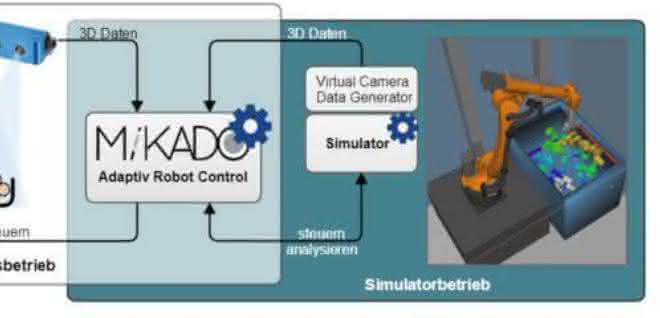
When "reaching into the box" with chaotically positioned parts, the robot controller uses a three-dimensional image in the form of a 3D point cloud to determine how parts can be gripped safely and passed on in the correct position. Behind this are complex processes with a lot of potential for error. A robot only performs its grips safely and reproducibly if many factors are known before the gripping situation is realized and can be incorporated into the development. System integrators want to eliminate potential sources of error and faults as far as possible during the planning and design phase in order to avoid downtimes during productive operation and time-consuming reworking. However, long test phases with elaborately manufactured prototypes can make the development of a project unprofitable right from the start. The optimization of cycle times or the degree of emptying can also bring a running bin-picking application to a standstill for a longer period of time. System integrators therefore want to be able to plan, commission and maintain a robotic system economically.
Simulated commissioning
Robot control solutions such as Mikado ARC enable system integrators to model the robot cell, the gripper design and many other basic parameters as a digital image of a real scene. With this so-called "digital twin", the system concept can already be verified and improved in automatically running simulation runs, even though not a single prototype has been manufactured in reality at this stage. The simulation of the hardware components is carried out using the planning data and the real Mikado control technology. This virtual commissioning shows the results and potential problems of the planned system concept - faster, more cost-effectively and with greater variation possibilities than would be possible with a real test system. All the findings and parameters determined in the process can be used directly in the subsequent real commissioning.
With "virtual camera technology", Mikado ARC expands the possibilities of simulation, allowing 3D camera data to be generated adaptively and synthetically from every possible view of a gripping situation. This means that no camera images of a simulated real scene need to be recorded and imported for the simulation. Both special problem cases and random situations can therefore be reproduced one hundred percent as often as required. The "virtual camera technology" gives the system integrator an indication of where and how many Ensenso 3D cameras are required during the planning of the robot cell. Variations in the model, number and viewing angle of the cameras can be easily and cost-effectively pre-evaluated in simulator mode.
Parallel software
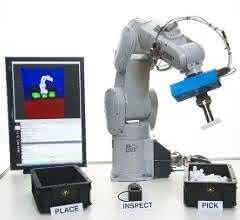
The simulator is parallel software that supplies Mikado ARC with 3D data from virtual reality and also logs and evaluates every action and reaction of the robot controller for the user. The Mikado control technology works with the virtual data as if it had been recorded by real cameras, calculates robot movements, automatically plans collision-free paths and picks up simulated parts from virtual boxes. Mikado ARC thus visualizes the robot's mode of operation in a simple way and uses the interface between the real and virtual worlds to optimize the productivity of a robot application.
The adaptive Mikado ARC robot controller also supports the conversion of a bin-picking application to new parts or the optimization of cycle times or the degree of emptying of the parts containers used thanks to the simulator-based workflow. By using 3D data from Ensenso cameras and CAD data of new parts and gripper prototypes, the Mikado ARC controller creates a realistic, virtual simulation of the gripping situation. Using "virtual camera technology" with an integrated physics engine, the containers can also be synthesized with virtual parts and randomly "filled" in any number. This allows grip variations or new grippers to be tried out virtually. The evaluation of the simulation enables reliable predictions to be made about cycle times and the achievable degree of emptying of the boxes. Based on these simulator results, the CAD data of a new gripper design can be improved until the specifications are met. The time-consuming and cost-intensive production of prototypes is therefore only necessary once before real commissioning on the robot. pb


You might also be interested in
Nomination Products of the Year 2024
Schrempp: Intelligent function handles with IO-Link interface
Nominated in the handling, assembly and production logistics category in the competition for the products of the year 2024 are the function handles with integrated signal surface and/or configurable keypad and feedback LEDs with IO-Link interface...
 read more...
Norelem supports VDI Racing Camp
Mastering the challenges of e-mobility
Promoting young talent has been a priority at Norelem for many years: the company supports young talents with components and the necessary know-how and provides schools with illustrative material.
read more...Three-point internal rapid action switch
High-precision internal measurements on drill holes
Feinmess Suhl has expanded its product range with the new 8480 three-point internal rapid probe. The probe has been specially developed for high-precision internal measurement of through and blind bores.
read more...Standardized machine elements
Flexibility is required in mechanical engineering for the rubber industry. Rubicon Gummitechnik und Maschinenbau uses standard and operating parts from Norelem for this purpose.
read more...Carry out cutting work with precision
Schukat now stocks all cutting pliers from the Electronic Super Knips series from the German manufacturer Knipex.
read more...Secure locking
Heinrich Kipp has added a series of snap locks to its range that are designed for flush installation in doors, flaps or drawers.
read more...Cobot for final aircraft assembly
The collaborative colleague works on the airplane fuselage
Together with Fraunhofer IGP and aircraft manufacturer Airbus, Tox Pressotechnik investigated the question of how final aircraft assembly can be made more productive and ergonomic.
read more...Industrial vacuum cleaner with a long service life
A powerful vacuum cleaner for coarse, fine, flammable and moist materials is in demand across all industries. Easy handling and a long service life are the most important criteria for regular use.
read more...Enough space for a cool head
What to do when an ergonomic lifting aid is required but the room height is too low for conventional crane systems? Schmalz has a modular flat jib made of aluminum in its product range that is used by Erkodent, a manufacturer of dental thermoforming...
read more...