

Edge processing
Ways to find the right edge
Processors of thick sheet metal and profiles apply edges or curves to their material. This is because it is often necessary to avoid the risk of injury, to prepare welding edges or to touch them up for visual reasons. The range of technical solutions is diverse. Users make use of high-quality mobile edge milling cutters or edge shapers.
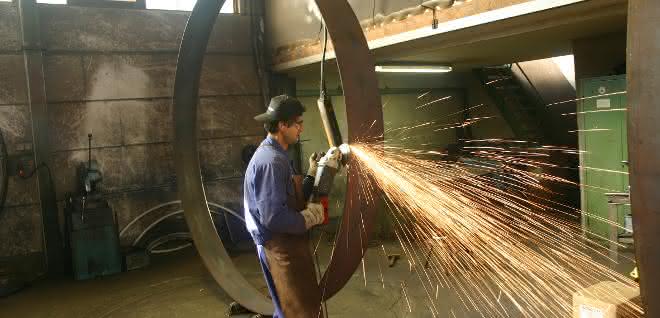
The metal trade has many facets. The classic steel substructure with welded constructions is just as much a part of it as the production of visible sheet metal cladding and design elements such as handrails or displays for the presentation of goods. At the same time, industries such as mechanical engineering and transportation are placing increasing value on visually attractive enclosures, which are also supplied by metal craftsmen. The sheet metal and profiles preconfigured for such purposes often have sharp edges that need to be machined. But what methods are there for this and which are most suitable? Do stationary or mobile systems generally have the advantage?
There is no general answer to this question, explains Philipp Herwerth, Head of Sales Power Tools Germany at Trumpf: "Stationary systems have advantages if companies process a large number of recurring components that are not too large. Then the high purchase and operating costs sometimes pay off." If the sheets and profiles vary greatly, the number of pieces is small or the components are very large, the stationary solution is less practical and often not economical.
This is when mobile solutions come into their own. They are flexible and can be used on the construction site as well as in the workshop. But here, too, the question arises as to which technical principle is the right process for which user: Routing, shaping or sanding - i.e. edge router, edge shaper or angle grinder?
Decisive question: How often are edges produced?
The first thing for the user to consider is how often edges are processed and what purpose they should fulfill. "If the demands on the quality of the edges are extremely low and only one or two meters of edge need to be produced every few days, an angle grinder may be sufficient because it is often already available and inexpensive to purchase," says sheet metal expert Herwerth.
"However, company bosses must be aware that they are exposing their employees to a health risk that should not be underestimated due to the large amount of dust, flying sparks and the rapidly rotating discs." Putting on the necessary protective equipment also costs valuable working time, and the work result can vary greatly in terms of uniformity and angular accuracy. The same applies to the working speed, which usually varies greatly depending on the edge length and material. In addition, the service life of the grinding wheels is short. "This is not an option for metalworkers who regularly produce edges," Herwerth states. "For them, edge milling cutters or edge shapers are the main option."
Edge shapers for welding edges
Whether an edge trimmer or edge shaper is the right choice depends primarily on the purpose of the edge. While edge trimmers are considered all-rounders that impress with the best surface quality and are suitable for almost any application, edge formers such as the TruTool TKF series from Trumpf have one particular strength: they produce perfect welded edges with a very good price-performance ratio.
The tools work according to the so-called impact steel principle, i.e. they eject material at a predetermined angle in a uniform cycle. No dust, vapors or gases are produced during this process. The heat development is so low that structural changes in the metal are ruled out.
Whether straight sheet edges or inner contours, large or small workpieces, even pipes can be easily processed. One work step with the TKF is enough to produce oxide-free and bright metallic surfaces. In this way, users obtain optimum welding edges that form the basis for highly durable joints. The wear costs are low.
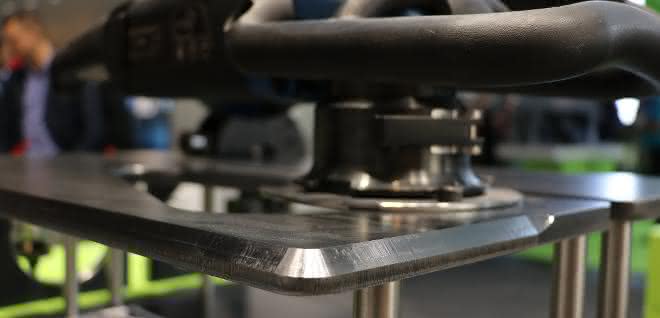
Trumpf offers the TruTool TKF 1500 as its largest edge former. It produces bevel lengths of up to 15 millimetres in a single operation and can be used on sheets up to 160 millimetres thick. The user can set the desired bevel angle continuously between 20° and 55°. It then removes the material at a high working speed of up to 2 meters per minute, making it significantly faster than an angle grinder.
Shiny edges with the edge router
Edge routers from the TruTool TKA series achieve similar working speeds to edge formers in some cases. For example, the largest and latest model, the TKA 1500, can achieve up to 1.5 meters per minute in classic mild steel at maximum infeed depth. If less material is removed, up to 4 meters per minute can even be achieved, according to Philipp Herwerth. He adds: "We mill just as quickly and efficiently on straight edges as we do on rounded inner and outer contours." The result for the user is chamfers with a length of up to 15 millimetres or radii of up to 4 millimetres. The desired chamfer length can be set quickly and easily using a 270° continuously rotatable scale ring. There are no restrictions on the use of TKA tools with regard to material thickness.
The surfaces produced are metallically bright and give the machined workpieces a high-quality shine. "They are of course also suitable for welding edges," says Herwerth, "but are more expensive in terms of tool wear than when they are produced with edge formers. But wherever visible edges are created, cutting burrs need to be removed cleanly or chamfers are required for subsequent powder and paint coating, the TKA is unbeatable." Accordingly, metal, steel, vehicle, ship and train builders, among others, are predestined for the use of these mobile milling tools.
In practical use, the ergonomically designed holders of the TKA 1500 prove to be helpful. For example, the front guide handle is only 9 centimetres away from the work surface, which means that the guide hand is close to the processing surface, enabling stable machine guidance. In addition, the handle shape, size and positioning have been selected so that the user achieves the greatest possible stability while exerting optimum pressure.
To ensure the longest possible service life of the wear parts, Trumpf uses multi-edged inserts in the TKA 1500, which are suitable for use in mild steel, aluminum or stainless steel. Thanks to the integrated soft start, start-up is always smooth and overload protection prevents the motor from overheating, even during continuous operation. am


You might also be interested in
Up to 50 percent higher cutting speeds
The current market situation is putting pressure on companies that rely on carbide tools: Rising raw material costs, volatile supply chains and limited predictability are putting pressure on the industry. Fette Werkzeugtechnik, a member of the LMT...
 read more...
A robot for all occasions
Industrial robots take on many tasks. Even milling with accuracies in the sub-millimeter range is now possible.
read more...High metal removal rate for high maneuverability
Large module gears for ship drives place high demands on machining. Switching from skiving to 5-axis simultaneous milling with high-feed tools considerably shortens the roughing process. Process parameters and a well thought-out tool selection are...
read more...Schunk shows flexible systems for electronics production
Schunk Electronic Solutions will be exhibiting modular, flexible systems for electronics production at Productronica 2025 - from stand-alone depaneling systems to fully integrated inline solutions.
read more...Hydraulic 4-jaw chuck for automated workpiece clamping
HWR Spanntechnik presents a hydraulically actuated 4-jaw chuck for automated workpiece changing. The clamping device is designed to enable short set-up times, precise clamping and high productivity in automation.
read more...Corner, face and plunge milling
Paul Horn is expanding the DA milling system for corner, face and plunge milling. With the DA65 variant, the system offers a larger cutting insert compared to the existing DA62.
read more...World premieres at the EMO 2025
From September 22 to 26, 2025, Grob will be presenting several innovations at EMO Hannover. The focus of the trade fair appearance will be on the latest 4- and 5-axis universal machining centers and the associated automation solutions.
read more...Flexible and efficient processing
New high-performance CNC series
Fanuc's presentation at EMO will focus on the new FS500i-A CNC series. The new CNC generation offers high user-friendliness, process optimization as well as digital and network technologies.
read more...New PCD milling program
As part of the new PCD milling program, Paul Horn has developed the DM70 and DM90 series, which are specially designed for face and corner milling operations. The focus here is on high milling and surface qualities as well as burr-free milling.
read more...