

High Speed Cutting
Milling in rapid traverse
Fast positioning, fast tool changes - machine manufacturers offer speeds of up to 100 m/min in G0 rapid traverse. In practice, however, feed rates of 3 to 8 meters are usually only used for machining. But there is another way: the key is the process design.
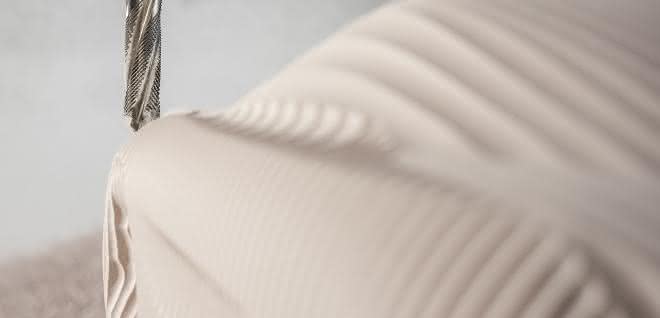
Hufschmied Zerspanungssysteme GmbH specializes in material-specific tools. Its areas of expertise include the optimization of machining processes, particularly in the field of composite materials. Managing Director Ralph Hufschmied is fascinated by the theoretically much greater agility of the machines. He explains: "Our expertise is in high-performance machining. Today, we offer special tools for customers in the automotive, aerospace, plastics and mold making or dentistry sectors. Our tool catalogs only show examples. Over 80 percent of the tools we supply are process and workpiece-specific variants. Essentially, we do not offer our customers tools, but time savings. To achieve this, our engineering department analyses the entire process - programming, machine settings and options, tool, workpiece - develops optimizations, tests them and implements them for the customer."
Tiring out machines
For safety reasons, users are often not allowed to set the feed speed to any limit. Machine manufacturers do this, for example, to prevent damage to the spindle due to excessive vibrations that could cause it to swing open. However, Hufschmied's knowledge of the processes and workpieces shows what would be possible and still be safe. In cooperation with various machine manufacturers and Siemens as the control manufacturer, Hufschmied has opened up the possibility of running feeds beyond the normal limits. These modified parameters are also stored in CAD/CAM so that the software knows the modified parameters for simulations.
The fact that Hufschmied obtains greater leeway from the machine and control manufacturers means that highly individual processes are possible, in which variables such as feed rate, spindle speeds, accuracies, dynamic and jerk values, approach angles and tool geometries are precisely coordinated. The entire process chain is tested at Hufschmied, for example on a five-axis EiMa Gamma S high portal machine equipped with Sinumerik 840D sl and multi-touch panel for mold making. This can be used to test the dry machining of fiber composites in particular. When deburring and roughing in plastics or during surface finishing of additively manufactured workpieces for rapid prototyping, significantly higher feed rates can be achieved - without negative consequences for dimensional accuracy and surface quality or on the machine.
Up to 80 percent time savings
What was developed in collaboration with individual machine and control manufacturers can actually be implemented with any CNC machine. Instead of using the predefined cycles and control settings, you program your own toolpath with a high feed rate in CAM and optimize the basic machine settings. A high-speed setting is used here: the machine is allowed to "violate" the geometry within certain limits in order to be faster, but at the same time it must of course be counteracted and the machine programmed in such a way that as few geometry deviations as possible actually occur. Time savings of up to 80 percent are possible with this method.
High-speed cutting
The individual use of machines beyond the usual safety limits also allows for very special tools. One example is the Graftor ball and torus milling cutter, which combines the roughing and finishing of graphite in electrode production and the machining of workpieces in tool, mold and model making in a single operation. Feed speeds of up to 80 m/min can be achieved with the Graftor.
"Our customers benefit from our experience and close cooperation with machine manufacturers and Siemens. Only this allows us to make the necessary in-depth interventions in settings and processes. We also work with universities on research and development in the field of high-speed cutting. If the entire process chain is optimized, dramatic efficiency gains can be achieved, as the example of one customer shows: It used to take him eight days to produce the finished model, now he produces it in just over eight hours after several optimization projects," reports


You might also be interested in
Up to 50 percent higher cutting speeds
The current market situation is putting pressure on companies that rely on carbide tools: Rising raw material costs, volatile supply chains and limited predictability are putting pressure on the industry. Fette Werkzeugtechnik, a member of the LMT...
 read more...
A robot for all occasions
Industrial robots take on many tasks. Even milling with accuracies in the sub-millimeter range is now possible.
read more...High metal removal rate for high maneuverability
Large module gears for ship drives place high demands on machining. Switching from skiving to 5-axis simultaneous milling with high-feed tools considerably shortens the roughing process. Process parameters and a well thought-out tool selection are...
read more...Schunk shows flexible systems for electronics production
Schunk Electronic Solutions will be exhibiting modular, flexible systems for electronics production at Productronica 2025 - from stand-alone depaneling systems to fully integrated inline solutions.
read more...Hydraulic 4-jaw chuck for automated workpiece clamping
HWR Spanntechnik presents a hydraulically actuated 4-jaw chuck for automated workpiece changing. The clamping device is designed to enable short set-up times, precise clamping and high productivity in automation.
read more...Corner, face and plunge milling
Paul Horn is expanding the DA milling system for corner, face and plunge milling. With the DA65 variant, the system offers a larger cutting insert compared to the existing DA62.
read more...World premieres at the EMO 2025
From September 22 to 26, 2025, Grob will be presenting several innovations at EMO Hannover. The focus of the trade fair appearance will be on the latest 4- and 5-axis universal machining centers and the associated automation solutions.
read more...Flexible and efficient processing
New high-performance CNC series
Fanuc's presentation at EMO will focus on the new FS500i-A CNC series. The new CNC generation offers high user-friendliness, process optimization as well as digital and network technologies.
read more...New PCD milling program
As part of the new PCD milling program, Paul Horn has developed the DM70 and DM90 series, which are specially designed for face and corner milling operations. The focus here is on high milling and surface qualities as well as burr-free milling.
read more...